


Listen to the article
Trump Administration Appeals to Supreme Court Over Controversial Deportations
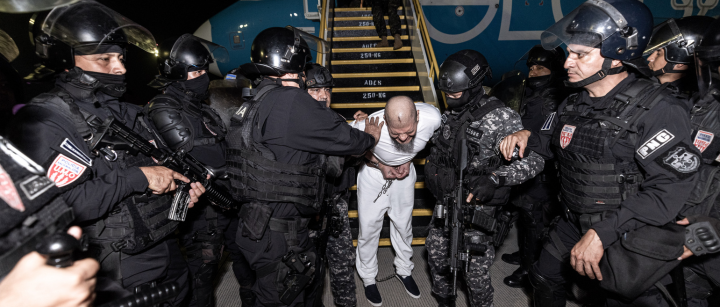
The Trump administration has asked the Supreme Court to overturn a District Court judge’s order blocking its use of the obscure 18th-century Alien Enemies Act to summarily deport Venezuelan immigrants. The legal battle erupted after the administration sent over 250 immigrants to an El Salvador prison in mid-March, claiming they were members of the dangerous Venezuelan gang Tren De Aragua.
The controversial deportation operation occurred on March 15, when three planes carrying the immigrants landed in El Salvador. The detainees were immediately transferred to the country’s largest prison, with the Trump administration asserting they were members of Tren de Aragua, a criminal organization that originated in Venezuela but has expanded throughout South America and reportedly into the United States.
Just one day earlier, President Trump had signed a proclamation invoking the Alien Enemies Act, a rarely used law dating back to 1798. The proclamation declared that “all Venezuelan citizens 14 years of age or older who are members of TdA” and aren’t U.S. citizens or permanent residents “are liable to be apprehended, restrained, secured, and removed as Alien Enemies.”
U.S. District Court Judge James Boasberg later questioned the timing and secrecy of the operation. “Why is this proclamation essentially signed in the dark on Friday night, early Saturday morning, when people [were] rushed on the plane?” Boasberg asked during a March 21 hearing. “To me, the only reason to do that is if you know the problem and you want to get them out of the country before a suit is filed.”
The American Civil Liberties Union and Democracy Forward had indeed filed a lawsuit on the same day as the deportations on behalf of five Venezuelan men facing removal. Judge Boasberg granted a temporary restraining order, blocking further use of the act and ordering any planes carrying deported immigrants to return to the U.S. The administration did not comply with the return order, and when questioned about flight details, government lawyers invoked state secrets privilege.
The Alien Enemies Act, part of the four laws known collectively as the Alien and Sedition Acts of 1798, was originally created as the U.S. prepared for potential war with France. Unlike its three companion laws that have since expired or been repealed, the Alien Enemies Act has remained on the books, though it has been used only three times in U.S. history – during the War of 1812, World War I, and World War II.
Legal experts have criticized the administration’s application of this wartime law in the current context. Harvard Law Professor Noah Feldman wrote, “The legal problems with the deportations are obvious: The US is not at war with Venezuela; the gang isn’t a government; and in any case it’s not threatening the US with invasion or incursion in any ordinary English language sense of those words.”
The Trump administration, however, has attempted to establish a connection between Tren de Aragua and Venezuelan President Nicolás Maduro’s regime, calling Venezuela a “hybrid criminal state that is perpetrating an invasion of and predatory incursion into the United States.” This characterization contradicts the fact that Maduro’s government conducted a raid on Tren de Aragua’s base in 2023.
Information about those who were deported remains limited. CBS News published 238 names from an “internal government list,” reporting that 137 were deported under the Alien Enemies Act. Individual cases reported by media outlets suggest that some deportees may have been misidentified as gang members.
For instance, professional soccer player Jerce Reyes Barrios, who was seeking asylum after allegedly being tortured in Venezuela for protesting against Maduro, was apparently misidentified as a gang member based on a Real Madrid soccer team tattoo and a social media post showing a hand gesture that meant “I love you” in sign language, according to his lawyer’s court declaration.
White House Press Secretary Karoline Leavitt described the deportees as “heinous monsters, rapists, murderers, kidnappers, sexual assaulters, predators who have no right to be in this country.” However, an Immigration and Customs Enforcement declaration filed in court acknowledged that many deportees lacked criminal records, attributing this to their short time in the United States.
On April 7, the Supreme Court issued a split decision that overturned the lower court’s pause on using the Alien Enemies Act, ruling that challenges should be brought in the jurisdiction where detainees are held rather than in Washington, D.C. However, the Court noted, “The detainees subject to removal orders under the AEA are entitled to notice and an opportunity to challenge their removal.”
On April 19, the Supreme Court temporarily blocked the administration from using the Act to deport another group of Venezuelan men, stating, “The Government is directed not to remove any member of the putative class of detainees from the United States until further order of this Court.” Justices Clarence Thomas and Samuel Alito dissented from this order.
Fact Checker
Verify the accuracy of this article using The Disinformation Commission analysis and real-time sources.

8 Comments
While I don’t have a strong opinion on the specifics of this case, I’m generally wary of the government using obscure or outdated laws to circumvent established legal protections. Maintaining the integrity of the justice system and upholding civil liberties should be paramount, even in the face of complex security challenges.
The presence of violent criminal gangs like Tren de Aragua in the US is undoubtedly a serious concern. However, the government’s invocation of the Alien Enemies Act to enable mass deportations without due process raises major red flags. I’ll be curious to see how this plays out in the courts.
This is a complex and concerning situation. The use of the Alien Enemies Act to summarily deport immigrants raises serious legal and ethical questions. I’m curious to learn more about the evidence linking these individuals to the Tren de Aragua gang and the potential implications for due process and human rights.
The expansion of transnational criminal gangs like Tren de Aragua is certainly a worrying trend that warrants attention. However, the government’s approach here seems heavy-handed and potentially overreaching. I hope the courts carefully scrutinize the evidence and legal justifications before allowing these deportations to proceed.
I agree. The government needs to tread carefully and ensure that legitimate law enforcement concerns don’t trample on fundamental rights and protections. This is a delicate balance that the courts will need to navigate.
This is a troubling development that highlights the need for comprehensive immigration reform and a more humane, nuanced approach to addressing transnational criminal threats. I hope the courts can find a balanced solution that upholds the rule of law while also protecting the rights of vulnerable populations.
While the threat of gang violence is real, the use of obscure 18th-century laws to enable mass deportations without due process is extremely concerning. I hope the Supreme Court will carefully consider the broader implications for civil liberties and the rule of law in this case.
As someone who follows developments in the mining and energy sectors, I find this story quite tangential. However, the broader issues of immigration policy, national security, and human rights are certainly relevant to anyone concerned about the state of the country. I’ll be following this case with interest.