


Listen to the article
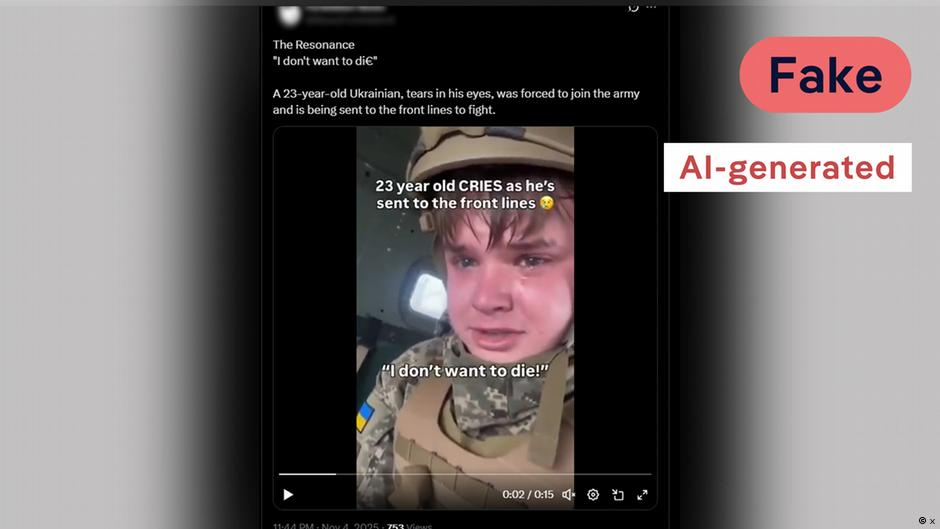
A wave of viral disinformation featuring a tearful young soldier claiming to be forcibly drafted into the Ukrainian military has spread across global social media platforms, reaching millions of viewers in multiple languages.
“I’ve been mobilized, I’m heading to Chasiv Yar,” says the purported Ukrainian soldier through floods of tears from the back of a military vehicle. “Help me, I don’t want to die. I’m only 23. Please help me.”
The emotionally charged clip has been viewed millions of times and translated into at least a dozen languages, including English, German, French, Italian, Spanish, and Russian. One Hungarian X account alone garnered 1.8 million views for the video.
The footage appears designed to reinforce a specific narrative: that Ukraine is desperately conscripting increasingly younger men against their will to replace mounting casualties on the frontlines of the Russian invasion. However, a Deutsche Welle (DW) investigation has conclusively determined the video is entirely fabricated.
Multiple elements in the video reveal its artificial origin. The visual inaccuracies are apparent to those familiar with standard Ukrainian military equipment, particularly the poorly-fitted helmet. More significantly, the minimum conscription age in Ukraine was lowered from 27 to 25 in April 2024 – never to 23 as claimed in the video.
The most damning evidence came from facial recognition technology, which identified the face in the video as belonging to Vladimir Yuryevich Ivanov, a Russian streamer from St. Petersburg who uses the online pseudonym “Kussia88.” Ivanov maintains a substantial online presence with over 1.3 million followers on Twitch, where his account has reportedly faced temporary bans.
The pseudonym itself contains troubling references. While “kussia” (pronounced “kasha”) means “porridge” in Russian, the “88” is recognized as neo-Nazi code for “Heil Hitler,” and the use of a double “SS” alongside “IA” – code for “14” in neo-Nazi circles – references the infamous “14 words” slogan popularized by American white nationalist David Lane. These codes appear throughout Ivanov’s online profiles on platforms like TikTok and Boosty, a Russian subscription-based content platform.
DW’s investigation traced the original source of the AI-generated video to a now-deleted TikTok account, @fantomoko, which had published dozens of similar fabricated clips allegedly showing Ukrainian soldiers crying in military vehicles. While most of these videos received only thousands of views, several gained significant traction, with the most popular exceeding 2.1 million views. Some even displayed the watermark “Sora,” identifying OpenAI’s image generator as the tool used to create them.
The @fantomoko account also misappropriated the likeness of Aleksei Gubanov, a critic of Russian President Vladimir Putin who now resides in New York. Contacted by DW, Gubanov emphatically denied any involvement with the clips.
“All of them were created by someone using AI and without my consent or involvement,” Gubanov told DW. “Those videos play directly into Russian propaganda narratives and gain millions of views. To be absolutely clear — I did not create, approve, or participate in any of those videos, and I strongly condemn the use of AI-generated fake media for manipulation or propaganda.”
DW attempted to contact Ivanov but received no response by publication time. According to the Ukrainian database “Stars about war,” which documents celebrities’ positions on Russia’s invasion of Ukraine, Ivanov typically avoids commenting on the conflict. The database notes that he was once reprimanded by Russian authorities for mocking children of mobilized soldiers, after which he reportedly apologized in a video featuring a Russian flag backdrop and stated that Crimea belongs to Russia.
On his Telegram channel, Ivanov responded sarcastically to suggestions of his involvement in the AI videos and accusations of being a “pro-Putin Nazi,” saying: “The Twitter crowd have finally learned what ‘delivery’ means” – Russian Twitch slang essentially meaning “They’ve finally got on board the hype train.”
This case highlights the growing sophistication of AI-generated disinformation in conflict zones and the challenges in combating its spread. As tools like OpenAI’s Sora become more accessible, verifying the authenticity of emotional content purporting to show wartime realities becomes increasingly difficult for average social media users, allowing fabricated narratives to rapidly spread across linguistic and national boundaries.
Fact Checker
Verify the accuracy of this article using The Disinformation Commission analysis and real-time sources.

11 Comments
This is a concerning development, but I’m glad the DW report was able to debunk the video as fake. It’s important to be vigilant against the spread of disinformation, especially around such a sensitive and impactful conflict.
This is a timely reminder of the need to be critical consumers of information, especially on social media. I commend the DW for their thorough investigation and fact-checking efforts.
Absolutely. In an age of rapid information sharing, it’s crucial that we take the time to verify claims before spreading them further. Fact-checking is a vital service.
The widespread dissemination of this fabricated video is concerning. I’m grateful for the DW’s diligence in uncovering the truth and exposing the visual inaccuracies. Fact-checking is crucial in the fight against misinformation.
It’s disheartening to see the proliferation of fake videos designed to manipulate public opinion. I’m glad the DW investigation was able to conclusively determine this particular video was fabricated.
It’s disappointing to see these kinds of manipulative videos being used to sway public opinion. I appreciate the thorough investigation that uncovered the visual inaccuracies. Fact-checking is crucial in the age of social media.
Agreed. Fact-checking is essential to combat the rise of online misinformation. I’m glad reputable news sources are taking the time to thoroughly investigate these types of claims.
While the emotional impact of the video is understandable, it’s concerning to see it being used to spread disinformation. I appreciate the DW’s efforts to uncover the truth and expose the visual inaccuracies.
While the emotional impact of the video is understandable, it’s important to remember that not everything we see online is necessarily true. I’m glad the DW was able to conclusively debunk this particular piece of disinformation.
It’s disappointing to see the spread of this kind of manipulative content. I appreciate the DW’s efforts to investigate the video and reveal its artificial origins. Fact-checking is essential in the digital age.
This is a good reminder of the importance of verifying information, especially when it comes to sensitive topics like an ongoing military conflict. I’m glad the DW report was able to determine the video was fabricated.