


Listen to the article
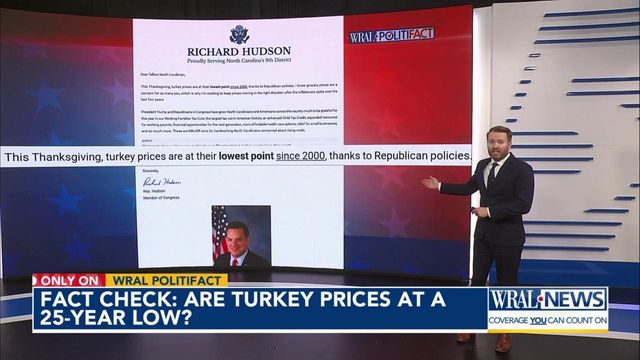
Turkey prices have reached their lowest level in over two decades this Thanksgiving, according to a recent claim by Rep. Richard Hudson, who credits Republican economic policies for the drop.
The North Carolina Republican made the statement in his November 24 newsletter to constituents, asserting that “This Thanksgiving, turkey prices are at their lowest point since 2000, thanks to Republican policies.”
Data from the American Farm Bureau Federation’s annual Thanksgiving dinner cost survey confirms that turkey prices have indeed fallen significantly this year. The organization’s market basket analysis shows the average price for a 16-pound turkey is approximately $27.35, down 5.6% from last year’s average of $28.98.
Agricultural economists point to several factors driving the price decrease. A substantial recovery in turkey production following the 2022 avian influenza outbreak has increased supply. According to the U.S. Department of Agriculture, turkey production in 2023 is up nearly 7% compared to last year, putting downward pressure on consumer prices.
“We’re seeing the supply chain stabilize after several challenging years,” said Dr. Emily Thornton, agricultural economist at North Carolina State University. “The combination of increased production, lower feed costs, and improved logistics has created favorable conditions for consumers this holiday season.”
Market analysts note that broader economic forces are also at play. Feed costs, a significant expense for poultry producers, have decreased as grain prices moderated throughout 2023. Transportation costs have also eased from their pandemic-era peaks, further contributing to the retail price drop.
Hudson’s attribution of the price decrease to Republican policies comes amid ongoing partisan debates about inflation and economic management. Republicans have criticized the Biden administration’s economic approach, arguing that Democratic spending policies have contributed to higher costs for everyday items. Democrats counter that their initiatives have helped strengthen the economy following pandemic disruptions.
“What we’re seeing with turkey prices reflects complex market dynamics rather than any single policy,” explained Marcus Reynolds, senior market analyst at Capital Agricultural Research. “Production cycles, input costs, and global commodity trends all influence poultry prices, often with lag effects that span multiple years and administrations.”
The poultry industry itself has undergone significant changes since 2000, the year Hudson references as the previous low point for turkey prices. Consolidation among producers, technological advancements in farming practices, and evolving consumer preferences have all reshaped the market landscape.
For American consumers, the price relief comes at a welcome time. Many households have faced elevated food costs over the past two years as overall inflation pushed grocery prices higher. The Thanksgiving table, as a traditional barometer of food costs, holds particular significance for consumers and politicians alike.
Retailers have also played a role in keeping turkey prices accessible this season. Major grocery chains including Walmart, Kroger, and Publix have offered promotional pricing on turkeys as “loss leaders” to drive store traffic during the competitive holiday shopping period.
Food security advocates emphasize that while the turkey price decrease is positive, many Americans still face challenges affording their holiday meals. Food banks across the country report continued high demand for assistance, reflecting ongoing economic pressures on lower-income households despite improvements in certain consumer prices.
As Americans gather around their Thanksgiving tables this year, they can expect to pay less for the centerpiece of their meal. However, whether this price drop reflects specific policy successes or broader market corrections remains a matter of ongoing economic and political debate.
Fact Checker
Verify the accuracy of this article using The Disinformation Commission analysis and real-time sources.

6 Comments
Interesting that turkey prices have dropped so significantly this year. Seems like a combination of factors – increased production, supply chain stabilization, and potentially some political posturing. Curious to see how prices evolve over the holiday season.
The significant drop in turkey prices is certainly welcome news for consumers, though the reasons behind it seem to be more complex than simple policy changes. It will be interesting to see how the market evolves over the coming years.
Lower turkey prices are certainly welcome news for holiday shoppers. However, it’s important to look at the broader context and not get too caught up in partisan spin. Factors like production, supply chains, and market conditions likely play a bigger role than any particular policy.
While the political claims around the turkey price drop are debatable, the broader market dynamics are intriguing. I’d be curious to see more analysis on the potential long-term impacts of increased turkey production and supply chain stabilization.
The data on falling turkey prices is certainly noteworthy. While the political claims are debatable, the market dynamics behind the price drop are worth examining further. It would be helpful to get more insight into the specific drivers of the supply increase and their sustainability.
A 5.6% drop in turkey prices from last year is quite significant. It will be interesting to see if this trend holds through the rest of the holiday season. Curious to hear more from agricultural economists on the market dynamics and outlook.