


Listen to the article
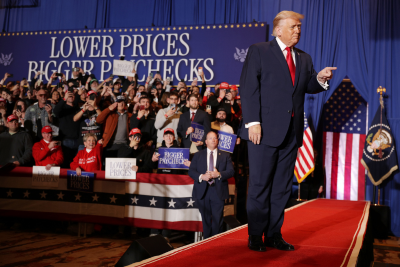
In a bid to rally supporters ahead of the 2025 midterm elections, President Donald Trump delivered a campaign-style speech in Pennsylvania on December 9, focusing on his economic message of “lower prices, bigger paychecks.” However, a fact-check of his claims reveals several inaccuracies and exaggerations about the economy.
Trump falsely claimed he inherited “the worst inflation in the history of our country” upon taking office. Historical data shows the worst inflation in U.S. history occurred after World War I, when prices surged 23.7% from June 1919 to June 1920. Another significant inflationary period occurred from 1979 to 1980, when prices rose 14.8%. When Trump began his second term, the annual inflation rate was already at a relatively moderate 3%.
The president’s assertion that inflation has “stopped” also contradicts economic reality. Consumer Price Index data shows inflation increased 3% for the 12 months ending in September, the last month for which data is available due to the recent 43-day government shutdown. Federal Reserve Chair Jerome Powell, while announcing the year’s third interest rate cut on December 10, directly contradicted Trump’s claim by stating that “inflation remains somewhat elevated.”
On energy prices, Trump’s statements were partially accurate. The price of West Texas Intermediate crude, the U.S. oil benchmark, has indeed declined approximately 25% since January. However, the broader picture on energy costs is mixed. While the Bureau of Labor Statistics shows a slight 0.5% decrease in overall energy inflation from January to September, household energy costs actually increased 4.3% during the same period.
Trump exaggerated when claiming gasoline prices had reached $1.99 per gallon in “three or four states.” According to AAA data, no state’s average price is currently that low, with Oklahoma having the lowest average at $2.37 per gallon. While individual gas stations in four states advertise prices at or below $1.99, this represents isolated cases rather than statewide averages.
One of Trump’s most inflated claims involved new investments in the United States. At the Pennsylvania rally, he stated his administration had attracted “right around $18 trillion” in investments since January. This figure has grown dramatically in Trump’s speeches throughout the year, starting at $3 trillion immediately after his inauguration, rising to “close to $10 trillion” by May, and now reaching $18 trillion. However, the White House’s own webpage tracking these investments lists only $9.6 trillion as of December 10.
Economic experts point out that even this lower figure is questionable because it includes pledges and plans that may never materialize. Adam Hersh of the Economic Policy Institute noted that “there’s no guarantee that any of the investments that are announced actually come to fruition,” while Scott Lincicome from the Cato Institute characterized them as “just promises — and often vague ones at that.”
On manufacturing jobs, Trump’s local claim about Pennsylvania was accurate but misleading in the national context. While Pennsylvania has indeed gained 4,000 manufacturing jobs since January, the United States as a whole has lost 49,000 manufacturing jobs during the same period, according to BLS data.
The president also repeated his claim that “more Americans are working today than at any time in the history of our country.” While technically accurate in absolute numbers, this statement lacks meaningful context since the U.S. population is also at its highest level ever. More telling employment metrics show little or negative change — the labor force participation rate declined slightly from 62.6% in January to 62.4% in September, while the employment-population ratio dropped more significantly, from 60.1% to 59.7% over the same period.
As the president continues to campaign for Republican candidates ahead of the 2025 midterms, these economic claims will likely remain central to his messaging strategy, despite their factual shortcomings.
Fact Checker
Verify the accuracy of this article using The Disinformation Commission analysis and real-time sources.

18 Comments
If AISC keeps dropping, this becomes investable for me.
Good point. Watching costs and grades closely.
The cost guidance is better than expected. If they deliver, the stock could rerate.
Nice to see insider buying—usually a good signal in this space.
Good point. Watching costs and grades closely.
If AISC keeps dropping, this becomes investable for me.
Nice to see insider buying—usually a good signal in this space.
Good point. Watching costs and grades closely.
Good point. Watching costs and grades closely.
Silver leverage is strong here; beta cuts both ways though.
Good point. Watching costs and grades closely.
Interesting update on Trump’s Economic Claims Examined: A Fact Check. Curious how the grades will trend next quarter.
Exploration results look promising, but permitting will be the key risk.
Good point. Watching costs and grades closely.
Good point. Watching costs and grades closely.
Silver leverage is strong here; beta cuts both ways though.
Good point. Watching costs and grades closely.
Production mix shifting toward Fact Check might help margins if metals stay firm.