


Listen to the article
Fact Check: Trump’s First 100 Days Marked by Misleading Claims
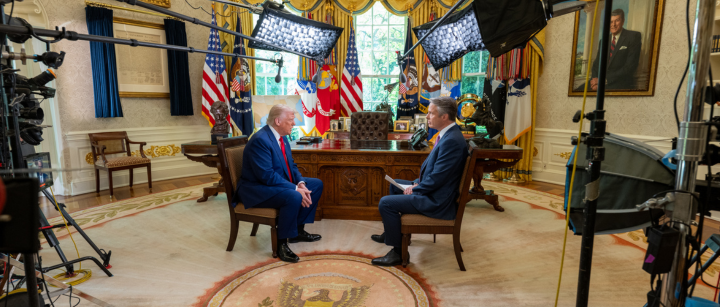
President Donald Trump’s commemoration of his first 100 days in office included a speech in Michigan and interviews with major news outlets, but fact-checkers have identified numerous false and misleading statements throughout his remarks.
Among the most notable claims was Trump’s insistence that an immigrant deported to El Salvador had “M-S-one-three” tattooed on his knuckles. When ABC News correspondent Terry Moran pointed out that the letters and numbers were digitally added to an image Trump shared, the president vehemently denied it. Digital forensics expert Hany Farid of the University of California, Berkeley, described the text as an “obvious digital manipulation,” noting that the Trump administration had interpreted tattoos and then added annotations to the image.
The White House declined to clarify whether the photo had been altered, instead providing a statement claiming that law enforcement officials would confirm the tattoos were MS-13 related. Independent analysis from multiple experts has yielded mixed interpretations of the tattoos’ significance, with most concluding they don’t signify gang affiliation.
Trump also claimed that the FBI had confirmed Venezuela’s government was sending gang members to the United States. While Fox News reported that an unnamed “senior administration official” shared portions of an FBI assessment supporting this claim, the Associated Press reported that 17 other intelligence agencies disagreed with that assessment, finding “no coordination between Tren de Aragua and the Venezuelan government.”
In his Michigan speech, Trump took credit for military recruitment improvements, stating, “After years of missed targets, our military suddenly has the best recruiting numbers in 30 years.” While recruitment has indeed increased, this trend began under the Biden administration, with the Defense Department announcing last September that it had recruited 12.5% more people than the previous fiscal year.
The president also made misleading statements about proposed Medicaid cuts, claiming Republicans would simply “look at waste, fraud, and abuse” rather than cut $800 billion from the program. Experts note such substantial cuts would force states to make difficult choices between raising revenue, cutting other budget areas, or reducing Medicaid services.
On employment, Trump claimed that “for the first time in nobody even knows when,” job gains for native-born Americans now exceed those for foreign workers. However, government data shows this pattern occurred several times throughout 2024 under the previous administration.
Trump exaggerated business investment figures, claiming “$7 to $8 trillion” in investments during his first two months, while the White House officially cited “over $5 trillion in new U.S.-based investments” secured in his first 100 days. He falsely claimed Apple “never invested in this country” before, despite the company announcing a $430 billion U.S. investment under Biden in 2021 and a $350 billion investment during Trump’s previous term in 2018.
The president mischaracterized Democrats’ concerns about deportations, claiming they were “not allowed to deport illegals.” In reality, Democratic lawmakers have primarily expressed concerns about due process, arguing that noncitizens targeted for deportation are typically entitled to hearings.
Trump overstated the administration’s food dye policy, saying Health and Human Services Secretary Robert F. Kennedy Jr. “announced that we’re banning eight major artificial dyes.” The FDA is working with industry to eliminate synthetic dyes, but there’s no formal agreement or broad ban in place.
Citing a Trump-friendly Rasmussen poll, the president claimed that “for the first time in modern history,” more Americans believe the country is headed in the right direction than the wrong direction. Other polls, including those from Marquette University, YouGov, and Gallup, consistently show most Americans believe the country is on the wrong track.
Trump also contradicted data on international tourism, claiming “we’re doing great” and that tourism would become “way up” in six months. Current figures from the Department of Commerce show overseas visitors to the U.S. were down 11.6% in March compared to March 2024.
The president repeated previously debunked claims about inflation rates, gas and egg prices, trade deficits, electric vehicle mandates, U.S. education rankings, and illegal immigration statistics – all of which contain significant factual errors or misrepresentations.
As Trump continues promoting his administration’s accomplishments, the consistent pattern of factual inaccuracies raises questions about the reliability of his statements and the administration’s relationship with verifiable truth.
Fact Checker
Verify the accuracy of this article using The Disinformation Commission analysis and real-time sources.

14 Comments
Interesting to see the fact-checking on President Trump’s claims about the deportee’s tattoos. It seems there’s a lot of uncertainty and debate around the significance of those markings.
Yes, the digital forensics analysis suggests the text was likely added, rather than being an actual tattoo. It’s concerning when public figures make unsubstantiated claims.
The detailed fact-checking in this article is a valuable resource for understanding the nuances and complexities behind Trump’s statements on his first 100 days. It’s important to look beyond the headlines.
Absolutely. The media’s role in scrutinizing claims and providing context is essential for an informed citizenry. This level of analysis is commendable.
It’s troubling to see the president making claims that are contradicted by digital forensics and independent analysis. Fact-checking is crucial to hold leaders accountable and maintain public trust.
I agree. Spreading misinformation, even inadvertently, can have serious consequences. Rigorous fact-checking helps ensure the public receives accurate information.
While I may not agree with all of Trump’s policies, I appreciate the even-handed approach this fact-check takes. It’s a good example of journalism that aims to inform, rather than inflame.
I agree. Maintaining objectivity and focusing on the facts is crucial, especially when it comes to high-profile political figures and their claims.
The reporting on Trump’s 100-day claims seems fair and balanced, pointing out both accurate and misleading statements. It’s good to see the media holding leaders accountable for their rhetoric.
I agree. Fact-checking is essential for maintaining trust in our political institutions and decision-making processes.
While I don’t agree with all of Trump’s policies, I appreciate that the fact-check article takes an objective approach in evaluating the accuracy of his statements. This is the kind of journalism we need more of.
Definitely. Impartial, evidence-based reporting is key to a healthy democracy, regardless of one’s political leanings.
This highlights the importance of verifying information, especially when it comes from high-profile political figures. The fact-checkers have done a thorough job in identifying the misleading aspects of Trump’s remarks.
Absolutely. In the age of misinformation and fake news, it’s critical that we scrutinize claims and look to authoritative, impartial sources to get the facts.