


Listen to the article
Trump’s Misleading “Reciprocal Tariff” Chart Raises Questions Among Economists
President Donald Trump unveiled a controversial plan for “reciprocal tariffs” during a Rose Garden announcement, using a chart that economists quickly criticized as fundamentally flawed in its methodology and calculations.
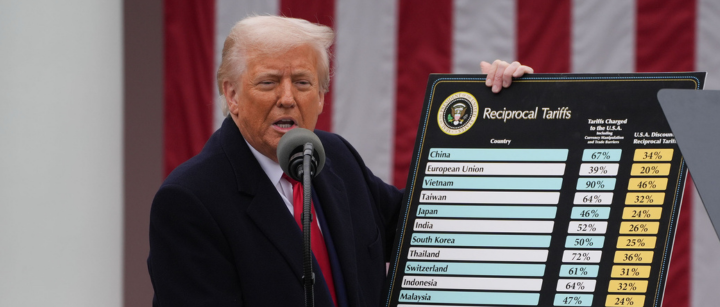
During his April 2 speech, Trump held up a chart purporting to show tariffs other countries charge on U.S. goods and the corresponding “reciprocal” tariffs the U.S. would impose in return. “Reciprocal. That means they do it to us and we do it to them,” Trump said. “Very simple. Can’t get any simpler than that.”
The plan calls for a minimum 10% tariff on all imported goods, with additional tariffs of up to 50% on some countries based on what Trump described as matching half of what other nations charge the United States, including “currency manipulation and trade barriers.”
However, economists and trade experts immediately pointed out significant problems with the chart’s figures, which bore little resemblance to actual tariff rates published by the World Trade Organization.
According to a fact sheet from the Office of the U.S. Trade Representative, the administration’s method for calculating these “reciprocal tariffs” was not based on actual tariffs at all. Instead, USTR divided each country’s trade deficit with the U.S. in goods by how much America imports from that nation.
For example, the chart claimed the European Union charges the U.S. 39% in tariffs. The WTO reports the EU’s trade-weighted average tariff rate is actually 2.7%. The 39% figure instead comes from dividing the U.S. goods trade deficit with the EU ($235.6 billion) by total U.S. imports from the EU ($605.8 billion).
“Those listed numbers are simply not tariffs, but some other made-up measure based on a formulaic trade deficit calculation,” explained Kimberly Clausing, a nonresident senior fellow at the Peterson Institute for International Economics. “In almost every instance, countries’ true trade barriers are far, far lower.”
Erica York, vice president of federal tax policy at the Tax Foundation, was even more direct: “The Trump administration’s calculations are a fundamentally nonsensical way to calculate ‘reciprocal’ tariffs. Absolutely none of the factors the White House purports to be looking at, like tariffs, non-tariff barriers, or other unfair practices, factor into the tariff rate they calculate in any way. They are invented numbers that have zero relationship to real policies.”
The methodology also ignores trade in services, where the United States enjoys a consistent surplus. “That skews the results. A lot,” Clausing noted. “The U.S. has a comparative advantage in services, and this ignores our substantial trade surpluses in that sector.”
Even some researchers whose work was cited by the administration in its fact sheet disputed the way their findings were applied. Andrei Levchenko, a professor of international economics at the University of Michigan whose paper was referenced, said the “elasticity estimate” in his research “should not be directly applied in this tariff calculation” because it fails to account for factors like potential retaliatory tariffs and effects on wages, prices, and exchange rates.
Trump’s claim that tariffs will bring in “trillions and trillions of dollars to reduce our taxes” also misrepresents their economic impact. The Tax Foundation projects that these tariffs, combined with earlier ones announced by Trump, would raise nearly $3.2 trillion over ten years, but would simultaneously reduce Americans’ after-tax income by “an average tax increase of more than $2,100 per U.S. household in 2025.”
William Reinsch, senior adviser at the Center for Strategic and International Studies, offered what he called “the most charitable interpretation” of the administration’s approach: “This is the tariff rate that would be necessary to balance bilateral trade with each partner.” However, York noted that “tariffs will not reduce the U.S. trade deficit because tariffs, either through their effects on the U.S. dollar or through retaliation, will also reduce U.S. exports.”
The announcement also included several previously debunked trade claims, including exaggerations about Canadian dairy tariffs and mischaracterizations of how U.S. tariffs on Chinese goods actually work.
As the administration moves forward with implementing these tariffs, economists warn that the disconnect between the stated methodology and economic reality could lead to unintended consequences for American businesses and consumers.
Fact Checker
Verify the accuracy of this article using The Disinformation Commission analysis and real-time sources.

7 Comments
Interesting that Trump’s chart appears to misrepresent the tariff data. Factual data and transparent analysis are crucial for informed policy decisions. I’m curious to learn more about the administration’s methodology and how it compares to WTO figures.
This report highlights the importance of rigorous, objective analysis when it comes to trade policy. I hope the administration will take these concerns seriously and provide clearer justification for its tariff plans.
This report raises serious questions about the integrity of the administration’s policymaking process. Accurate, unbiased data is essential for making informed decisions that impact the economy and consumers.
It’s concerning to see the White House using potentially flawed data to justify its trade agenda. Rigorous fact-checking and public accountability are vital to ensuring sound economic policies.
This is concerning if the White House is using misleading data to justify trade policy. Economists and trade experts should be consulted to ensure tariff calculations are accurate and policies are based on sound economic analysis.
It’s concerning to see the administration using questionable data to back up its trade policies. Factual, impartial information is essential for making informed decisions that impact the economy and consumers. I hope further scrutiny leads to more transparency.
The use of misleading data is troubling. Trade policy should be based on factual information and input from credible economic experts, not political agendas. I’m glad FactCheck.org is scrutinizing these claims.