


Listen to the article
Trump’s Inaccurate Drug Overdose Claims Contradict CDC Data
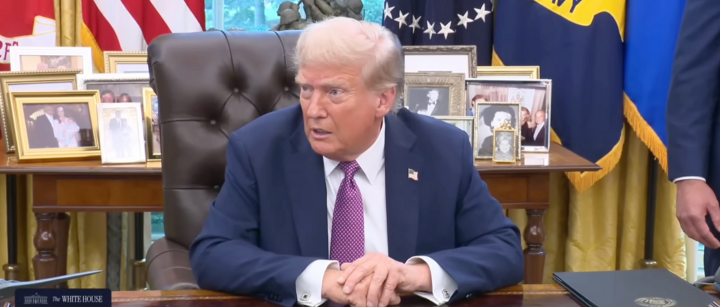
President Donald Trump significantly overstated the number of Americans who died from drug overdoses in 2024, claiming at a recent White House event that “300,000 or 350,000 people died last year from drugs.” This statement, made while signing an executive order to rename the Department of Defense as the Department of War, contradicts official government statistics.
According to the Centers for Disease Control and Prevention (CDC), the provisional number of drug overdose deaths in 2024 was actually 79,383—roughly a quarter of Trump’s estimate. CDC spokesperson Gabriel Alvarado confirmed this figure, which represents a substantial 24% decrease from the 105,007 deaths recorded in 2023.
Dr. Daniel Ciccarone, professor of addiction medicine at the University of California San Francisco, characterized Trump’s estimate as “a gross exaggeration,” noting that annual drug overdose deaths in the U.S. have never approached 300,000. CDC data indicates that overdose deaths peaked at 111,466 during the 12-month period ending June 2023, followed by what Ciccarone described as an “impressive drop” to approximately 75,000 for the 12-month period ending March 2025.
The president made these claims when responding to a reporter’s question about the recent U.S. military buildup in the southern Caribbean near Venezuela. Trump linked the deployment—which includes eight warships carrying attack aircraft, a submarine, and Navy surveillance planes—to efforts against drug trafficking.
This follows a September 2 announcement on Trump’s social media platform Truth Social about a U.S. airstrike on what he described as a boat carrying “positively identified Tren de Aragua Narcoterrorists” with illegal drugs. Trump claimed the strike “resulted in 11 terrorists killed in action” and shared video of the incident, though the administration has provided little additional information about the occupants or cargo.
“We’re strong on drugs. We don’t want drugs killing our people,” Trump stated. “They always say 95[,000], 100,000. I believe they’ve been saying that for 20 years. I believe we lost 300,000 people last year.”
This isn’t the first time Trump has made such claims. During a 2024 campaign rally in Phoenix, he asserted that “300,000 people are dying a year,” calling this “the real numbers” despite official statistics. At a 2023 rally in Waco, Texas, he described the NCHS figures as a “lie,” suggesting the actual total was “probably” five times higher.
When questioned about potential undercounting in overdose statistics, CDC spokesperson Alvarado explained, “Death investigations involving drug overdose can take time and, in some cases, the cause of death may still be pending investigation when we finalize data for the year.” However, the CDC estimates any undercount in recent years at merely 1-1.5%.
Christopher Ruhm, a professor at the University of Virginia, previously noted he had “not seen convincing evidence that the number of overall drug deaths is drastically underreported.” While incomplete death certificates had led to some understatement of opioid deaths in the past, reporting has improved over time.
The recent decline in overdose deaths appears to stem from multiple factors. NCHS data shows that overdose deaths from synthetic opioids, including fentanyl, declined 34% from 74,091 in 2023 to 48,661 in 2024.
Dr. Ciccarone attributes this reduction to “a complex mix of supply and demand forces,” including decreased fentanyl seizures at the U.S.-Mexico border, improved chemical precursor controls in China, and effective actions against the Sinaloa cartel, which the DEA describes as “one of the world’s oldest and most powerful drug cartels” and a major fentanyl trafficker.
“Keep in mind that overdoses had started to drop during the Biden administration,” Ciccarone noted. “Many eastern states were seeing drops from peak as early as 2021/22. The success of Chinese regulation of fentanyl and precursors is due to policies during the Biden administration.”
The White House did not respond to requests for evidence supporting Trump’s claims about drug overdose deaths.
Fact Checker
Verify the accuracy of this article using The Disinformation Commission analysis and real-time sources.

14 Comments
The discrepancy between Trump’s claims and the CDC data highlights the importance of relying on authoritative, fact-based sources when discussing public health issues. Objective information is key.
Absolutely. Exaggerating the problem could lead to misguided responses and undermine efforts to address the opioid crisis effectively.
A 24% decrease in overdose deaths is encouraging, though the overall numbers are still tragically high. Continued vigilance and evidence-based approaches will be key going forward.
Agreed. While any reduction is positive, the opioid epidemic remains a major public health challenge that requires sustained, data-driven efforts.
It’s concerning that the President would make such a significant overstatement about overdose deaths. Fact-checking and transparency are essential, especially on matters of public health.
I agree. Exaggerating the crisis could undermine efforts to address it effectively. Reliable data from the CDC should guide the policy response.
Interesting to see the discrepancy between Trump’s claims and the CDC’s data on overdose deaths. It’s important to rely on authoritative, fact-based sources when discussing public health issues.
Absolutely. Accurate statistics are crucial for understanding the scope of the opioid crisis and crafting effective solutions.
It’s troubling that the President would make such a significant overstatement about overdose deaths. Accurate data and transparency are crucial for addressing this crisis effectively.
I share your concern. Inflating the problem could lead to misguided policies and undermine public trust. The CDC figures should be the basis for policymaking.
While any reduction in overdose deaths is positive, the overall numbers remain unacceptably high. Continued vigilance and evidence-based approaches will be essential going forward.
I agree. The opioid epidemic is a complex, multifaceted challenge that requires a sustained, data-driven response from policymakers and public health experts.
It’s concerning that the President would make such a significant overstatement about overdose deaths. Accurate, fact-based information should guide the policy response to the opioid crisis.
Absolutely. Relying on reliable data from the CDC is crucial for understanding the scope of the problem and developing effective solutions.