


Listen to the article
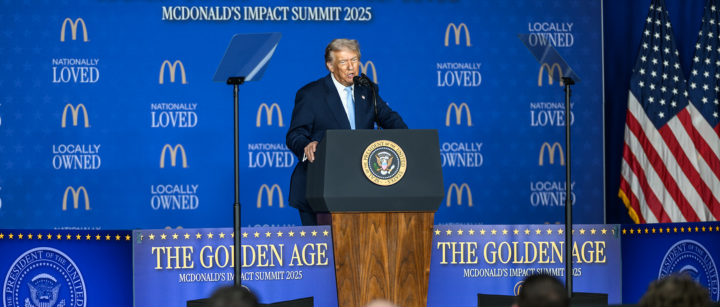
In a recent address to McDonald’s restaurant owners, President Donald Trump made several misleading claims about economic trends during his predecessor’s tenure, particularly regarding employment figures and social assistance programs.
Speaking at the McDonald’s Impact Summit in Washington, D.C. on November 17, Trump told franchise owners, “Government jobs were going up, real jobs were going down. You are so damn lucky that I won that election.” This statement mischaracterizes the employment landscape under former President Joe Biden’s administration.
Data from the Bureau of Labor Statistics shows private-sector employment—which Trump appeared to reference as “real jobs”—grew consistently throughout Biden’s presidency. By the time Biden left office, private-sector jobs had increased by approximately 14.3 million, representing an 11.8% growth. Government positions also increased during this period, but at a slower rate of 8.3%, adding about 1.8 million jobs.
The White House did not respond to requests for clarification on Trump’s employment claims.
While some of Biden’s employment gains were attributable to post-pandemic recovery, the job growth pattern remained consistent throughout his term. Comparative analysis shows private-sector job growth during Trump’s first nine months in office (January to September) reached 567,000 jobs—a 0.42% increase. This represents slower growth than during the same period in Biden’s final year, when private-sector employment rose by 956,000 positions (0.71%).
Trump has previously made more accurate statements about government employment during Biden’s presidency, noting that approximately 26% of jobs added during Biden’s final two years were government positions. However, about 90% of those were state and local government jobs, areas where presidential influence is minimal.
Since returning to office, Trump has reduced federal government employment by approximately 97,000 jobs through September, according to preliminary BLS data. This reduction aligns with initiatives from his new Department of Government Efficiency (DOGE), though recent reports from NPR and the Associated Press indicate hundreds of terminated employees have since been rehired. Overall government employment—including federal, state, and local positions—increased by 6,000 jobs from January to September under Trump’s current term.
During the same McDonald’s event, Trump also claimed, “In nine months, we’ve lifted over 600,000 Americans off of food stamp[s], and that’s a record.” While U.S. Department of Agriculture data confirms that more than 645,000 people stopped receiving Supplemental Nutrition Assistance Program (SNAP) benefits between January and May, experts dispute the characterization of this as a “record” decline.
Kate Bauer, an associate nutrition sciences professor at the University of Michigan, noted that between October 2024 and January 2025—just before Trump’s administration began—SNAP enrollment had already declined by 870,304 individuals. Overall SNAP participation has fluctuated between 41 million and 43 million recipients in recent years.
When questioned about Trump’s claim, White House spokesperson Anna Kelly attributed the decrease to the president’s “proven economic formula of tax cuts, deregulation, and unleashing American energy,” which she said “cooled inflation, raised real wages, and promoted growth.”
However, Sara Bleich, professor of public health policy at Harvard, explained that SNAP is designed to be countercyclical—expanding during economic downturns and contracting as the economy improves. She noted the decline in participation is “perfectly normal and expected” given economic conditions.
Bleich also pointed to specific Trump administration policies that may have affected enrollment numbers, including a February executive order targeting undocumented immigrants’ access to public benefits and stricter work requirements included in the One Big Beautiful Bill Act.
“It is not really accurate to say that people are being ‘lifted out of the program,'” Bleich stated. “SNAP is operating as normal (with people rolling off as the economy improves) and participation has simultaneously been discouraged by deliberate actions to dampen participation.”
Currently, approximately 41.7 million Americans in 22.4 million households—nearly one in eight—receive SNAP benefits, according to the most recent USDA data from May.
Fact Checker
Verify the accuracy of this article using The Disinformation Commission analysis and real-time sources.

16 Comments
The discrepancy between Trump’s statements and the actual employment data is concerning. It’s a good reminder to always verify claims against reliable sources.
Agreed. Fact-checking and data literacy are essential skills for citizens to develop, especially when it comes to understanding economic performance and policy.
This article highlights the importance of fact-checking and holding leaders accountable for their claims, especially when it comes to critical economic data.
Absolutely. Rigorous, unbiased journalism is essential for maintaining a well-informed public and a healthy democracy.
This article highlights the importance of holding all political leaders accountable, regardless of party affiliation, when it comes to making factual claims about the economy.
Well said. Objective, non-partisan analysis is crucial for maintaining a healthy, functioning democracy.
Interesting to see the data on employment trends during the Biden administration. It’s important to look at the full picture rather than cherry-picking figures to support a particular narrative.
Agreed. Objective analysis of the data is crucial to understand the economic landscape, rather than relying on misleading claims.
The discrepancy between Trump’s statements and the actual employment figures is quite stark. It’s a good reminder to always cross-reference claims with reliable data sources.
Agreed. Fact-checking and data literacy are crucial skills for citizens to develop, especially in the age of misinformation.
This article is a timely reminder of the need for nuanced, evidence-based economic analysis, rather than relying on partisan rhetoric or selective data.
Well said. Maintaining a balanced, impartial perspective is key to understanding the complexities of the economy and policy decisions.
The employment statistics seem to tell a different story than what Trump claimed. I wonder what his motivation was for misrepresenting the data?
Good question. It’s concerning when political figures make false statements about economic performance, as it can sway public perception and discourse.
It’s disappointing to see a former president making misleading claims about economic performance. Transparent and accurate data should be the foundation of any policy discussion.
Absolutely. Distorting economic data for political gain erodes public trust and undermines informed decision-making.