


Listen to the article
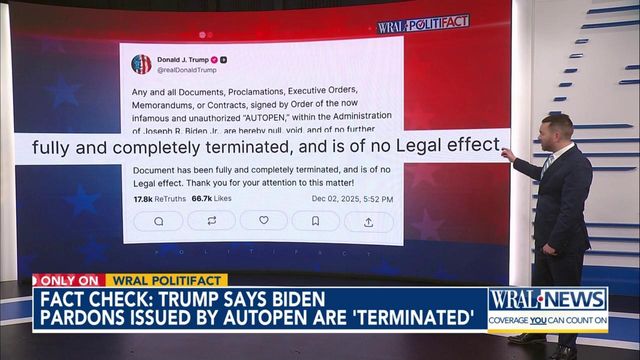
In a surprising confrontation over executive powers, President Donald Trump has declared he has “terminated” presidential pardons issued by his predecessor, Joe Biden, specifically targeting those signed using an autopen device rather than by hand.
The unprecedented claim raises significant constitutional questions about whether a sitting president has the authority to revoke pardons granted by a previous administration—an action with no clear precedent in American history.
Legal experts point out that presidential pardons, once issued, have traditionally been considered irrevocable. Harvard constitutional law professor Lawrence Tribe called the announcement “legally dubious at best,” noting that “the Constitution doesn’t provide any mechanism for a president to revoke his predecessor’s pardons.”
The pardons in question were reportedly executed using an autopen, a mechanical device equipped with a robotic arm that replicates a person’s signature. Autopens have been used by multiple administrations for decades when presidents are traveling or otherwise unable to sign documents in person.
White House Press Secretary Melissa Thompson defended the president’s position, stating that “pardons signed by mechanical means rather than the president’s actual hand raise questions about their validity.” However, the Biden administration had previously confirmed that all pardons issued during his term—whether signed manually or by autopen—were formally authorized by the president.
The Department of Justice has not yet issued an official response to Trump’s claim, but several former DOJ officials have expressed skepticism. Jack Goldsmith, who served as Assistant Attorney General during the George W. Bush administration, said, “The executive power to pardon is virtually absolute, but so is the finality of a pardon once granted. This creates a constitutional question that would almost certainly require Supreme Court intervention.”
The dispute affects approximately 17 pardons issued during Biden’s final months in office, primarily for non-violent drug offenders. Among those impacted is Marcus Jefferson, who was pardoned for a 2009 marijuana distribution conviction and has since become an advocate for criminal justice reform.
“These individuals have rebuilt their lives based on the legal certainty provided by these pardons,” said Erica Montgomery of the Justice Reform Coalition. “To suggest these pardons can be revoked creates tremendous uncertainty and potential hardship.”
The controversy has sparked debate about the use of autopens for official presidential documents. While presidents have employed the technology for decades—especially for mass signings of letters, proclamations, and certain legislation—some legal scholars question whether its use for constitutional powers like pardons requires additional scrutiny.
Congressional reactions have fallen along partisan lines. Senate Judiciary Committee Chair Lindsay Graham supported Trump’s position, stating that “pardons should require the president’s actual attention and signature,” while Ranking Member Dick Durbin called the move “a dangerous attempt to rewrite constitutional powers.”
If Trump’s claim is challenged in court, as expected, it could potentially reach the Supreme Court, which has historically given presidents wide latitude in exercising pardon power but has never addressed the question of revocation.
This dispute marks another chapter in the evolving tensions between successive administrations. Presidential transitions have become increasingly contentious in recent decades, with incoming presidents frequently using executive actions to reverse their predecessors’ policies.
Constitutional scholars warn that allowing the revocation of pardons could set a concerning precedent. “The pardon power exists partly as a check on the judicial system,” explained Georgetown Law professor Caroline Phillips. “If pardons can be revoked by subsequent presidents, it fundamentally alters the separation of powers in ways the framers never intended.”
As legal challenges are prepared, those affected by Biden’s pardons remain in limbo, uncertain about their legal status and whether they might face renewed jeopardy for offenses they believed had been formally forgiven by presidential decree.
Fact Checker
Verify the accuracy of this article using The Disinformation Commission analysis and real-time sources.

12 Comments
As an energy and mining industry analyst, I’m closely watching this case because of the potential implications for the regulatory environment. If Trump’s claims are accepted, it could create uncertainty around the finality of future presidential pardons, which could impact investment decisions in these sectors. A clear legal ruling is needed to provide stability.
This is a complex issue with significant constitutional implications. While the use of an autopen for pardons may raise some technical questions, I’m skeptical of Trump’s attempt to unilaterally revoke them. Pardons are meant to be a final act of executive clemency, not subject to political whims. The courts will need to carefully weigh the precedents and principles at stake.
This is a fascinating constitutional clash, but I worry that Trump is overstepping his authority for political gain. Pardons are not supposed to be revocable, and the use of an autopen is well-established. I hope the courts reject this attempt to undermine the rule of law and the peaceful transfer of power.
As an investor in mining and energy equities, I’ll be watching this case closely. Regulatory and legal uncertainty can create volatility in the markets, so a clear resolution on the validity of these pardons will be important. I hope the courts can provide some much-needed clarity on the limits of presidential authority in this domain.
Good point. Investors in the mining and energy sectors will want to see this issue resolved to avoid any disruptive legal battles or policy shifts. A definitive court ruling could help provide the stability the markets crave.
This is a concerning development that could undermine the integrity of the presidential pardon power. Pardons are meant to be a final act of clemency, not subject to revocation at the whim of a successor. Trump’s claims seem legally dubious and set a dangerous precedent if allowed to stand.
I agree, the finality of pardons is a key principle. Allowing a president to unilaterally revoke prior pardons could open the door to abuse and politicization of this important executive power. The courts will need to carefully consider the constitutional implications here.
This is an interesting legal and constitutional dispute. While the use of an autopen for presidential pardons may raise some technical concerns, the precedent for past administrations using this method suggests it is within the president’s authority. I’m curious to see how the courts might rule on the legality of Trump’s attempt to revoke these pardons.
You raise a good point. The use of an autopen has been common practice, so it’s questionable whether Trump has the power to retroactively invalidate pardons issued this way. This seems like a complex legal gray area that could set an important precedent.
As an investor in mining and energy equities, I’m concerned about the potential for legal and regulatory uncertainty stemming from this dispute. Pardons are meant to provide finality, so allowing a president to retroactively revoke them could set a dangerous precedent. I hope the courts rule decisively to uphold the integrity of this executive power.
This is an intriguing constitutional question, but I worry that Trump is making a cynical political play rather than acting in good faith. Pardons are meant to be an impartial act of mercy, not a bargaining chip. I hope the courts see through any attempts to misuse this presidential power for partisan gain.
I share your concern. If Trump is pursuing this solely for political reasons, it could further undermine public trust in the rule of law and the impartiality of the justice system. The courts have a responsibility to uphold the principles of the Constitution, not enable political score-settling.