


Listen to the article
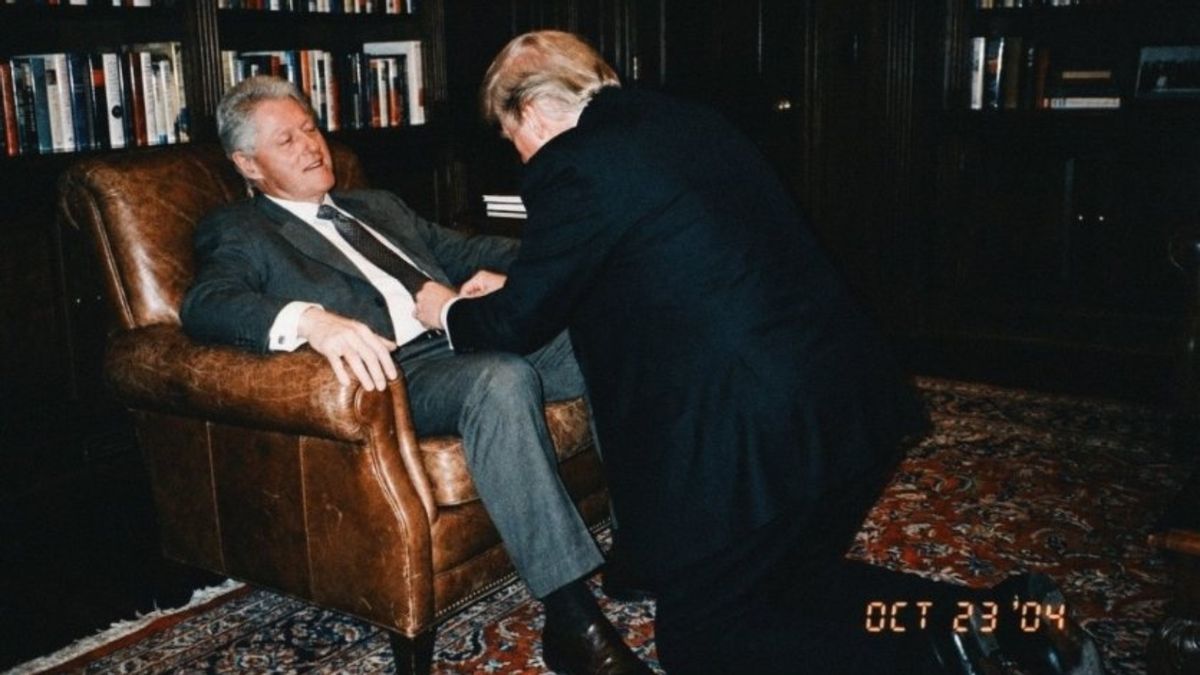
In a notable example of misinformation surrounding public figures, a manipulated image purportedly showing former President Donald Trump kneeling and unbuckling former President Bill Clinton’s trousers has been widely circulated across social media platforms. The image, which began spreading in November 2025, emerged shortly after Trump signed legislation mandating the release of files related to convicted sex offender Jeffrey Epstein’s case.
The photograph allegedly depicts a scene in a library where a man resembling Trump, identifiable primarily by his distinctive hairstyle, kneels before Clinton, who appears seated in a leather armchair. The image carries a timestamp suggesting it was taken in October 2004 and has spread widely across Reddit, Instagram, Facebook, and X (formerly Twitter).
The circulation of this image coincided with reports about an email from Mark Epstein to his brother Jeffrey, in which he allegedly asked about whether “Putin has the photos of Trump blowing Bubba” – a nickname widely believed to reference Clinton, though Mark Epstein reportedly denied this connection.
Several social media users claimed that AI-detection tools had verified the image’s authenticity. However, forensic analysis reveals numerous inconsistencies that clearly indicate manipulation. The carpet pattern shows irregularities, there’s a notable absence of natural shadows beneath the figures and furniture, and the “Trump” figure’s hand displays anatomically implausible finger positioning. Additionally, book titles in the background are illegible, suggesting poor digital composition.
Google’s AI Gemini chatbot reportedly identified SynthID watermarks in the image, indicating it was likely generated through Google’s AI tools. While AI detection software delivered mixed results – with tools like AI or Not and SightEngine suggesting it might be authentic, and others like Hive Moderation indicating artificial generation – experts emphasize that such detection technologies remain fallible and their results should be viewed critically.
The timing of the alleged photograph also raises significant doubts. In September 2004, Clinton underwent heart bypass surgery and was in recovery during October. News reports confirm that on October 24, 2004 – just one day after the alleged photograph’s timestamp – Clinton was interviewed at his Chappaqua home by journalist Diane Sawyer about his surgery and the upcoming election. The following day, he appeared at a campaign rally in Philadelphia supporting Democratic presidential candidate John Kerry.
Most tellingly, reverse-image searches yield no legitimate news sources or original publications containing this photograph. Had such an image of two former presidents been authentic, it would undoubtedly have generated significant media coverage.
This is not the first instance of manipulated imagery involving Trump and Clinton. Previous fact-checks have debunked other falsified images, including one miscaptioned to suggest Trump was inappropriately touching Clinton at the 2000 U.S. Open, and an AI-manipulated video purporting to show Trump kissing Clinton’s crotch.
While the two men were indeed photographed together at various events throughout the 2000s, these authentic images have frequently been misrepresented or digitally altered to suggest improper conduct.
This case highlights the growing challenge of distinguishing authentic imagery from sophisticated digital manipulations in an era where artificial intelligence tools are increasingly accessible. As these technologies advance, critical evaluation of digital media becomes ever more essential to prevent the spread of misinformation.
Fact Checker
Verify the accuracy of this article using The Disinformation Commission analysis and real-time sources.

7 Comments
While the visual impact of this photo may be striking, it’s concerning to see it being used to spread potentially false narratives. We should be vigilant about verifying the sources and motives behind such content.
The timing of this photo’s spread, along with the alleged Epstein email, certainly raises questions. However, we should be cautious about drawing conclusions without clear evidence.
Agreed. Fact-checking and responsible reporting are crucial in navigating the spread of misinformation, especially around high-profile political figures.
The analysis on the misleading nature of this Trump-Clinton photo is important. Manipulated images can have a significant impact, so it’s crucial that we approach such content with caution and verify its authenticity.
This is a good reminder that we need to be critical consumers of online content, especially when it comes to sensitive political topics. Fact-checking is essential to prevent the spread of misinformation.
Well said. Maintaining a skeptical yet open-minded approach is key to navigating the complex information landscape surrounding high-profile political figures.
Interesting analysis on the misleading Trump-Clinton photo circulating online. Manipulated images can be powerful disinformation tools, so it’s important to verify their authenticity before sharing.