


Listen to the article
Trump Administration Intensifies Military Role in Border Operations
President Trump’s second administration has dramatically expanded the use of military forces along the southern border, implementing several recommendations from the conservative Project 2025 blueprint that called for “a creative and aggressive approach” to border patrol operations.
The administration’s actions began immediately after taking office when Trump declared a national emergency at the southern border and issued an executive order to clarify the military’s role in protecting U.S. “territorial integrity,” granting himself broad powers to redirect federal resources toward border security.
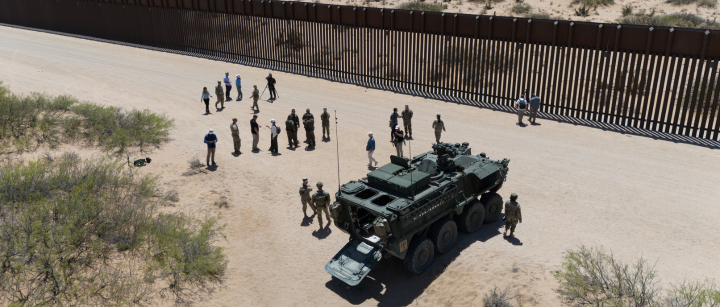
Within days, Acting Secretary of Defense Robert Salesses met with top military officials to deploy 1,500 active-duty service members to San Diego and El Paso, Texas—a significant departure from previous border security efforts that primarily relied on National Guard troops. “This is just the beginning,” Salesses stated on January 22, foreshadowing the expansion to come.
The administration subsequently established four National Defense Areas across Arizona, New Mexico, and Texas, covering approximately 515 miles of the southern border. These zones function as “slim, noncontiguous extensions of existing military bases,” according to a U.S. Northern Command spokesperson. In New Mexico, these military zones vary from 60 feet to a mile wide across about 170 noncontiguous miles.
Legal experts view this designation as a strategic maneuver to circumvent the Posse Comitatus Act, which normally prohibits federal military forces from engaging in domestic law enforcement. Mark Nevitt, associate professor at Emory University School of Law, described the move as effectively bypassing this restriction by turning “a strip of federal land along the U.S. southern border into a massive ‘National Defense Area.'”
The administration is utilizing the “military purpose doctrine” exception to Posse Comitatus—a concept that allows military actions to proceed if they primarily serve a military purpose, even when they incidentally benefit civilian law enforcement, according to Elizabeth Goitein and Joseph Nunn at the Brennan Center for Justice.
Current operations involve 7,600 active-duty personnel, including 250 who regularly patrol the southwest border. While hundreds of migrants have faced trespassing charges for entering these military zones, some cases have been dismissed by federal courts. One judge threw out approximately 100 cases, stating the government failed to prove defendants knowingly entered military property.
The expansion of military involvement extends beyond the border itself. In May, the Department of Homeland Security requested 20,000 National Guard troops to assist with immigration enforcement throughout the country’s interior—not just at the border—to fulfill what the administration called a “mandate from the American people to arrest and deport criminal illegal aliens.”
The Defense Department subsequently asked 20 Republican-led states to activate National Guard units under Title 32 status, placing them under governors’ command but with federal funding. Tennessee and Wyoming were among the first states to comply, while Vermont declined the request.
Experts note this interior deployment represents an unprecedented use of the National Guard for immigration enforcement. Chris Mirasola, assistant law professor at the University of Houston Law Center, called it a “serious escalation” in utilizing Guard troops for such purposes.
The administration has also deployed military assets for maritime operations, working with the Coast Guard on drug interdiction in the Gulf of Mexico and conducting air strikes against Venezuelan vessels in the Caribbean allegedly transporting narcotics.
Early data suggests these measures have significantly reduced illegal border crossings. U.S. Border Patrol reported 49,620 enforcement encounters at the southwest border from February through August, a 93% decrease compared to the same period in 2023.
In July, Trump signed legislation providing $1 billion to support military activities at the southern border, including temporary detention of migrants on Defense Department installations and infrastructure development in the designated “national defense areas.”
Fact Checker
Verify the accuracy of this article using The Disinformation Commission analysis and real-time sources.

4 Comments
The Project 2025 blueprint sounds like an aggressive plan. While border security is important, I hope the administration considers the broader social and economic impacts of their policies. What do you think are the key tradeoffs they need to weigh?
Deploying active-duty troops to the border is a significant escalation. I’m curious to hear your perspective on the legality and appropriateness of using the military in this way for domestic law enforcement. What are the potential risks and benefits?
Interesting to see the administration’s increased military involvement in border operations. I wonder how effective this approach will be in addressing immigration challenges. Do you think it strikes the right balance between security and humanitarian concerns?
The creation of National Defense Areas along the border is a bold move. I’d be interested to know more about the legal justification and practical implications of this. How does it fit into the administration’s overall immigration strategy?