


Listen to the article
The Philippines’ Supreme Court has no power to halt ICC proceedings against Duterte, fact-check reveals
Claims circulating on social media that the Philippines’ Supreme Court has dismissed the case against former president Rodrigo Duterte and effectively ended International Criminal Court (ICC) proceedings have been debunked as false.
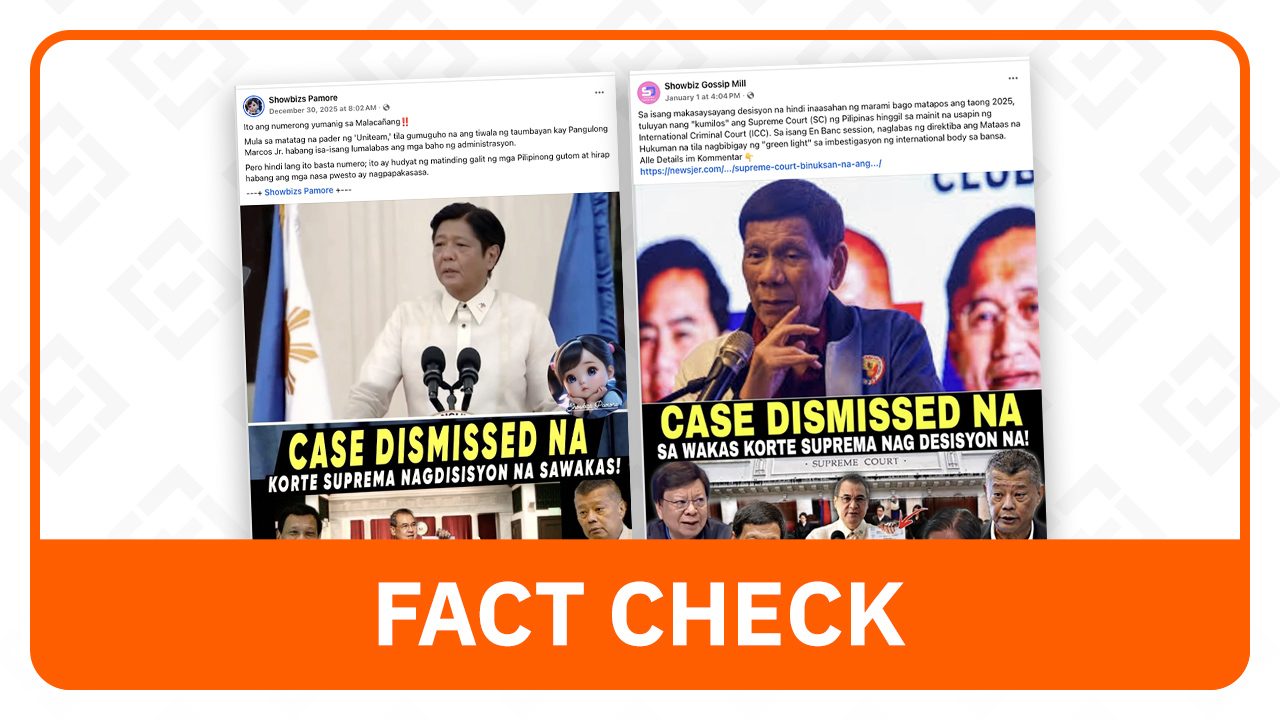
The misleading information appeared on a Facebook page posing as a news outlet with 41,000 followers before being reshared by another page with 23,000 followers. Together, the posts garnered over 5,200 likes, 1,648 comments, and 283 shares.
The viral posts featured an image with text in Filipino stating “Case dismissed! The Supreme Court has finally decided! The court has freed PRRD from the ICC?” The accompanying caption suggested that the Supreme Court had issued a directive giving a “green light” to the ICC’s investigation.
However, no such Supreme Court resolution, en banc decision, or directive exists. More critically, even if the Philippine Supreme Court were to issue such a ruling, it would have no authority to impact or terminate the ICC’s ongoing investigation into crimes against humanity charges against Duterte.
Legal experts explain that the ICC operates as an independent judicial institution established under the Rome Statute, with its own governing legal framework. Decisions on investigations are made solely by ICC prosecutors and judges, who act independently from political or judicial interference by member states. Simply put, local court rulings cannot override or nullify ICC actions.
The false claims emerged amid actual legal developments involving the Duterte family. The former president’s children—Davao City Representative Paolo Duterte, acting Davao City Mayor Sebastian Duterte, and Veronica “Kitty” Duterte—have filed consolidated petitions asking the Supreme Court to order their father’s release through a writ of habeas corpus. They argue that his arrest, surrender to the ICC, and continued detention are illegal and unconstitutional.
The Office of the Solicitor General has countered by urging the High Court to dismiss these petitions, stating that Duterte is already in ICC custody in The Hague, Netherlands—placing him beyond the jurisdiction of Philippine courts. Any Supreme Court order would therefore be “ineffectual and without practical value,” according to the OSG.
Duterte remains detained at the ICC detention center after the court’s appeals chamber unanimously rejected his appeal for interim release. He faces multiple counts of crimes against humanity connected to killings during his controversial war on drugs.
In December 2025, a three-member medical panel assessed Duterte’s cognitive capacity and determined that despite his age and frailty, he retains the mental faculties necessary to participate in pre-trial proceedings.
Duterte’s legal team subsequently filed an urgent motion requesting a new medical report focused specifically on whether his cognitive state could affect detention-related risks under Article 58(1)(b) of the Rome Statute. These risks include potential flight, witness interference, or committing further crimes. However, the ICC’s Pre-Trial Chamber I rejected this request, ruling that the existing expert assessment was sufficient.
The spread of misinformation regarding high-profile legal cases highlights the importance of verifying information from official sources before sharing on social media, particularly when claims involve complex international legal jurisdictions and high-stakes political figures.
Fact Checker
Verify the accuracy of this article using The Disinformation Commission analysis and real-time sources.

12 Comments
Interesting that the Supreme Court declined to dismiss the ICC case against former President Duterte. It seems the court recognizes the ICC’s jurisdiction, despite the misleading claims circulating on social media. This will be an important case to watch as it unfolds.
Yes, the ICC investigation appears to be moving forward despite efforts to shut it down. It will be crucial for ensuring accountability for any crimes against humanity committed during Duterte’s presidency.
This ruling is an important check on executive power and sends a message that no one is above the law, not even a former president. The ICC must be able to carry out its investigation without political interference. Fact-checking is crucial to expose the misinformation circulating.
You make a good point. Maintaining the integrity of the judicial process is vital, especially in high-profile cases with political implications. The Supreme Court’s decision here is a win for the rule of law.
This is an important ruling upholding the rule of law. While the social media posts tried to claim the Supreme Court had dismissed the case, the reality is that the ICC proceedings can continue. Transparency and judicial independence are vital here.
Agreed. The Supreme Court’s decision not to interfere with the ICC case shows they recognize the international court’s jurisdiction, even if the former president and his allies want to block the investigation.
It’s good to see the Supreme Court taking a principled stance here and not bowing to political pressure. The ICC case against Duterte must be allowed to proceed without interference from domestic courts. Justice and accountability are on the line.
Absolutely. The independence of the judiciary is critical in a case like this. The Supreme Court has upheld its duty by refusing to dismiss the ICC’s investigation, despite the misleading claims spreading online.
This Supreme Court decision is a positive step in ensuring that former President Duterte faces potential consequences for any crimes against humanity that may have been committed under his watch. The ICC probe must be allowed to proceed unimpeded, without political interference from domestic courts.
It’s encouraging to see the Supreme Court taking a principled stand and not succumbing to attempts to derail the ICC investigation. Transparency and accountability must prevail, regardless of the political sensitivities involved. This ruling is an important safeguard for the integrity of the judicial process.
The Supreme Court’s refusal to dismiss the ICC case against Duterte is a significant development. It shows the court’s commitment to upholding international law and human rights, even in the face of political pressure. This case will be one to follow closely in the months ahead.
The Supreme Court’s refusal to dismiss the ICC case against Duterte is a significant development that upholds the rule of law. It’s crucial that the judicial process be allowed to play out without undue influence, so that justice can be served and accountability established, if warranted.