


Listen to the article
South Carolina Election Law Questioned as Political Dual-Candidacy Rumors Emerge
A legal question regarding whether South Carolina candidates can simultaneously run for multiple political offices has sparked debate after comments from a prominent GOP strategist suggested Representative Nancy Mace might be exploring such an option.
The controversy began when Wesley Donehue, Rep. Mace’s former campaign strategist, claimed during an appearance on the “We The Palmetto” podcast that attorneys in Washington D.C. were examining state law provisions that might allow candidates to run for both state and federal offices concurrently.
“Specifically, we are hearing that Nancy Mace has asked for some opinions to run for Congress and governor,” Donehue stated. He further suggested that both Mace and Representative Ralph Norman might potentially pursue gubernatorial campaigns while simultaneously seeking re-election to their congressional seats.
Mace’s team quickly rejected the assertion. “Nancy Mace isn’t running for two offices. Never has,” a spokesperson said, adding that Mace is “running for governor to weed out the corruption Wesley Donehue is purportedly paid to promote.” The pointed response highlights ongoing tensions within South Carolina Republican circles.
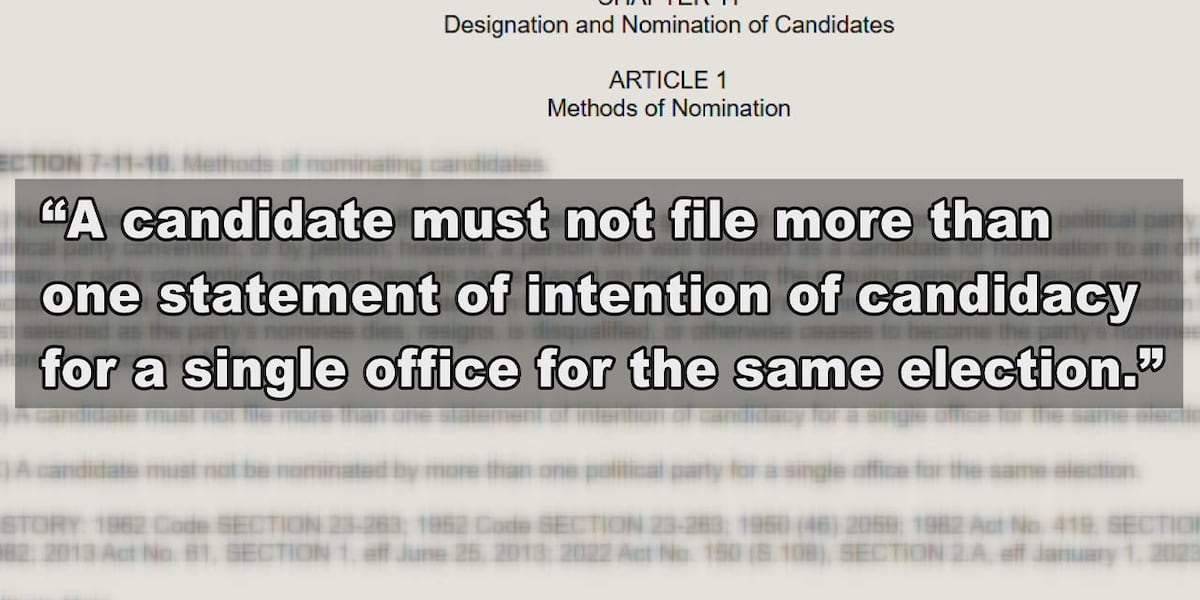
At the center of the controversy is the interpretation of South Carolina election law. The State Election Commission maintains a straightforward position, citing SC Code 7-11-10, which states: “A candidate must not file more than one statement of intention of candidacy for a single office for the same election.” Based on this language, the commission has concluded that candidates are limited to running in a single race.
However, attorney Jay Bender offers a contrasting legal interpretation that has fueled the debate. “I don’t see any way that section 7-11-10, subsection B can be read to preclude someone from running for two offices simultaneously,” Bender explained. “You cannot run for the same office in two political parties, as I read this statute, but it does not say you cannot run for governor and Congress simultaneously.”
Bender noted that if state legislators had intended to prohibit candidates from seeking multiple offices at once, they could have explicitly included such language in the statute. What is unambiguous in South Carolina law, however, is that an individual cannot hold two elected offices concurrently. A candidate who won both races would be required to forfeit one position.
The election calendar in South Carolina would technically permit dual filing. Candidates must submit their candidacy paperwork in March to qualify for the June primaries ahead of November’s general election. This timing would require simultaneous declarations for both offices.
Despite the potential legal opening, Bender emphasized that pursuing dual candidacies would likely create significant political complications. “It seems to me that it would weaken your message,” he said. “My guess is that if anybody is actually in that posture right now talking about running for both offices, it demonstrates an insecurity about their chance of success in the statewide race.”
The political calculus is further complicated by South Carolina’s write-in candidate provisions. If a sitting officeholder declines to file for re-election to pursue a gubernatorial bid and subsequently loses in the primary, they could only return to their current position as a write-in candidate. State law specifically prohibits primary losers from mounting write-in campaigns for the same office they sought in the primary.
This legal question emerges as South Carolina’s 2026 gubernatorial race begins taking shape, with potential candidates positioning themselves for what is expected to be a competitive Republican primary. The state, a reliable Republican stronghold in national elections, often sees its most significant electoral battles fought within GOP primaries rather than general elections.
Whether any candidate will test the boundaries of state election law remains to be seen, but the discussion has already highlighted the complex interplay between legal interpretation and political strategy that often characterizes American electoral politics.
Fact Checker
Verify the accuracy of this article using The Disinformation Commission analysis and real-time sources.

8 Comments
Interesting legal question around dual-candidacy in South Carolina. It’s important that candidates adhere to all applicable laws and regulations, regardless of party affiliation. A clear and transparent election process is crucial for democracy.
Candidates should avoid even the appearance of impropriety or attempts to game the system. South Carolina voters deserve full-time representatives who are focused on serving their constituents, not political maneuvering.
Agreed. Voters should demand integrity and accountability from all candidates running for office.
While the legal technicalities are important, I hope the candidates and their teams will ultimately prioritize the interests of South Carolina voters over partisan or personal agendas. Integrity should be the guiding principle.
While legal options may exist, the ethical choice is often not the easiest one. Voters will likely respond better to candidates who demonstrate a sincere commitment to public service over personal ambition.
This is a complex issue that touches on important democratic principles. I hope South Carolina officials will carefully review the relevant laws and provide clear guidance to ensure a fair electoral process.
It’s concerning to see allegations of potential legal maneuvering around dual-candidacy. Voters deserve representatives who are transparent about their intentions and focused on the issues that matter most to their communities.
Absolutely. Elected officials must be held to the highest ethical standards to maintain public trust.