


Listen to the article
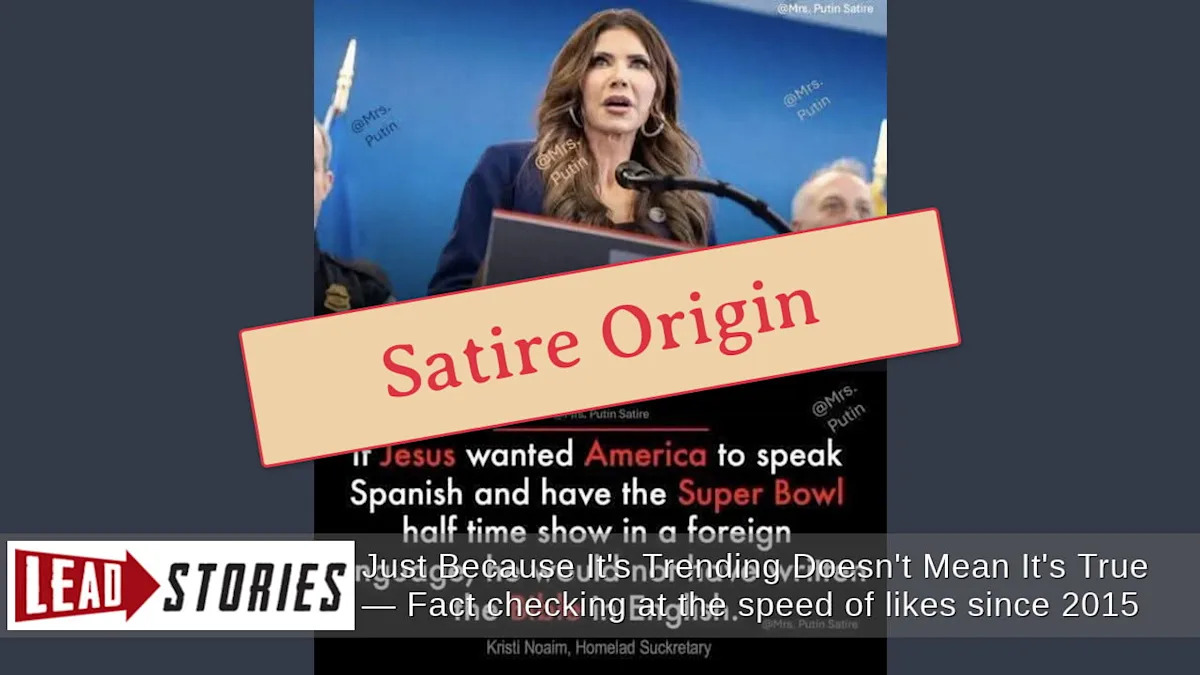
In a case of satire mistaken for reality, social media users have been circulating a quote falsely attributed to South Dakota Governor Kristi Noem claiming that “Jesus would not have written the Bible in English” if he had wanted Americans to speak Spanish.
The fabricated quote, which spread rapidly across social media platforms in recent days, was initially shared by a satirical Facebook page called “Mrs. Putin” before being reposted on X (formerly Twitter) by other users who appeared to believe it was authentic.
The full quote claimed Noem had said: “If Jesus wanted America to speak Spanish and have the Super Bowl half time show in a foreign language, he would not have written the Bible in English.” In the meme, Noem was also incorrectly identified as “Kristi Noaim, Homelad Suckretary,” a deliberate misspelling that was one of several indications the content was satirical.
The original post on the “Mrs. Putin” Facebook page included a satire disclaimer and watermarks identifying it as parody content. The page’s description clearly states it features “a fictional character” and is labeled as “Satire/Parody.” However, as is often the case with satirical content online, these disclaimers were overlooked when the image was shared across other platforms.
When the meme was reposted on X by an account named @WW3finalboss, it was presented with a caption that appeared to earnestly debunk the fake statement with historical context, further blurring the line between satire and misinformation for casual readers.
“Jesus Christ lived in the 1st century. The Gospels were written in Greek, with Jesus himself speaking Aramaic. The Torah (Old Testament) was written in Ancient Hebrew,” the X post correctly noted, adding that “Old English didn’t even begin to appear until the 5th century—about 400 years after Jesus’ death.”
This incident highlights the growing challenge of distinguishing between genuine political statements and satirical content in today’s fast-paced social media environment. As political discourse becomes increasingly polarized, outlandish or inflammatory statements attributed to public figures can gain traction quickly, even when they’re clearly marked as satire.
The timing of the fake quote coincided with recent discussions about language and culture following Shakira and Bad Bunny’s performances at the Super Bowl, which included Spanish-language music. These cultural moments often become flashpoints in America’s ongoing debates about national identity and immigration.
Governor Noem, who has positioned herself as a conservative voice on cultural issues, has not publicly addressed the misattribution. Her office did not respond to requests for comment about the viral meme at the time of this report.
Media literacy experts point to this incident as an example of how easily misinformation can spread when content is stripped of its original context. They recommend that social media users verify quotes from public figures by checking official accounts or reliable news sources before sharing or reacting to provocative statements.
This is not the first time satirical content has been mistaken for genuine political commentary. Similar incidents have affected politicians across the political spectrum, underscoring the challenges faced by both public figures and ordinary citizens in navigating today’s complex information ecosystem.
As debate about the incident continues online, it serves as a reminder that critical evaluation of sources remains essential in distinguishing between actual news and satirical content designed to entertain rather than inform.
Fact Checker
Verify the accuracy of this article using The Disinformation Commission analysis and real-time sources.
