


Listen to the article
Hungarian Political Polling Controversy Erupts as Pro-Government Officials Misrepresent Data
A political controversy has emerged in Hungary after several ruling party officials claimed that the European news outlet Politico had measured Fidesz, the governing party, as leading in popularity over the opposition Tisza Party. However, a closer examination reveals significant misrepresentations of how polling data is collected and presented.
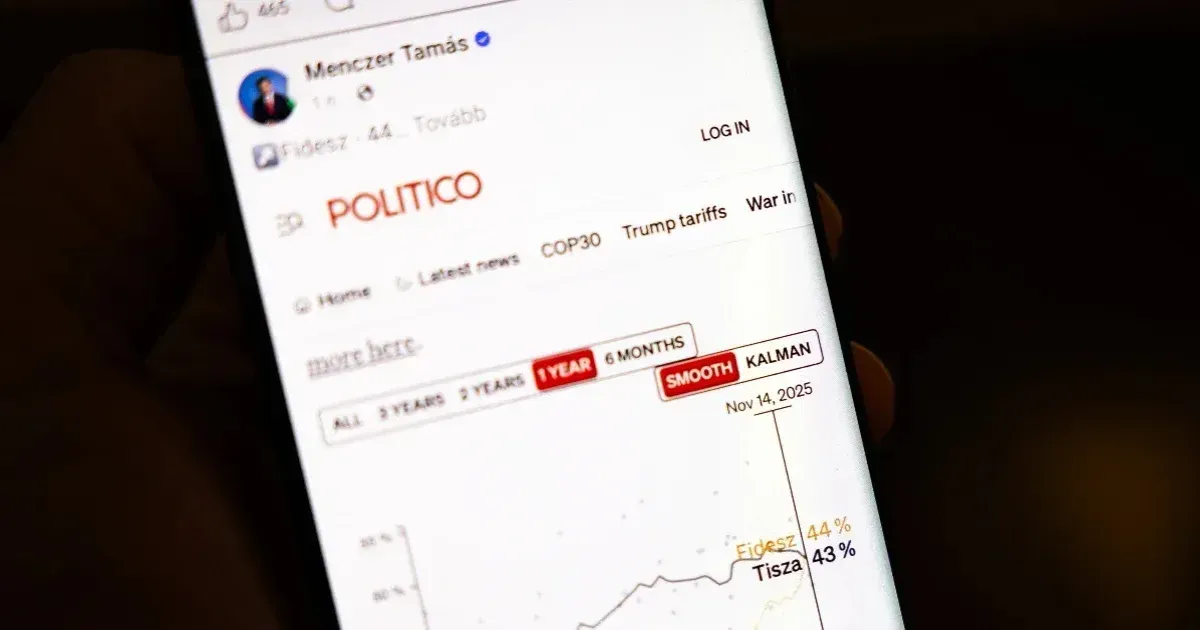
The incident began Sunday morning when Géza Sebestyén, head of MCC’s economic policy workshop, posted on Facebook that “Even Politico, which is typically critical of the Hungarian government, puts Fidesz ahead of the Tisza Party.” He included a screenshot from Politico’s Poll of Polls page showing Fidesz leading by one percentage point, following what appeared to be a reversal of previous trends.
The claim quickly spread through pro-government channels. Tamás Menczer, Fidesz’s communications director, stated that “Politico doesn’t like us. But even Politico says we are in the lead.” Máté Kocsis, Fidesz’s parliamentary group leader, similarly announced that “Politico has measured Fidesz’s advantage.” Numerous pro-government media outlets, including Index, Origo, Ripost, and Magyar Hírlap, amplified the story.
However, this characterization fundamentally misunderstands Politico’s Poll of Polls methodology. The platform does not conduct its own polling but rather aggregates results from various polling organizations to provide a more comprehensive picture of electoral trends. As Politico itself explains: “One poll can be misleading, so Politico aggregates data from multiple sources to provide a more accurate picture.”
For inclusion in the Poll of Polls, surveys must meet transparency requirements, disclosing methodology, timing, sample size, and funding sources. The platform applies a statistical model called Kalman filtering to create trend lines from these various polls, with larger and more recent samples given greater weight. Importantly, Politico excludes polls commissioned directly by political parties.
The polling landscape in Hungary presents unique challenges. The country has several polling institutes closely aligned with the government, while others maintain independence or work with opposition parties. These organizations often produce dramatically different results, with significant historical errors in both directions.
For example, prior to the 2019 Budapest mayoral election, pro-government pollsters Nézőpont and Századvég overestimated support for the ruling party candidate by 25 and 15 percentage points respectively. Conversely, before the 2022 elections, opposition-friendly pollsters Publicus, Republikon, and Závecz overestimated opposition support by 16-20 percentage points.
The controversy took an unexpected turn Monday when Politico removed the polls from Magyar Társadalomkutató and Alapjogokért Központ—two institutes linked to the government—from its aggregate calculation. These polls had shown Fidesz with substantial 10-point and 7-point leads respectively. Simultaneously, Politico added the latest Publicus poll showing Tisza with a 9-point advantage.
This recalibration dramatically shifted the Poll of Polls results, suddenly showing Tisza with a 7-point lead (46% to Fidesz’s 39%). The 8-percentage-point swing highlights the volatility of polling aggregation and the importance of understanding which surveys are included or excluded.
The polling landscape in Hungary has grown increasingly complex as pro-government research institutes have proliferated in recent years. Századvég and Nézőpont have been joined by Real PR 93 Kft., Magyar Társadalomkutató, Alapjogokért Központ, and XXI. Század Intézet—all of which typically measure stronger support for the ruling coalition than independent pollsters.
This multiplication of government-aligned polling organizations effectively floods the market with pro-Fidesz numbers, potentially skewing aggregators like Politico’s Poll of Polls if all surveys are weighted equally without consideration of their independence and methodological rigor.
The episode underscores the challenges of interpreting political polling in polarized media environments and the risks of taking aggregated trend lines at face value. One conclusion, however, remains clear: contrary to claims by ruling party officials, Politico did not “measure” a Fidesz lead over the Tisza Party.
Fact Checker
Verify the accuracy of this article using The Disinformation Commission analysis and real-time sources.

6 Comments
Interesting to see the political polling controversy in Hungary. It’s important to closely examine the data and methodology behind these types of claims, as misrepresentation of polling results can be quite misleading.
Agreed, the details around how the Politico data was collected and presented seem critical here. It’s prudent to approach such claims with scrutiny until the full picture is clear.
Polling and election integrity are sensitive topics, especially in polarized political climates. I hope the authorities can investigate this situation thoroughly and provide transparency around the actual data and analysis.
Absolutely, it’s essential that the public can trust that polling and election results are accurately reported, regardless of political affiliation. Transparency is key in maintaining democratic integrity.
This incident highlights the need for rigorous fact-checking and objective analysis when it comes to political polling data. Jumping to conclusions based on partial information can be very misleading.
You’re right, it’s critical that media outlets and political figures handle polling data responsibly and avoid cherry-picking or misrepresenting the information. Nuance and context are vital.