


Listen to the article
In a bizarre twist of misinformation, a satirical social media post claiming that an oil executive made derogatory comments about former President Donald Trump has been circulating online, causing confusion among some readers who believed it to be genuine news.
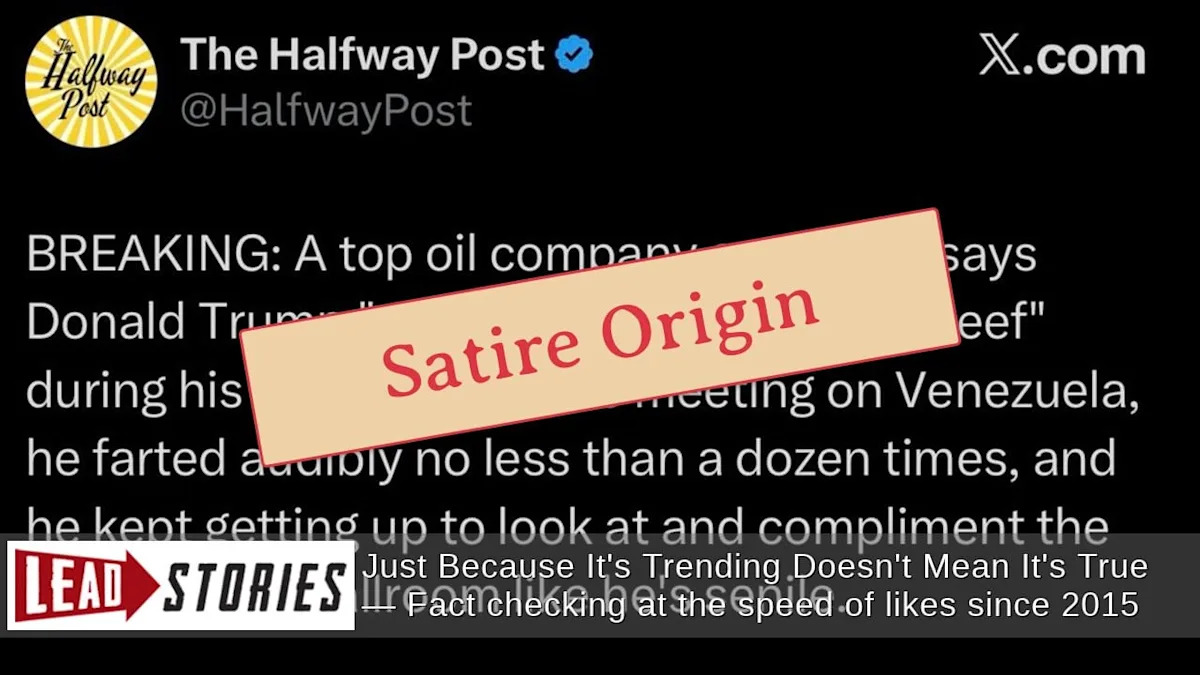
The viral post, which originated on the X (formerly Twitter) account “The Halfway Post” on January 10, 2026, falsely claimed that a top oil executive had described Trump as smelling “like rotten roast beef” during a White House meeting about Venezuela. The post also alleged that Trump “farted audibly no less than a dozen times” and appeared confused about his surroundings, supposedly complimenting a nonexistent ballroom.
Despite its presentation as breaking news, no legitimate media outlets have reported any such comments from participants of the January 9, 2026, meeting between Trump and oil industry leaders. A thorough search of major news databases revealed no corroborating stories containing these claims.
The source of the fabricated story, The Halfway Post, clearly identifies itself in its profile biography as a satirical account. “Dadaist graffiti news. Halfway true comedy and satire for your doomscrolling,” reads the account’s description, which explicitly states: “I don’t report the facts, I improve them.”
This incident highlights a growing concern in the media landscape where satirical content can be mistaken for legitimate news reporting, especially when shared outside its original context. Social media platforms have become breeding grounds for such misunderstandings, as posts can be quickly reshared without viewers checking the source or verifying the information.
The oil and energy sector has been a focal point of political discussion in recent years, with executive meetings at the White House often drawing significant attention. Relations between energy industry leaders and presidential administrations frequently make headlines due to their economic and environmental policy implications. However, these legitimate discussions can become muddled when satirical accounts create fictional narratives around them.
Media literacy experts caution that as the 2026 political cycle heats up, the public should expect to encounter more satirical or misleading content. They recommend verifying information through multiple reputable sources before accepting claims, particularly those that seem sensational or unusual.
The spread of this particular piece of misinformation underscores how easily satire can be misconstrued as fact in today’s fast-paced digital environment. With the increasing sophistication of content creation tools and the speed at which information travels online, distinguishing between genuine news and satirical commentary requires greater vigilance from readers.
The Halfway Post incident serves as a reminder that even content with clear satirical markers can escape its intended context and be presented as factual reporting. As political tensions rise and public figures remain under intense scrutiny, the line between satire and misinformation becomes increasingly important to recognize.
No legitimate journalists have reported that any oil executives made such comments about Trump following the January meeting, confirming that the viral post was entirely fictional and created solely for satirical purposes.
Fact Checker
Verify the accuracy of this article using The Disinformation Commission analysis and real-time sources.

14 Comments
It’s good to see this false story being debunked. In the age of social media, the spread of misinformation can be rapid, so it’s crucial that credible outlets work to correct the record.
Absolutely. Fact-checking efforts help counter the proliferation of fabricated stories, even those presented in a satirical context.
Interesting, it’s good to see fact-checking efforts debunking false claims about political figures. Maintaining accuracy in reporting is crucial, even for satirical content.
I agree, spreading misinformation, even in jest, can sow confusion and undermine trust. Transparency about the satirical nature of the source is important.
This serves as a good reminder to be cautious about quickly believing or sharing unverified claims, even if they seem plausible or align with our own biases. Fact-checking is crucial.
This highlights the importance of critical thinking and fact-checking, especially when it comes to politically charged topics. Verifying sources and claims is key to maintaining an informed public.
This is an interesting case study in the challenges of navigating the media landscape. The line between satire and misinformation can sometimes be blurred, underscoring the need for media literacy.
It’s reassuring to see that the false claims about the oil executive’s comments were debunked. Maintaining the integrity of news reporting is vital, even when it comes to satirical content.
Absolutely. Transparency and accountability in media are essential, especially in an era of widespread misinformation and disinformation.
I’m glad to see this false claim being addressed. It’s a good reminder that we should always verify information, especially when it involves high-profile figures or sensitive political issues.
Yes, and it’s important to be aware of the potential for satirical content to be taken out of context or misconstrued as genuine news.
Hmm, I wonder what the motivation was behind the fabricated story about the oil executive’s comments. Spreading disinformation, even in a satirical context, can have unintended consequences.
Yes, it’s a reminder that we need to be cautious about quickly believing or sharing unverified claims, even if they seem plausible or align with our biases.
This is a cautionary tale about the importance of source verification and critical thinking when consuming news and information online. Fact-checking is crucial to maintain trust and accuracy.