


Listen to the article
Trump Outlines Ambitious Agenda in First Congressional Address of Second Term
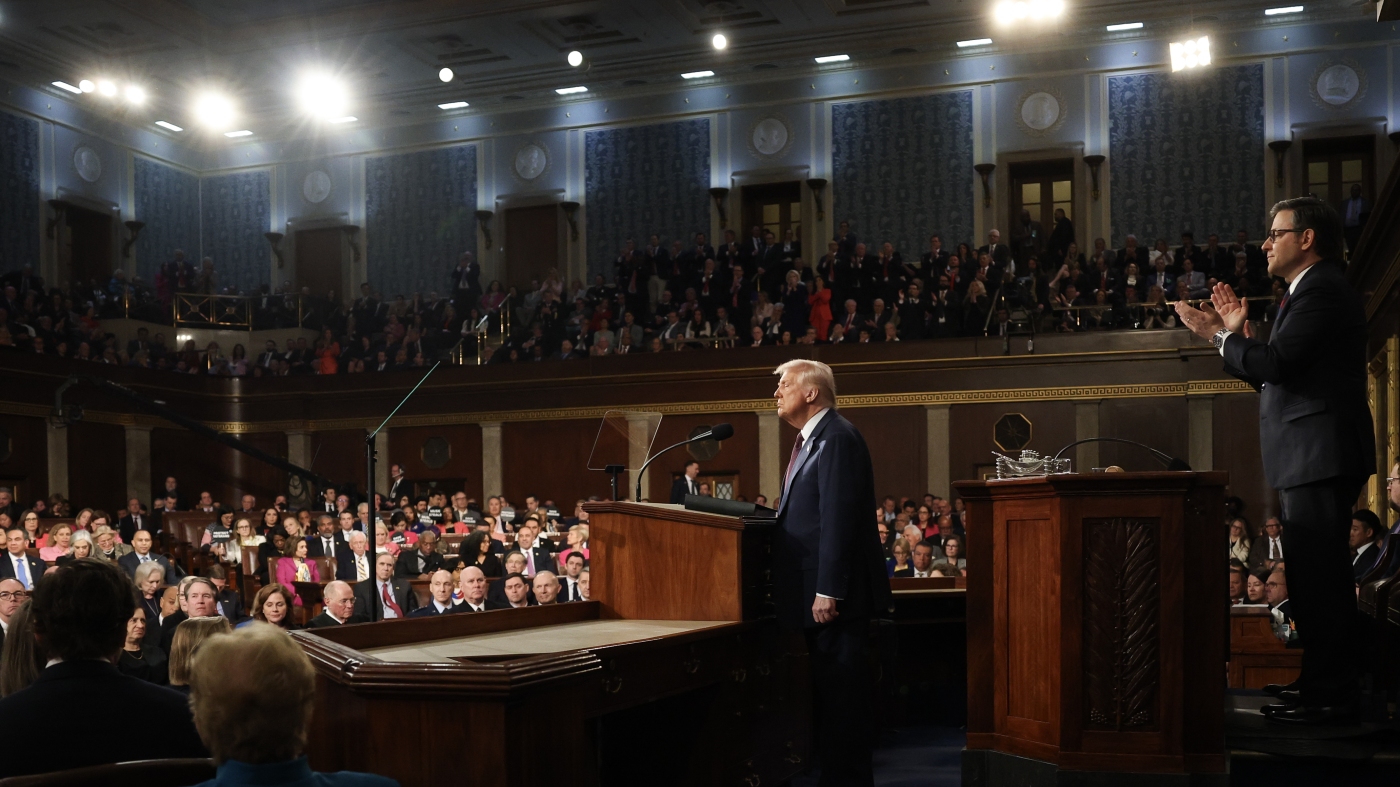
President Trump delivered his first address to a joint session of Congress on Tuesday night, six weeks into his second term, presenting a sweeping vision of his administration’s priorities and celebrating early policy victories while lambasting the previous administration’s record.
Speaking from the U.S. Capitol, Trump highlighted dramatic shifts in immigration policy, outlined economic plans, and defended controversial tariffs that have already triggered international retaliation. The speech offered a comprehensive look at his agenda after a flurry of executive actions that have rapidly reshaped federal priorities.
Border Security and Immigration
Trump claimed significant early success in reducing illegal border crossings, stating February’s numbers were “by far the lowest ever recorded.” While official figures haven’t been released, Reuters reported the administration is on track for approximately 8,500 arrests at the U.S.-Mexico border for February, potentially the lowest monthly total since the Department of Homeland Security began reporting such data in 2000.
“Within hours of taking the oath of office, I declared a national emergency on our southern border, and I deployed the U.S. military and border patrol to repel the invasion of our country,” Trump said.
The president pledged to oversee “the largest deportation operation in American history,” referencing 1954’s “Operation Wetback” under President Eisenhower, which forcibly removed over a million Mexican immigrants and some U.S. citizens. Immigration experts note that modern deportation efforts face significant logistical and capacity challenges.
Trump also promoted his proposed “gold card” initiative, which he said would allow “the most successful job creating people from all over the world to buy a path to U.S. citizenship” for $5 million. The plan would require congressional action to modify or replace the existing EB-5 immigrant investor visa program.
Economic Policy and Tariffs
Much of Trump’s speech focused on economic issues, particularly inflation, which he blamed on the Biden administration. “We inherited from the last administration an economic catastrophe and an inflation nightmare,” Trump said, calling it “the worst inflation in 48 years.”
While inflation peaked at 9.1% in 2022—the highest in 40 years, not 48—it has since moderated to 3% as of January 2024. Economic data shows the average worker now has more purchasing power than before the pandemic, with wages rising faster than prices for nearly two years.
Trump forcefully defended his administration’s recent tariff impositions on imports from Mexico, Canada, and China. “Tariffs are not just about protecting American jobs, about protecting the soul of our country. Tariffs are about making America rich again,” he said, promising they would generate “trillions of dollars and create jobs like we have never seen before.”
Hours before the speech, the administration announced new 25% tariffs on most imports from Mexico and Canada, along with an additional 10% tariff on Chinese goods. Both Canada and China have already announced retaliatory measures, with Mexico expected to follow suit in the coming days.
Department of Government Efficiency
Trump devoted significant time to discussing the newly created Department of Government Efficiency (DOGE), led by Elon Musk and Vivek Ramaswamy. The president claimed the initiative had already identified “hundreds of billions of dollars of fraud” in government spending.
In particular, Trump alleged “shocking levels of incompetence and probable fraud in the Social Security program,” claiming government databases list millions of impossibly old Social Security beneficiaries. However, a 2023 report from the Social Security Administration’s Office of the Inspector General clarified that nearly 19 million Social Security number-holders aged 100-plus in databases “almost none… currently receive SSA payments.”
Culture and Identity Issues
The president emphasized his early executive actions on cultural issues, stating: “I signed an order making it the official policy of the United States government that there are only two genders, male and female.”
He also called on Congress to pass legislation “permanently banning, criminalizing sex changes on children,” despite research showing that legal restrictions on transgender youth are associated with increased suicide attempts among this population.
Foreign Policy
On international affairs, Trump criticized U.S. support for Ukraine, claiming America has sent “hundreds of billions of dollars” for Ukraine’s defense. Most tracking indicates the actual figure is around $114 billion since Russia’s full-scale invasion began three years ago.
The president reiterated his withdrawal from the Paris Climate Agreement during his first term, calling it “unfair” and claiming it would have cost “trillions of dollars that other countries were not paying.”
The address came against a backdrop of significant Republican advantages, with the GOP controlling both chambers of Congress. However, the House and Senate have yet to align on how to implement Trump’s legislative agenda, particularly regarding border security funding and tax cuts.
As Trump concluded his remarks, he expressed optimism about the country’s direction, claiming “for the first time in modern history, more Americans believe that our country is headed in the right direction than the wrong direction.” Polling data suggests otherwise, with most recent surveys still showing more Americans believe the country is on the wrong track, despite improving numbers since the election.
Fact Checker
Verify the accuracy of this article using The Disinformation Commission analysis and real-time sources.

9 Comments
Tariffs and trade policy seem to be a key focus area for the administration. While the president is touting early successes, I’m curious to understand the longer-term impacts on industries like mining, manufacturing, and energy. Balanced assessments of the costs and benefits will be important.
You raise a good point. The effects of tariffs and trade actions can be complex, with both winners and losers. It will be crucial to look at the implications across different sectors and stakeholders to get a more complete picture.
The speech appears to signal a continued emphasis on economic nationalism and protectionist policies. While this may resonate with some voters, there are valid concerns about potential ripple effects on global trade and supply chains, which could impact the mining and energy industries.
The president’s ambitious agenda seems to cover a wide range of issues, from immigration to the economy. It will be important to closely scrutinize the claims and see how they hold up under further analysis. Fact-checking and objective assessment will be crucial going forward.
I agree, the NPR fact check provides a helpful starting point, but there’s likely more nuance and context to unpack around these policy initiatives. I look forward to seeing how independent analysis and reporting unfold.
Curious to see how the administration’s plans for reviving the coal industry and promoting fossil fuels will be received, especially in light of growing global momentum towards renewable energy and emissions reductions. A balanced, fact-based analysis of the energy policy proposals will be important.
Interesting to see the administration’s progress on border security and immigration. While the data hasn’t been officially released, if the reported numbers are accurate, that would be a significant early accomplishment. I’m curious to learn more about the specific policies and strategies driving this change.
While the speech outlines an ambitious agenda, it’s important to remember that execution and implementation will be key. I look forward to seeing how these policies and initiatives play out in the coming months and years, with a critical eye towards empirical evidence and balanced assessment.
The president’s claims about reducing illegal border crossings are noteworthy, but it will be crucial to verify the accuracy of the data once officially released. Objective analysis of the immigration and border security policies is needed to assess their true impact.