


Listen to the article
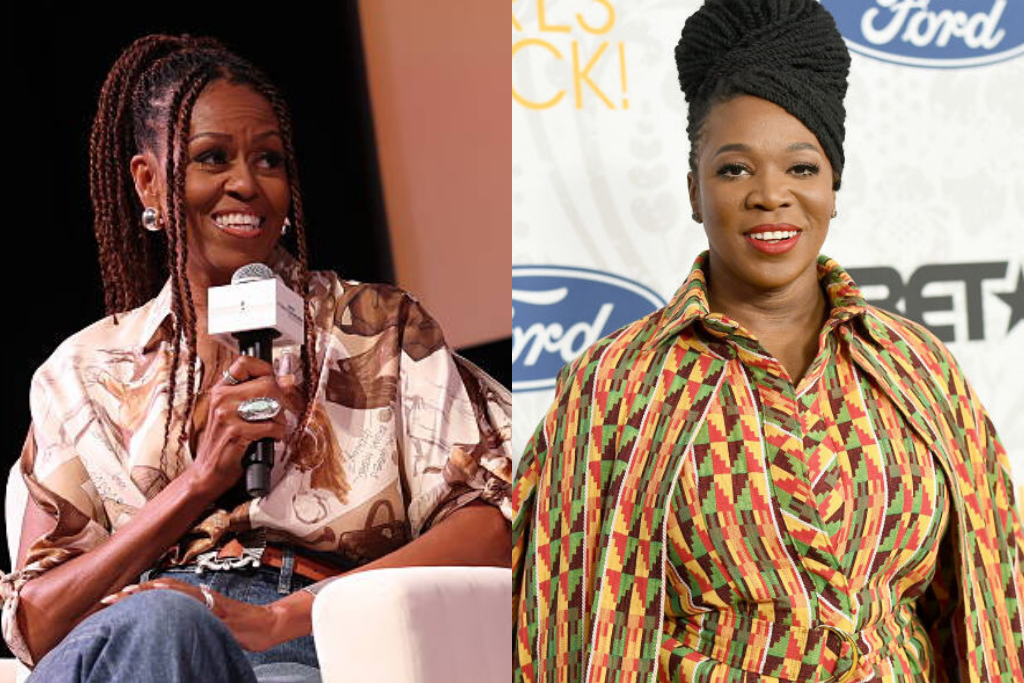
India Arie Defends Michelle Obama’s Comments on Black Hair and Assimilation
Grammy-winning singer-songwriter India Arie joined a heated online debate yesterday, defending former First Lady Michelle Obama’s comments about Black women straightening their hair to conform to white beauty standards.
The controversy erupted after Obama, currently promoting her new book “The Look,” spoke candidly during a conversation with actress Tracee Ellis Ross about the politics of Black women’s hair choices.
“Let me explain something to white people. Our hair comes out curly. When we straighten it to follow your beauty standards, we are trapped by the straightness,” Obama stated during the event. “That’s why so many of us can’t swim, won’t go to the gym because we’re trying to keep our hair straight for y’all!”
Obama’s remarks, which explored how fashion and beauty influenced her political career, quickly sparked debate across social media platforms. One user on Threads, identified as Chanel Coco, posted a rebuttal that went viral.
“Dear Michelle Obama, newsflash black women do not straighten their hair because of white peoples beauty standards,” the user wrote. “As a Curly natural myself most black women straighten their hair because they choose to and it’s easier to manage for them. Let’s drop this narrative that we do anything for the white beauty standard, black women are the true beauty standard.”
The post drew widespread criticism from users who pointed out that Black women of Obama’s generation often straightened their hair specifically to avoid discrimination in professional and public settings. Many emphasized that the acceptance of natural Black hair styles in workplaces and formal environments is a relatively recent cultural shift.
India Arie, whose 2006 hit “I Am Not My Hair” directly addressed these issues, entered the conversation after being repeatedly tagged in the thread. The four-time Grammy winner took to social media to defend Obama’s perspective while acknowledging the generational differences at play.
“I want to thank everybody in these comments who is trying to educate this woman,” Arie wrote on X. “I did my 25 year bid of trying to help people awaken. Maybe the path we layed made it too easy to walk down.”
Arie suggested that younger Black women may not fully appreciate the struggles of previous generations who fought for the acceptance of natural hair. “There LITERALLY IS no curl specialist job without the path we laid for you,” she emphasized, noting how the natural hair movement created opportunities now taken for granted.
The exchange between Arie and the original poster grew increasingly tense, with Chanel Coco claiming she had never heard of the influential singer before. Arie remained steadfast in her position that it was the work of artists and activists like herself who created space for younger Black women to wear their natural hair without fear of repercussions.
After reflection, Arie returned to Threads today with a more conciliatory tone. “I slept on this and I realized – I responded out of my LOVE for black women. – her too,” she wrote. “BUT! Tough love only has a CHANCE at working if the person knows you love them.”
The debate highlights ongoing conversations about Black beauty standards, cultural assimilation, and the historical context of hair politics. Obama’s book “The Look” addresses these complex intersections of personal style and political identity, examining how her fashion and beauty choices were scrutinized throughout her time in the White House.
For many Black women, particularly those who came of age before the natural hair movement gained mainstream acceptance in the 2000s, hair straightening was often considered necessary for professional advancement and social acceptance – a reality that younger generations may experience differently in today’s more inclusive beauty landscape.
Fact Checker
Verify the accuracy of this article using The Disinformation Commission analysis and real-time sources.

6 Comments
This is a complex issue that deserves careful consideration. I appreciate the nuanced discussion around the multiple factors that influence Black women’s hair choices. There’s clearly room for diverse perspectives on this topic.
I appreciate Michelle Obama’s candid remarks on this sensitive topic. She’s right that hair choices can be influenced by societal pressures, even if unintentional. Hopefully this sparks more open dialogue about embracing diverse beauty standards.
Kudos to India Arie for providing historical context around this debate. Exploring the deeper cultural and social dynamics is crucial to fully understanding the politics of Black hair.
Interesting discussion on the politics of Black hair. While beauty standards do play a role, there are many personal and practical reasons why Black women may choose to straighten their hair. It’s a complex issue with nuanced cultural and historical context.
This is a thought-provoking discussion. While I respect Michelle Obama’s perspective, I can also understand the view that hair straightening is not solely driven by white beauty standards. There are many complex factors at play.
The debate around Michelle Obama’s comments highlights how personal hair decisions can be for Black women. I don’t think there’s a one-size-fits-all answer, as individual preferences and experiences vary widely. It’s an important conversation to have.