


Listen to the article
In the aftermath of the Bondi Beach terror attack, social media has become a breeding ground for misinformation about the perpetrators, with innocent individuals falsely linked to the tragedy that claimed at least 15 lives.
Australian authorities have confirmed the actual identities of the two gunmen as Sajid Akram, 50, and his son Naveed Akram, 24. The father-son pair opened fire at a Jewish event in a beachside park on December 14, 2025. Sajid was killed by police during the attack, while Australian-born Naveed remains hospitalized.
Despite these official identifications, numerous false claims about the attackers have spread rapidly across social media platforms, dragging uninvolved individuals into the controversy and potentially endangering their safety.
In one widely shared Facebook post, an image of a man wearing a Pakistan cricket jersey was displayed alongside a photo of Naveed Akram, with text claiming the individual was one of the shooters. A reverse image search revealed the man in the jersey had no connection to the attack. The photo was taken from his private Facebook profile posted in 2019.
The wrongfully identified man has since made public statements denying any involvement. “This photo being circulated is NOT the person involved in the Bondi incident,” he wrote. “That is me, and I am completely innocent and have no connection whatsoever to what happened.” He expressed concern that the false association was putting his “safety, reputation, and well-being at risk.”
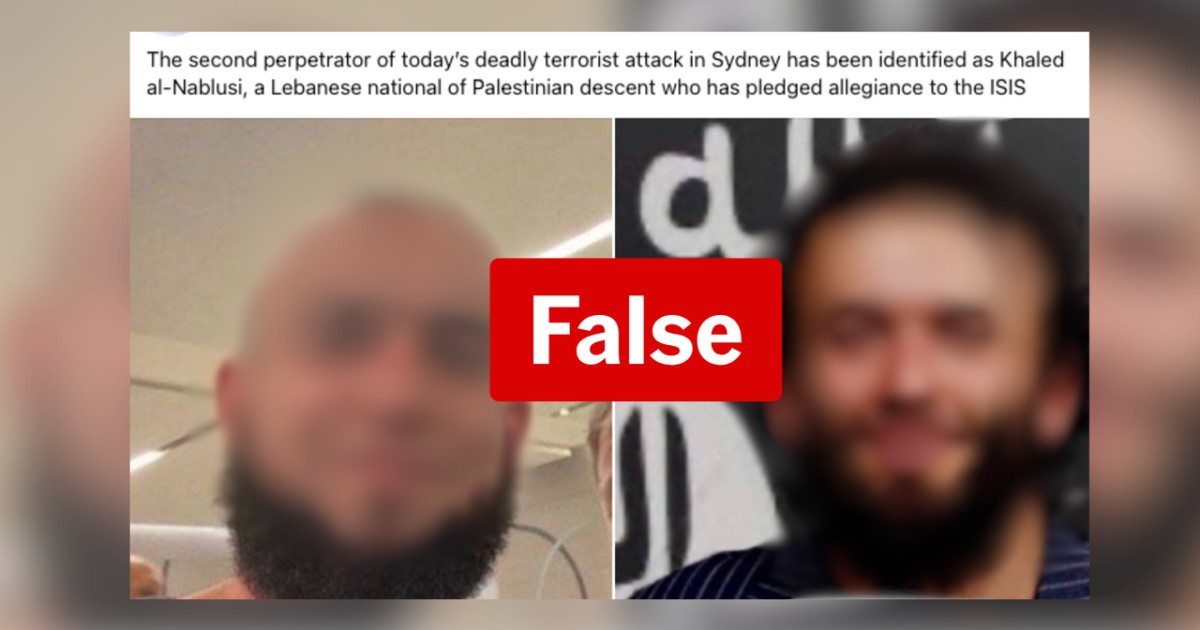
Another fabrication circulating online involves images of a supposed attacker named “Khaled al-Nablusi,” described as “a Lebanese national of Palestinian descent.” The same images had previously been used in false reports about an unrelated incident at a U.S. Army base in August 2025. Analysis shows these are manipulated photographs of a writer whose images were published in an online magazine, with a beard digitally added to alter his appearance.
Perhaps most disturbing is the emergence of a completely fabricated identity claiming one of the gunmen is actually “David Cohen,” an Israeli Jew. Posts supporting this false narrative include screenshots of what appears to be a Facebook profile, but examination reveals telltale signs of artificial generation, including misspelled navigation tabs like “Eeopis” instead of “Photos,” and buttons reading “Ernsage” rather than “Add friend.” A supposed photo of the fictional Cohen at a bar mitzvah shows clear signs of manipulation.
These attempts to spread disinformation about the Bondi Beach attack demonstrate the growing challenge of separating fact from fiction in crisis situations. Law enforcement officials have repeatedly confirmed that Naveed Akram is Australian-born, with no evidence suggesting Israeli or Jewish connections as falsely claimed.
Social media platforms continue to struggle with the rapid proliferation of such falsehoods, which can heighten tensions and potentially lead to reprisal attacks against innocent communities. The false identification of individuals following violent incidents remains a persistent problem that can cause substantial harm to those wrongfully accused.
Authorities are urging the public to rely on official sources for information about the attack as the investigation continues, and to refrain from sharing unverified claims that could further complicate an already tragic situation.
Fact Checker
Verify the accuracy of this article using The Disinformation Commission analysis and real-time sources.

8 Comments
False accusations can have devastating consequences, even for those completely uninvolved. I hope the authorities quickly identify the actual perpetrators and the public exercises more caution when sharing sensitive information online.
This highlights the urgent need for better digital literacy and media awareness. We must all be more critical consumers of online information to prevent the further spread of misinformation.
It’s disturbing to see how quickly false claims can spread on social media, with potentially devastating consequences for uninvolved individuals. Improved fact-checking and accountability are clearly needed.
The rush to share unverified information, even with good intentions, can do real harm. I hope the authorities are able to quickly identify and address the actual perpetrators, and the public becomes more cautious about spreading sensitive claims.
Social media can be a powerful tool, but also a breeding ground for dangerous misinformation. Fact-checking and responsible reporting are essential to prevent innocent people from being unfairly targeted.
This is a concerning case of misinformation causing harm. It’s crucial that authorities provide accurate information and the public verifies claims before spreading them, to avoid putting innocent people at risk.
Spreading unverified claims about the identities of suspects is deeply irresponsible and can endanger innocent lives. I hope the public learns from this incident to be more discerning about online information, especially around sensitive events.
You’re absolutely right. Verifying facts before sharing should be the standard, especially for sensitive topics like this.