


Listen to the article
Somalia-Somaliland-Israel Diplomatic Row Intensifies
Somaliland has firmly denied allegations that it agreed to host Israeli military facilities or resettle Palestinian refugees from Gaza as part of a diplomatic recognition deal with Israel. In an official statement, Somaliland’s Ministry of Foreign Affairs characterized its engagement with Israel as “purely diplomatic” and conducted “in full respect of international law.”
The denial comes in direct response to claims made by Somalia’s President Hassan Sheikh Mohamud in an interview with Al Jazeera. President Mohamud alleged that Somaliland had accepted multiple conditions from Israel, including the resettlement of Palestinians, the establishment of an Israeli military base along the strategically important Gulf of Aden, and joining the Abraham Accords—a series of normalization agreements between Israel and several Arab states brokered by the United States in 2020.
Somaliland officials insist no discussions have occurred regarding Palestinian resettlement or military bases, though they have publicly acknowledged plans to join the Abraham Accords framework. This diplomatic initiative has significantly raised tensions in the Horn of Africa, where Somalia continues to claim sovereignty over Somaliland despite the latter’s de facto independence since 1991.
Israeli Prime Minister Benjamin Netanyahu confirmed earlier this week that Somaliland would indeed join the Abraham Accords. Speaking to US media outlet Newsmax, Netanyahu framed the relationship as Israel extending support to “a democratic, moderate country” willing to participate in the normalization agreement.
The diplomatic relationship appears to be moving forward rapidly. According to Israel’s public broadcaster Kan, Somaliland President Abdurrahman Mohamed Abdullahi, commonly known as “Cirro,” is expected to visit Israel in the coming weeks to formally join the Abraham Accords.
Regional security experts suggest Israel’s interest in recognizing Somaliland may be strategically motivated. The self-declared republic occupies a critical geographic position near the Bab el-Mandeb Strait, a vital shipping lane connecting the Red Sea to the Gulf of Aden. This location places Somaliland directly across from Yemen, where Houthi forces have recently targeted commercial shipping in solidarity with Palestinians in Gaza.
Somalia’s president has warned that Israel’s recognition of Somaliland serves as a cover for broader strategic objectives and could potentially destabilize the entire Horn of Africa region. The diplomatic move has already triggered widespread protests across Somalia, with demonstrations reported on December 30 in Mogadishu, Baidoa, Dhusamareb, and other major cities.
International organizations have responded cautiously to the developing situation. Both the African Union and the European Union have issued statements reiterating that Somalia’s territorial integrity should be respected, implicitly rejecting Israel’s unilateral recognition of Somaliland.
Despite international concerns, Somaliland’s leadership appears emboldened by Israel’s recognition. President Cirro has indicated that more nations will soon recognize the breakaway region, which has maintained its own functioning government, currency, and military for over three decades without widespread international recognition.
The diplomatic tension unfolds against the backdrop of Israel’s ongoing military operations in Gaza following the October 7 Hamas attacks, adding another layer of complexity to an already volatile situation. For Somaliland, recognition by Israel represents a potential breakthrough in its long-standing quest for international legitimacy, while for Somalia, it constitutes an unacceptable violation of its claimed sovereignty.
As this diplomatic crisis develops, the strategic implications for maritime security, regional stability, and the broader geopolitical landscape of the Horn of Africa remain significant concerns for regional and international stakeholders alike.
Fact Checker
Verify the accuracy of this article using The Disinformation Commission analysis and real-time sources.

9 Comments
This is an interesting geopolitical development in the Horn of Africa. It’s important to get the facts straight, as misinformation can easily spread on social media. I’m curious to see how the diplomatic situation between Somalia, Somaliland, and Israel evolves going forward.
Absolutely. Reliable information is crucial, especially on sensitive international affairs. It will be worth following updates from official government sources to understand the true nature of any agreements or plans.
The diplomatic maneuvering between Somalia, Somaliland, and Israel is certainly complex. While Somaliland may have plans to join the Abraham Accords, the allegations of hosting military facilities or resettling Palestinians seem far-fetched without substantive evidence. Maintaining transparency is key.
The claims of Somaliland hosting Israeli military facilities or resettling Palestinian refugees seem quite extraordinary, if unsubstantiated. I appreciate the Somaliland government’s clear denial and emphasis on conducting diplomatic relations in line with international law.
Yes, the denial provides an important clarification. Verifying facts is so important when dealing with high-stakes geopolitical issues that could have significant regional implications.
This is a sensitive geopolitical issue that requires nuanced understanding. I appreciate the Somaliland government’s clear position on the nature of their engagement with Israel. Fact-based reporting and official statements are crucial to avoid escalating tensions in the region.
Agreed. Careful analysis of the facts, rather than unsubstantiated claims, is essential when it comes to complex international relations, especially in volatile regions like the Horn of Africa.
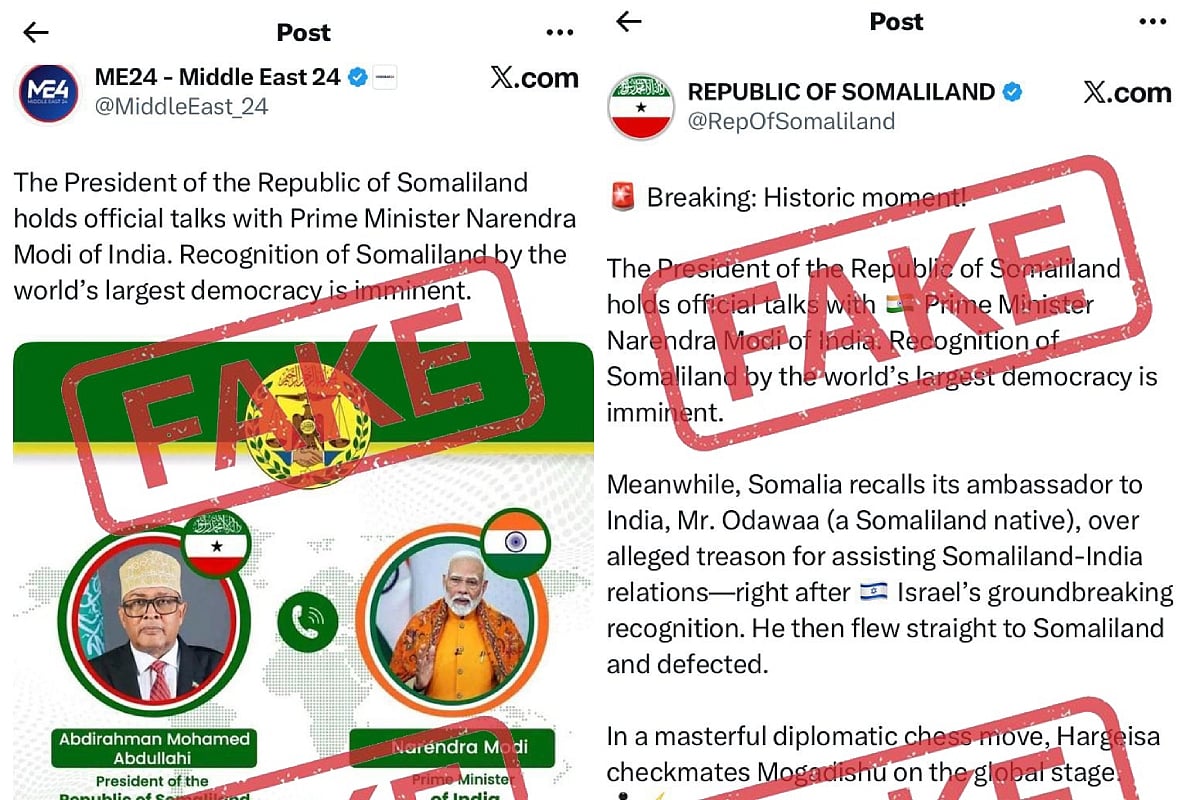
This appears to be another case of misinformation spreading rapidly on social media. It’s good to see the Indian government swiftly refuting the claims about recognizing Somaliland. Fact-checking and official statements are crucial to counter the proliferation of false narratives.
The denial by India’s Ministry of External Affairs regarding the recognition of Somaliland is a prudent step. Verifying information and countering the spread of misinformation on social media platforms is an important responsibility for governments. Maintaining transparency and sticking to the facts is crucial in these situations.