


Listen to the article
Indian Religious Procession Misrepresented as Nuclear Warhead Worship on Social Media
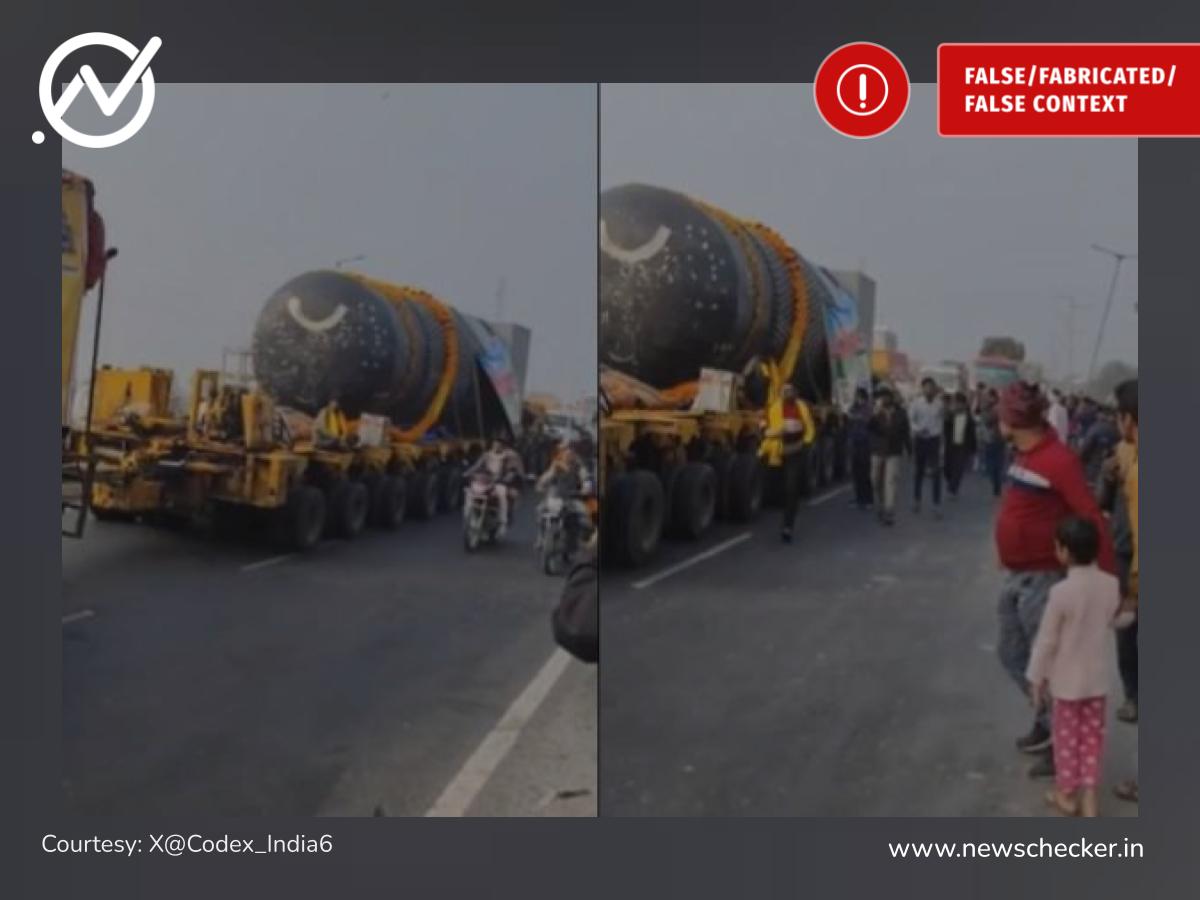
A viral video showing a large religious procession in India has sparked controversy after being falsely presented as Indians worshipping a nuclear warhead. The misleading claim, which suggested the object was a weapon built to counter China and Pakistan, has generated significant reactions across social media platforms.
The widely-shared footage shows crowds gathering around a large object being transported on a vehicle. Social media accounts, including one identified as @Codex_India6, helped propagate the false narrative by sharing the video with provocative captions suggesting military implications.
Upon closer examination, the video clearly displays a text overlay reading “World’s Largest Shivling,” contradicting the nuclear warhead claim. A Shivling is a sacred symbol representing Lord Shiva in Hinduism and holds profound religious significance for millions of devotees.
India’s prominent news agency ANI confirmed the true nature of the procession in a post dated January 4, 2026. According to their report, the object is indeed the world’s largest Shivling, which was being transported from Tamil Nadu in southern India to Gopalganj in Bihar, northern India. The Shivling was en route to its final destination at the Virat Ramayan Temple in Motihari, Bihar.
Visual comparison between the viral clip and ANI’s verified footage confirms they depict the same religious procession. The large crowds visible in both videos are devotees participating in what is essentially a religious event, not a military display.
Further corroboration came from mainstream media outlet Aaj Tak, which reported on January 6, 2026, that the Shivling had successfully reached Motihari. Their coverage included visuals matching those in the viral video, definitively debunking the nuclear warhead narrative.
This incident highlights the growing challenge of misinformation on social media platforms, where religious and cultural events are sometimes deliberately mischaracterized to create division or stoke geopolitical tensions. In a region where relations between India, Pakistan, and China remain sensitive, such false claims can potentially inflame existing tensions.
India does possess nuclear capabilities, as do its neighbors Pakistan and China, but the country’s nuclear program remains under strict civilian control and military oversight. Public displays of nuclear weapons would contradict India’s stated nuclear doctrine and international commitments.
Religious processions featuring sacred objects are common across India, where public expressions of faith often draw large crowds. The transport of significant religious artifacts between temples or to new religious sites typically involves elaborate ceremonies and community participation.
The Virat Ramayan Temple project in Motihari represents one of several major temple developments currently underway in India. Religious tourism has become an increasingly important economic sector in many parts of the country, with state governments often supporting the development of religious sites and facilitating the transport of sacred objects.
Fact-checkers and media outlets continue to play a crucial role in identifying and correcting such misinformation, particularly when it intersects with sensitive geopolitical issues or religious sentiments. This case serves as a reminder of the importance of verifying claims before sharing content on social media, especially when the subject matter involves national security implications or religious symbolism.
Fact Checker
Verify the accuracy of this article using The Disinformation Commission analysis and real-time sources.

7 Comments
The world’s largest Shivling is quite a sight to behold! It’s understandable how it could be mistaken for something else, but I’m glad the true nature of this religious procession was clarified.
Interesting to see how a religious ceremony can be misconstrued as a military display. Fact-checking is so important to avoid perpetuating false narratives, even inadvertently. Cultural context is key.
This is a good example of how videos can be easily misrepresented online. Fact-checking is crucial to avoid perpetuating false narratives, even unintentionally. Religious and cultural symbols deserve to be respected.
Glad the true nature of this procession was clarified. It’s concerning how easily something can be taken out of context and spun into a misleading story these days. We should be more cautious about jumping to conclusions.
This case shows the importance of verifying information, especially around sensitive geopolitical issues. Social media can amplify misinformation quickly, so we must be vigilant in separating fact from fiction.
The world’s largest Shivling being transported is quite impressive, even if it was mistaken for a nuclear warhead at first. India has a rich cultural heritage that deserves to be accurately portrayed.
Interesting how social media can spread misinformation so quickly. It’s important to verify claims, especially around sensitive topics like nuclear weapons. The video appears to depict a religious ceremony, not a military display.