


Listen to the article
The International Criminal Court (ICC) has not reversed its decision to reject former Philippine President Rodrigo Duterte’s request for interim release, despite claims circulating widely on social media platforms suggesting otherwise.
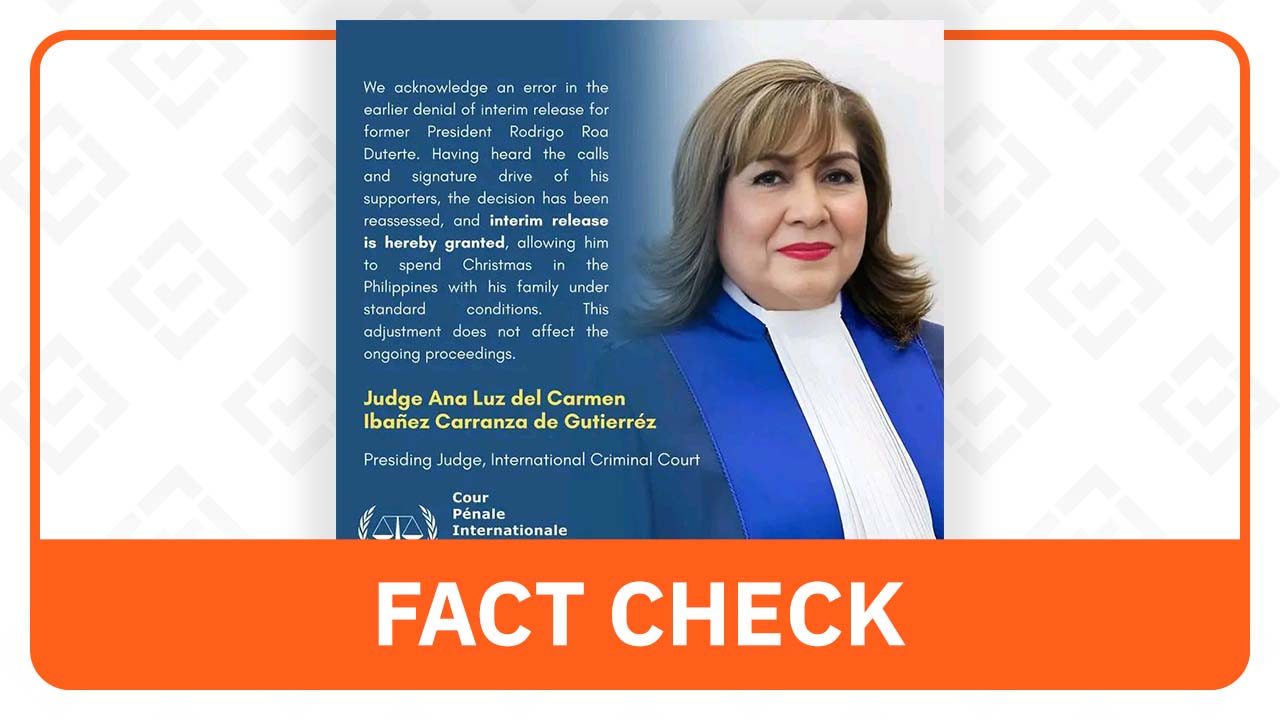
Misinformation began spreading across Facebook when several accounts, including one user named Kathy Poqueco, shared a fabricated quote card claiming the ICC had reconsidered its November 28 decision. The post, which garnered over 3,000 reactions and hundreds of shares, featured a purported statement from an ICC judge named “Ana Luz del Carmen Ibañez Carranza de Gutierréz.”
According to the fabricated statement, the ICC allegedly acknowledged “an error in the earlier denial” and granted Duterte interim release “allowing him to spend Christmas in the Philippines with his family under standard conditions.” The post claimed this decision came after “hearing the calls and signature drive of his supporters.”
Legal experts have categorically dismissed these claims. The appeals chamber’s rejection of Duterte’s interim release request on November 28 stands as the final judgment, as there is no higher court within the ICC’s judicial hierarchy. ICC assistant to counsel Kristina Conti clarified in an interview with News5 that there is no provision for a motion for reconsideration in ICC procedures.
While Duterte’s legal team could technically file another request for interim release, Conti emphasized it would need to be based on entirely new grounds or developments not included in the original petition – not simply a reassessment of the previous decision as falsely claimed in the viral posts.
The fabricated quote card contained several obvious errors that exposed its inauthenticity. The photograph purportedly showing the ICC presiding judge does not match any official on the ICC’s website. Though bearing some resemblance to Appeals Chamber Judge Luz del Carmen Ibáñez Carranza, the facial features differ noticeably, with some social media users pointing out similarities to Filipino actress Annabelle Rama instead.
Additionally, the fake post incorrectly modified Judge Ibáñez Carranza’s name, adding “Ana” at the beginning and “de Gutierréz” at the end – neither of which appear in her official ICC designation.
The misinformation campaign appears to have emerged as a direct response to the ICC appeals chamber’s November 28 decision, which definitively rejected Duterte’s plea for interim release. In that request, Duterte’s legal team had cited his age and “proven weak state of mental and physical health” as justifications for allowing him to participate in trial proceedings outside the ICC detention center.
The appeals chamber acknowledged that humanitarian considerations were weighed but determined they “were not sufficiently set out in the case at hand.” The judges further concluded that the risks associated with Duterte’s temporary freedom could not be adequately mitigated by the proposed conditions.
The circulation of these false claims highlights the ongoing tensions surrounding the ICC’s investigation into allegations related to Duterte’s controversial war on drugs campaign during his presidency, which human rights organizations claim resulted in thousands of extrajudicial killings.
The ICC prosecutor’s office continues to investigate these allegations despite the Philippine government’s formal withdrawal from the Rome Statute in 2019, maintaining jurisdiction over crimes allegedly committed while the country was still a member state.
Fact Checker
Verify the accuracy of this article using The Disinformation Commission analysis and real-time sources.

7 Comments
This is a concerning case of misinformation spreading on social media. The ICC’s decision to reject Duterte’s request for interim release is final and should not be misrepresented. It’s important to rely on authoritative legal sources when reporting on such matters.
The ICC’s rejection of Duterte’s interim release request is a significant development in this case. It’s crucial that the public has access to accurate information from credible sources, rather than falling victim to fabricated claims circulating online.
Agreed. Fact-checking and verifying information from legitimate authorities is essential, especially for high-profile legal cases like this. Spreading misinformation can undermine the integrity of the judicial process.
While it’s understandable that Duterte’s supporters would want him to be released, the ICC’s decision must be respected. The judicial system needs to be allowed to operate without the interference of false claims or undue public pressure.
This case highlights the importance of maintaining the independence and impartiality of international courts like the ICC. Fabricated stories that misrepresent their rulings should be swiftly debunked to protect the integrity of the legal process.
Absolutely. The public deserves to have access to accurate, fact-based information about high-profile legal cases, not misleading claims that can sow confusion and undermine trust in the justice system.
It’s concerning to see such blatant misinformation spreading about the ICC’s decision on Duterte’s interim release request. Fact-checking and reliable reporting are crucial in these situations to uphold the rule of law.