


Listen to the article
Fake Photo of Trump Supporter’s Shirt Circulates Amid Epstein Document Release
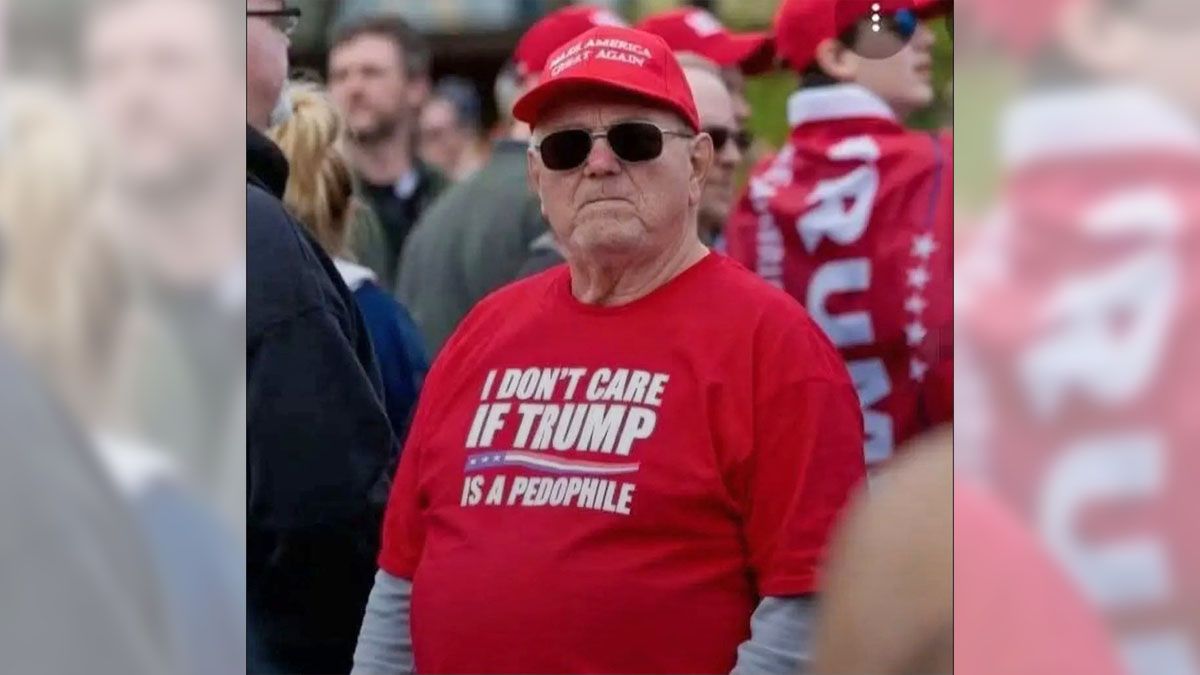
A digitally altered photograph claiming to show a Trump supporter wearing an inflammatory T-shirt has been debunked as fabricated. The manipulated image, which began circulating on social media platforms in November 2025, depicted a man in a red “Make America Great Again” cap wearing a shirt with the text: “I don’t care if Trump is a pedophile.”
The doctored image spread rapidly across multiple social media platforms, including Facebook, Instagram, Reddit, Threads, and X (formerly Twitter). One user shared the image with the caption “It is not a cult,” apparently criticizing the perceived blind loyalty of Trump supporters.
However, a reverse-image search using Google Lens revealed the original, unaltered photograph on Flickr. The authentic image, captured by photographer Lorie Shaull on October 4, 2018, shows the man actually wearing a “Trump Pence 2020” shirt with the slogan “Keep America Great!” beneath it. Shaull documented the scene as the supporter waited to enter a Trump rally at the Mayo Civic Center in Rochester, Minnesota. She uploaded this and several other photos from the same event the following day.
The timing of the fake image’s circulation appears deliberately aligned with politically charged developments. The manipulated photo gained traction immediately following the November 12 release of over 20,000 documents related to convicted sex offender Jeffrey Epstein by the U.S. House Committee on Oversight and Government Reform.
Among these documents were emails that mentioned former President Donald Trump. Democratic members of the committee highlighted three specific emails, including one claiming Trump “knew about the girls.” Another email from Epstein to Ghislaine Maxwell—who was later convicted of sex trafficking—alleged that Trump “spent hours” at Epstein’s house with a sex-trafficking victim.
The White House responded strongly to these revelations. Press Secretary Karoline Leavitt told Snopes: “The Democrats selectively leaked emails to the liberal media to create a fake narrative to smear President Trump.”
The relationship between Trump and Epstein has been the subject of previous reporting and fact-checking. Trump was quoted in 2002 describing Epstein as a “terrific guy,” adding: “He’s a lot of fun to be with. It is even said that he likes beautiful women as much as I do, and many of them are on the younger side.”
This incident underscores the increasing prevalence of manipulated media in political discourse. As the House Oversight Committee continues to release documents related to Epstein, the digital manipulation of images represents a concerning trend in how political opponents attempt to influence public opinion through fabricated visual “evidence.”
The rapid spread of the doctored image across multiple platforms demonstrates the challenges of maintaining factual integrity in today’s digital information ecosystem, particularly during politically sensitive moments. While the original photo documented a supporter at a legitimate political rally, the altered version attempted to create a false narrative about Trump supporters’ attitudes toward serious allegations.
Fact-checking resources like reverse image searches proved crucial in identifying this manipulation, highlighting the importance of verification tools as digital deception becomes increasingly sophisticated in political contexts.
Fact Checker
Verify the accuracy of this article using The Disinformation Commission analysis and real-time sources.

7 Comments
The rapid spread of this fabricated image is concerning. It’s a good example of the need for media literacy and fact-checking skills to combat the rise of online misinformation.
Interesting to see how quickly misinformation can spread online, even with doctored images. It’s a good reminder to always verify the source and context of content before sharing.
The doctored photo is a clear attempt to mislead and inflame tensions. It’s encouraging to see it was quickly debunked, but it’s troubling how easily such content can go viral.
This incident underscores the challenges we face in an era of digital manipulation and rapid information sharing. Staying vigilant and verifying sources is key to combating the spread of misinformation.
Well said. Fact-checking and critical thinking are essential skills in today’s media landscape.
Agreed. We must all be more discerning consumers of online content to prevent the further spread of falsehoods.
This highlights the importance of critical thinking and fact-checking, especially when it comes to politically-charged content. Kudos to the photographer for capturing the authentic scene.