


Listen to the article
U.S. Military Captures Venezuelan President Maduro in Surprise Operation
In a dramatic escalation of U.S.-Venezuela relations, President Donald Trump announced Saturday that American forces have captured Venezuelan President Nicolás Maduro and his wife, Cilia Flores, both of whom face U.S. charges related to cocaine trafficking under newly unsealed indictments.
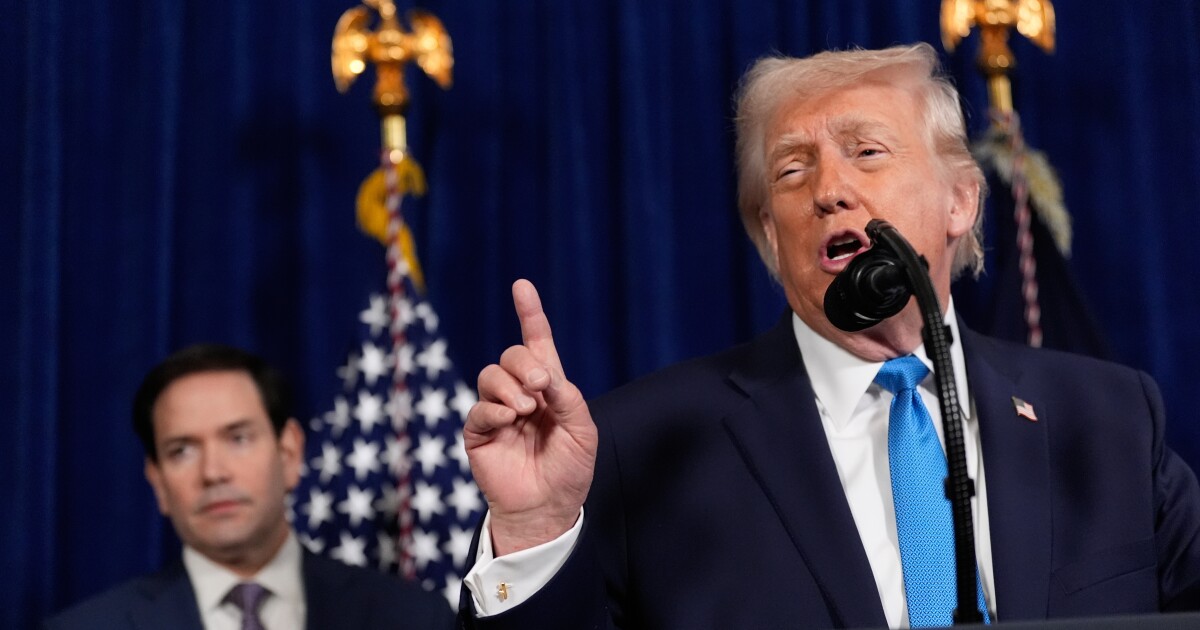
During a press conference at Mar-a-Lago, Trump declared that the United States would “run the country until such time as we can do a safe, proper and judicious transition” in Venezuela, marking an extraordinary intervention in the affairs of a sovereign nation.
The operation came without prior congressional notification, raising concerns about executive overreach among Democratic lawmakers. While Senate Majority Leader John Thune praised the mission as “decisive action,” Sen. Tim Kaine criticized it as an “unauthorized attack” that put American service members at risk.
Trump claimed Venezuelan Vice President Delcy Rodríguez had been sworn in as interim president and was “essentially willing to do what we think is necessary to make Venezuela great again” after speaking with Secretary of State Marco Rubio. However, in a contradictory development, Rodríguez appeared on Venezuelan state television denouncing the U.S. military action as “brutal aggression” and demanded Maduro’s immediate release.
The capture follows Venezuela’s disputed July 2024 election, which Maduro declared himself the winner of despite international observers describing it as fraudulent. Opposition candidate Edmundo González Urrutia reportedly received about 70% of the vote according to independent assessments.
Relations between Washington and Caracas have deteriorated significantly in recent months. Since September, the Trump administration has conducted strikes against vessels off Venezuela’s coast, killing approximately 115 people in what Trump characterized as anti-drug trafficking operations. The president claimed each boat carried drugs that would kill “on average, 25,000 people,” though experts note this figure vastly exceeds plausible estimates and that Venezuela plays only a minor role in drug trafficking to the United States.
When asked about opposition leader Maria Corina Machado, who recently won the Nobel Peace Prize for her democracy advocacy, Trump dismissed her importance, claiming she “doesn’t have the support or the respect within the country.” This statement contradicts polling data showing Machado enjoys a 72% approval rating among Venezuelans according to a March survey by ClearPath Strategies.
Trump asserted without evidence that American governance of Venezuela “won’t cost us anything” because U.S. oil companies would invest in the country’s petroleum infrastructure, adding, “It’s going to make a lot of money.” He also made unsubstantiated claims that Venezuela had previously “stolen” U.S. oil, though experts note that Venezuela’s 1975 nationalization of its oil industry included compensation for American companies and was relatively uncontroversial at the time.
The military operation appears to have bypassed established legal protocols. Under the 1973 War Powers Resolution, presidents must report to Congress within 48 hours of introducing U.S. military into hostilities, and no congressional authorization for military force in Venezuela exists. The Trump administration has progressively reduced prior notification requirements for military operations, previously informing only Republican lawmakers about strikes on Iranian nuclear facilities in June 2025.
Trump also claimed without evidence that Maduro had “sent savage and murderous gangs, including the bloodthirsty prison gang Tren de Aragua, to terrorize American communities nationwide.” This assertion contradicts an April report from the federal National Intelligence Council, which stated, “While Venezuela’s permissive environment enables (Tren de Aragua) to operate, the Maduro regime probably does not have a policy of cooperating with TDA and is not directing TDA movement to and operations in the United States.”
The capture of Maduro represents one of the most significant U.S. military interventions in Latin America in decades and raises profound questions about international law, sovereignty, and America’s role in regime change operations abroad. The situation continues to develop as regional powers and international organizations assess their responses to this unprecedented action.
Fact Checker
Verify the accuracy of this article using The Disinformation Commission analysis and real-time sources.

18 Comments
This appears to be a significant escalation of US involvement in Venezuela’s internal affairs. I’m curious to hear more about the legal and diplomatic justifications the administration is using to support this action.
Yes, the claims about Maduro’s involvement in drug trafficking are serious, but unilateral military intervention raises a lot of questions about national sovereignty and international law.
While I share the administration’s concerns about the Maduro regime’s human rights abuses and economic mismanagement, I’m deeply worried that this unilateral military intervention will only exacerbate the crisis in Venezuela. We need a comprehensive, multilateral approach to address the country’s challenges.
Absolutely. The US should be working closely with regional partners, the UN, and other international bodies to find a peaceful, negotiated solution that respects Venezuelan sovereignty and self-determination. Anything less risks turning this into a dangerous proxy conflict with unpredictable consequences.
This news raises a lot of troubling questions about the legality and strategic rationale behind the US’s actions in Venezuela. I hope Congress and the international community will scrutinize this operation closely and hold the administration accountable.
Agreed. The lack of transparency and apparent disregard for due process is very concerning. The administration needs to provide a clear and compelling justification for this intervention, or risk damaging America’s global standing.
The details in this report raise a lot of red flags. Capturing a foreign leader without congressional approval sets a dangerous precedent that could undermine the US’s standing and credibility on the global stage.
Absolutely. This move seems more like a unilateral power grab than a carefully considered foreign policy decision. The administration will need to provide a lot more justification to convince me this was the right call.
Interesting to see the details on this controversial operation. While the capture of Maduro may achieve some short-term goals, the long-term implications for regional stability and US-Venezuela relations remain unclear.
I agree, this seems like a risky move that could further inflame tensions. The lack of congressional approval is also concerning from a checks-and-balances perspective.
While I’m no fan of Maduro’s regime, I’m skeptical that a US-led transition is the best path forward for Venezuela. This seems like it could backfire and deepen the country’s political and economic crises.
Agreed. The administration should tread carefully here and work closely with regional partners and international bodies to find a sustainable solution that respects Venezuela’s self-determination.
As an American, I’m deeply concerned about the implications of this operation. While Maduro’s rule has been disastrous for Venezuela, I don’t believe US military intervention is the answer. We need to explore diplomatic solutions that respect Venezuelan sovereignty.
I agree. The US should work through established international institutions and regional partners to address the crisis in Venezuela, not act unilaterally. Anything less risks further destabilizing the country and the broader region.
While I understand the administration’s desire to address the humanitarian crisis in Venezuela, I’m deeply skeptical that unilateral US military action is the right approach. This could easily backfire and make the situation even worse.
Absolutely. The US should be working through the UN, the OAS, and other multilateral bodies to find a peaceful, negotiated solution that respects Venezuela’s sovereignty and self-determination. Anything less risks turning this into a dangerous proxy conflict.
This is a highly concerning development that raises serious questions about the administration’s commitment to international law and the rules-based global order. The US should be seeking a diplomatic resolution to the crisis in Venezuela, not pursuing unilateral military action.
I agree. The lack of congressional approval and regional coordination is very troubling. The administration needs to explain its legal and strategic rationale for this operation in a transparent manner, or risk further damaging America’s credibility on the world stage.