


Listen to the article
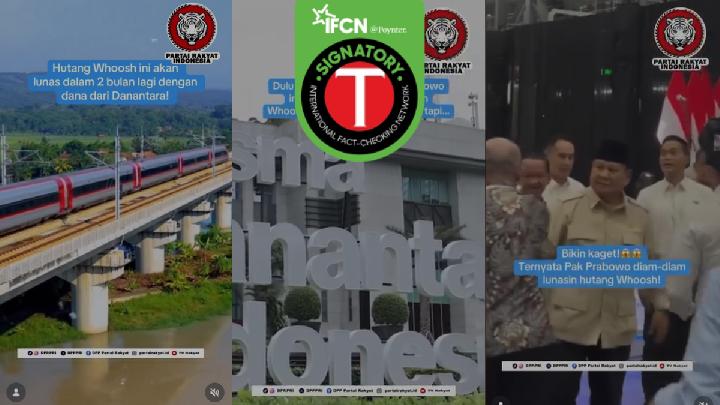
Social media posts claiming that Indonesian President Prabowo Subianto plans to pay off the Jakarta-Bandung Whoosh high-speed rail debt within two months have been debunked as misleading, according to a recent fact-check investigation.
The viral claims, which began circulating across Instagram, Facebook, Threads, TikTok, and YouTube on April 11, 2026, suggested that the debt would be repaid through the Danantara Investment Management Agency without impacting the State Budget (APBN).
After thorough verification including interviews with economic researchers and analysis of credible sources, Tempo news agency determined that the two-month timeframe mentioned in the posts actually refers to a period set aside for discussing debt restructuring options, not for completing repayment.
The Whoosh high-speed rail project has faced significant financial challenges since its inception. Initially budgeted at US$5.5 billion (approximately Rp89.6 trillion), costs ballooned to US$7.27 billion (Rp118.4 trillion) due to overruns. The project, which began operations in October 2023, is a joint venture with 60 percent Indonesian ownership and 40 percent Chinese investment.
Former President Joko Widodo addressed the cost overruns by signing Presidential Decree No. 93 of 2021, providing State Capital Participation (PMN) of Rp7.3 trillion through PT KAI for Indonesia’s share in PT Kereta Cepat Indonesia China (KCIC). The remaining 75 percent of funding came from a China Development Bank loan totaling US$5.415 billion (Rp81.2 trillion).
The debt carries significant financial obligations, with an annual interest rate of 2 percent on the principal loan and 3.4 percent on cost overruns. KCIC must pay approximately US$120.9 million in interest annually, creating substantial ongoing financial pressure.
As of mid-April 2026, the Indonesian government has yet to finalize its approach to handling the Whoosh debt. On February 10, 2026, Minister of State Secretary Prasetyo Hadi, who also serves as President Prabowo’s spokesperson, indicated that loan repayment would likely involve state funds from the APBN. Separately, Dony Oskaria, head of the State-Owned Enterprises Regulatory Agency, suggested that the Ministry of Finance might take over PT KCIC as one possible strategy.
Teuku Riefky, a macroeconomics researcher at the University of Indonesia’s Institute for Economic and Social Research, clarified that Danantara requires two months to develop restructuring options for Whoosh’s debt, not to complete repayment. “It’s not the debt that’s being paid off in two months,” Riefky told Tempo on April 16.
This assessment was echoed by Muhammad Zulfikar Rakhmat, Director of Indonesia-China Studies at CELIOS, who called it “financially unrealistic” to repay such massive debt within a two-month timeframe. These expert opinions align with CNBC reporting from April 8, which indicated that options for resolving Whoosh’s financial problems would be finalized within 1-2 months, after which the government would announce its decision.
The prospect of using the state budget for debt repayment has drawn criticism from economic experts. INDEF Executive Director Esther Sri Astuti warned that such an approach would add pressure to an already substantial government debt burden of Rp800 trillion. She argued that budget priorities should focus on industrial development and infrastructure projects rather than bailing out the high-speed rail project.
Riefky recommended maintaining repayment through business-to-business mechanisms rather than involving state funds, noting that the Jakarta-Bandung high-speed rail offers relatively limited benefits compared to its costs.
As discussions continue, the Indonesian public awaits official clarification on how the government will ultimately approach the financial challenges of this major infrastructure project, which represents one of the most significant transportation investments in the nation’s recent history.
Fact Checker
Verify the accuracy of this article using The Disinformation Commission analysis and real-time sources.

26 Comments
It’s disappointing to see the viral claims about the debt being repaid in 2 months were inaccurate. Transparency and accountability are crucial for major public infrastructure projects like this. I hope the authorities can find a sustainable solution to the Whoosh rail’s financial challenges.
Interesting fact check. It’s important to verify claims, especially when it comes to major infrastructure projects and debt repayment. Sounds like the two-month timeframe refers to discussions, not actual repayment, which is an important distinction.
Agreed, rushing to repay debt in such a short timeframe seems unrealistic. Careful analysis of the project’s financials and restructuring options is prudent.
The Whoosh high-speed rail project’s financial challenges highlight the importance of robust project management and risk mitigation strategies, especially for large-scale, cross-border initiatives. Careful planning upfront can help avoid costly issues later on.
Absolutely. Conducting thorough feasibility studies, securing appropriate financing, and implementing strong governance frameworks are critical for the success of complex infrastructure projects like this.
It’s encouraging to see the Indonesian government taking a measured approach to addressing the Whoosh high-speed rail debt, rather than rushing into unrealistic repayment timelines. Careful negotiations and restructuring discussions are prudent steps.
I’m curious to learn more about the joint venture structure of the Whoosh project and how that impacts the debt repayment dynamics. Navigating international partnerships can add another layer of complexity.
Good point. The 60/40 ownership split between Indonesia and China likely means coordinating the debt repayment process will require careful negotiation and collaboration between the partners.
Fact-checking is so important, especially when it comes to claims about major infrastructure projects and government finances. It’s good to see credible media outlets like Tempo investigating these viral social media posts.
The Whoosh high-speed rail project seems to exemplify the challenges that can arise with large-scale, cross-border infrastructure initiatives. While the concept is exciting, the financial realities highlighted in this fact check are a sobering reminder of the importance of robust planning and risk management.
The financial complexities of the Whoosh high-speed rail project highlight the importance of robust public-private partnership frameworks and transparent reporting. Balancing commercial viability with public interests is crucial for the long-term success of such initiatives.
Absolutely. Striking the right balance between private investment and public oversight is key to ensuring major infrastructure projects like this deliver sustainable benefits to the community.
This fact check provides a valuable reality check on the viral claims around the Whoosh high-speed rail debt repayment. It’s crucial that the public receives accurate information, especially on issues of public spending and infrastructure development. I appreciate the detailed investigation and analysis presented here.
The Whoosh high-speed rail project is an ambitious infrastructure undertaking, but the financial troubles highlighted in this fact check are concerning. I wonder what lessons can be learned to improve project management and cost control for future large-scale transportation initiatives.
Good point. Rigorous feasibility studies and better oversight mechanisms could help prevent such significant budget overruns in the future.
The Whoosh high-speed rail project’s financial troubles are a cautionary tale about the need for careful oversight and risk management in major infrastructure initiatives. Lessons learned here could help inform best practices for future projects.
Well said. Analyzing the challenges faced by the Whoosh project can provide valuable insights to improve planning and execution of similar large-scale transportation endeavors moving forward.
Cost overruns are a common challenge with major infrastructure projects. I hope the Whoosh high-speed rail team can find ways to optimize operations and finances to ensure the long-term viability of the system.
This high-speed rail project seems to have faced significant financial challenges from the start. I’m curious to learn more about the reasons for the cost overruns and the debt restructuring process. A 2-month timeline to fully repay the debt does seem unrealistic.
Agreed, the 2-month claim sounds misleading. Debt restructuring can be a complex process, so it’s important to get the facts right.
The Whoosh high-speed rail project seems to have faced significant challenges with cost overruns. It’s crucial that projects like this are properly managed to ensure they deliver value and are financially sustainable.
Absolutely, cost overruns can really undermine the viability of infrastructure projects. Transparent reporting and effective oversight are essential to avoid such issues.
It’s encouraging to see the Indonesian government taking a measured approach to the Whoosh high-speed rail debt, rather than rushing into unrealistic repayment timelines. Careful planning and restructuring discussions are prudent steps.
Agreed. Rushing into debt repayment without thorough analysis could lead to even bigger problems down the line. A thoughtful, deliberate approach is key for complex infrastructure projects like this.
The Whoosh high-speed rail project seems to be a complex endeavor with both opportunities and challenges. I hope the stakeholders can find a sustainable solution to address the financial hurdles and deliver the promised benefits to the public.
It’s good to see fact-checking efforts debunking misleading claims about the Whoosh high-speed rail debt repayment. Maintaining transparency and accuracy in reporting on public infrastructure projects is crucial for informed decision-making.