


Listen to the article
Deepfake Images of Maduro’s Capture Spread Online as US Reports Military Operation in Venezuela
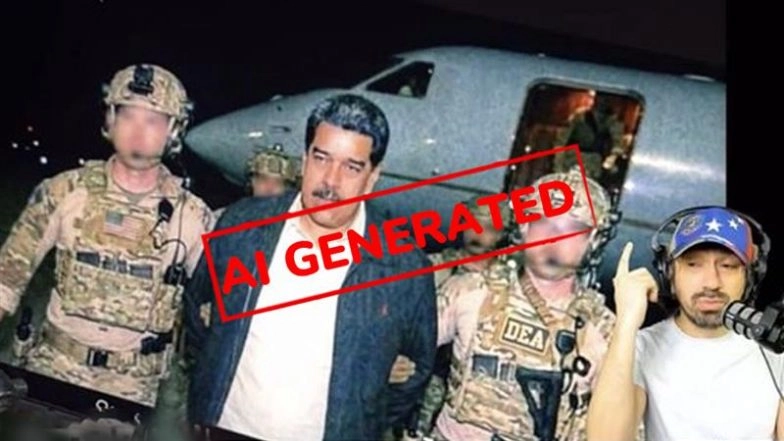
Images purporting to show Venezuelan President Nicolas Maduro in US military custody are circulating widely across social media platforms, creating confusion amid confirmed reports of American military action in Venezuela. Analysis reveals these images are AI-generated deepfakes with no connection to official US government communications.
The manipulated photos, which show a disheveled Maduro supposedly being detained by American forces, began appearing on social media platforms shortly after President Donald Trump announced a major military operation in Venezuela early Saturday. Some posts falsely claim the White House has authenticated the images.
Digital forensics experts quickly identified telltale signs of AI generation in the viral photos, including inconsistent lighting, unnatural facial features, blurred military insignia, and compression artifacts characteristic of synthetic media. Several images appear to mimic the iconic 2003 photos of Saddam Hussein’s capture by US forces, raising further suspicions.
While the United States has confirmed a significant military operation in Venezuela, no official visual evidence of Maduro’s capture has been released by the Pentagon, State Department, or White House as of this reporting.
President Trump did state in an official address that Maduro and his wife, First Lady Cilia Flores, had been “captured by US forces and flown out of the country” following coordinated strikes across Caracas. However, this announcement came solely through verbal statements, not through photographic or video evidence.
The military action represents a dramatic escalation in US-Venezuela relations after years of diplomatic tension. Washington has justified the operation under its “War on Drugs” initiative, accusing the Maduro administration of operating what it terms a “narco-state” that facilitates cocaine trafficking networks throughout the region.
US intelligence agencies have specifically linked the Maduro government to Tren de Aragua, a transnational criminal organization recently designated as a foreign terrorist group by the State Department. This designation provided legal justification for direct military intervention under existing counter-terrorism authorities.
Witnesses in Caracas reported explosions near key military installations, including Fuerte Tiuna military base and La Carlota air base, accompanied by widespread power outages across the capital. Venezuelan state media initially denied reports of Maduro’s capture before broadcasts were suddenly interrupted.
Several geopolitical factors underpin this dramatic development. The operation follows months of tightened US sanctions targeting firms linked to Venezuela’s oil sector, which holds the world’s largest proven petroleum reserves. Energy analysts note the intervention coincides with global supply concerns that have pushed crude prices to multi-year highs.
The diplomatic fallout has been swift. Colombia called for an emergency United Nations Security Council meeting, while several Latin American nations condemned the unilateral military action. Russia and China, long-standing allies of the Maduro government, have issued strong statements opposing what they characterize as US aggression.
Regional stability experts warn of potential humanitarian consequences and displaced populations if fighting intensifies. The UN has urged restraint and called for diplomatic channels to remain open.
While the US military operation in Venezuela appears to be confirmed through official channels, the public should remain skeptical of unverified images allegedly showing Maduro in custody. These digitally manipulated photos highlight the growing challenge of distinguishing authentic visual evidence from increasingly sophisticated AI-generated content during fast-moving international events.
Fact Checker
Verify the accuracy of this article using The Disinformation Commission analysis and real-time sources.

11 Comments
Appreciate the thorough investigation into these synthetic media images. It’s a good reminder that we can’t always trust what we see online, even when it seems like credible visual evidence. Glad the experts were able to spot the inconsistencies and compression artifacts indicative of AI generation.
Absolutely, it’s a timely reminder to be highly skeptical of any visual ‘evidence’ circulating on social media these days. The deepfake technology is advancing rapidly and it’s crucial we develop the skills to spot these manipulations.
Helpful to see this detailed fact check on the viral photos of Maduro. Given the confirmed US military action in Venezuela, it’s important we don’t get misled by AI-generated fakes, no matter how convincing they may appear. Good to know the experts could spot the telltale signs of synthetic media.
Good to see this fake media being called out and debunked. With the US confirming military action in Venezuela, it’s important to separate fact from fiction, especially when it comes to visuals that could be easily manipulated. Appreciate the thorough analysis provided here.
Interesting to see the analysis on these apparent deepfake images of Maduro’s capture. Given the confirmed US military operation, I can understand the temptation to want visual ‘proof’. But it’s crucial we don’t get misled by synthetic media, no matter how convincing. Kudos to the experts for spotting the red flags.
Absolutely, these kinds of manipulated visuals are a real threat to an informed public discourse, especially around major geopolitical events. We have to stay vigilant and critically examine any ‘evidence’ we see online, no matter how compelling it may seem at first glance.
As someone following the news on Venezuela, I appreciate this thorough investigation into the authenticity of those viral photos. It’s disturbing how easily misinformation can spread, even with visual ‘evidence’. Glad the experts were able to identify the clear signs of AI generation. We all need to stay vigilant.
Thanks for the detailed fact check on these viral photos. It’s smart to take a critical look at images that seem too good to be true, especially during a major news event. Glad the US confirmed a military operation, but these AI-generated fakes could still cause real confusion if not debunked.
Interesting to see the analysis on these apparent deepfake images of Maduro’s capture. It’s concerning how easy it is to spread misinformation online, even with visual ‘evidence’. Glad the experts were able to identify the telltale signs of AI generation. We need to be very cautious about what we see on social media these days.
These AI-generated images of Maduro’s capture are a concerning example of the misinformation that can spread online. While the US has confirmed military operations, we can’t take viral social media posts at face value. Kudos to the experts for identifying the telltale signs of synthetic media.
Agreed, it’s crucial we maintain a healthy skepticism towards visuals shared online, even if they seem convincing at first glance. The prevalence of deepfake tech makes it harder than ever to distinguish truth from fiction.