


Listen to the article
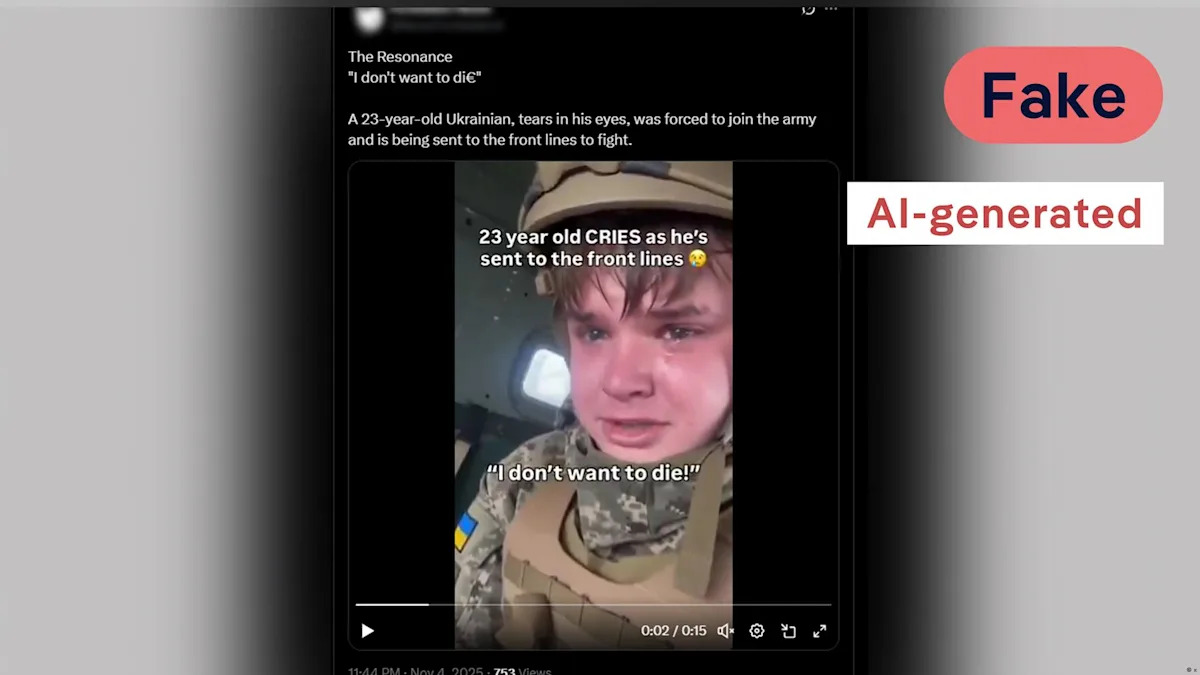
In a troubling case of digital deception, an AI-generated video purporting to show a distraught Ukrainian soldier has gone viral across social media platforms worldwide, spreading false narratives about Ukraine’s military conscription practices.
“I’ve been mobilized, I’m heading to Chasiv Yar,” says what appears to be a young Ukrainian soldier through floods of tears in the back of a military vehicle. “Help me, I don’t want to die. I’m only 23. Please help me.”
The video has been shared hundreds of times across social media, accumulating millions of views and advancing the misleading claim that Ukraine is forcibly drafting young men to replace battlefield casualties amid Russia’s ongoing invasion. A particularly viral iteration on a Hungarian X account garnered at least 1.8 million views.
Investigation by DW has revealed the video is entirely fabricated. The minimum conscription age in Ukraine was lowered from 27 to 25 in April 2024, not to 23 as claimed in the video. More tellingly, facial recognition analysis identified the person in the footage as Vladimir Yuryevich Ivanov, a Russian streamer from St. Petersburg who uses the online pseudonym Kussia88.
The artificial intelligence origins of the video are evident in various visual inconsistencies, including the poorly-fitted helmet that doesn’t match standard Ukrainian military equipment.
The pseudonym “Kussia88” itself carries troubling connotations. While “kussia” (pronounced “kasha”) means “porridge” in Russian, the use of “88”—widely recognized as neo-Nazi code for “Heil Hitler”—and the stylized double “SS” appear deliberate. Similarly, the letters “IA” in neo-Nazi circles represent “14,” referencing the infamous “14 words” slogan coined by American white nationalist David Lane, which has become a rallying cry for militant white supremacist groups globally.
These coded references appear consistently across Ivanov’s digital footprint, with the numbers 1488 and 8814 embedded in the URLs and profile descriptions of his TikTok and Boosty accounts. According to Reddit discussions, his Twitch account, which boasts over 1.3 million followers, has reportedly faced at least one temporary ban in recent months.
The fabricated video featuring Ivanov’s likeness appears to have originated on a now-deleted TikTok channel named @fantomoko, which published dozens of similar AI-generated clips allegedly showing Ukrainian soldiers crying in military vehicles. While most received modest viewership, several went viral with views ranging from 800,000 to over 2.1 million. Some clips even displayed the watermark “Sora,” identifying OpenAI’s image generator as the tool used to create them.
Another recurring face in these fabricated videos belonged to Aleksei Gubanov, a critic of Russian President Vladimir Putin who now resides in New York. When contacted by DW, Gubanov emphatically denied any involvement, stating he had “absolutely no connection” to the clips.
“All of them were created by someone using AI and without my consent or involvement,” Gubanov told DW. “Those videos play directly into Russian propaganda narratives and gain millions of views. To be absolutely clear—I did not create, approve, or participate in any of those videos, and I strongly condemn the use of AI-generated fake media for manipulation or propaganda.”
According to the Ukrainian database “Stars about war,” which documents celebrities’ positions on Russia’s invasion, Ivanov typically avoids commenting on the conflict. The database notes that he was once reprimanded by Russian authorities for mocking children of mobilized soldiers, after which he reportedly apologized in a video featuring a Russian flag backdrop and asserted that Crimea belongs to Russia.
When confronted about his potential connection to the AI videos and allegations of being a “pro-Putin Nazi,” Ivanov responded sarcastically on his Telegram channel, saying: “The Twitter crowd have finally learned what ‘delivery’ means”—Russian Twitch slang essentially meaning “They’ve finally got on board the hype train.”
Regardless of whether Ivanov actively participated in creating these videos or his personal views, the viral footage remains entirely fabricated—representing a concerning example of how artificial intelligence can be weaponized to spread misinformation in conflict zones.
The case highlights the growing challenge of synthetic media in information warfare, as increasingly sophisticated AI tools enable the rapid creation and dissemination of convincing fake content designed to manipulate public opinion and undermine trust in legitimate reporting from conflict zones.
Fact Checker
Verify the accuracy of this article using The Disinformation Commission analysis and real-time sources.

10 Comments
The ability to create such convincing yet fabricated videos is troubling, as it can be used to manipulate public opinion and undermine trust in legitimate sources. I’m glad the fact-checkers were able to identify the true origin of this video and expose it as a deception. Ongoing efforts to combat misinformation are critical to preserving the integrity of information and protecting vulnerable populations.
Absolutely. The proliferation of AI-powered tools for generating synthetic media poses significant challenges for maintaining informational integrity. Rigorous fact-checking and media literacy initiatives are essential to equipping the public with the skills to navigate this evolving landscape and identify credible sources.
Interesting, it’s concerning to see the spread of misinformation like this fabricated video. I’m glad the fact-checking process was able to identify the real source and debunk the false narrative. It’s important to be vigilant about verifying information, especially around sensitive topics like military service and wartime events.
Yes, absolutely. Fact-checking is crucial to combat the rising tide of disinformation online. Kudos to the investigators for their thorough analysis to expose this deception.
This is a concerning example of the potential for malicious actors to leverage digital tools to create and disseminate misinformation. While the investigative work to debunk this fabricated video is commendable, it highlights the ongoing challenge of combating the spread of disinformation online. Continued efforts to promote media literacy and critical thinking are essential.
Well said. As technology advances, the battle against misinformation becomes increasingly complex. Vigilance, fact-checking, and public education will be key to maintaining an informed and discerning populace in the face of these evolving threats to the integrity of information.
It’s disturbing to see how easily doctored videos can go viral and shape public perceptions, even on sensitive topics like military service. Kudos to the investigators for their diligence in tracing the origins and exposing this as a fabrication. Rigorous fact-checking is essential to counter the proliferation of misinformation.
Absolutely. In the age of AI-generated media, we must be even more cautious about verifying the authenticity of online content. Fact-checking efforts like this are crucial to maintaining public trust and preventing the spread of harmful falsehoods.
This highlights the need for increased media literacy and critical thinking when consuming online content, especially around geopolitical issues. Spreading fabricated videos can have serious consequences by misleading the public. Fact-checking efforts are vital to maintaining an informed society.
Agreed. Combating the spread of misinformation requires a multi-pronged approach, including educating the public on identifying credible sources and verifying claims. It’s an ongoing challenge, but important work to preserve the integrity of information.