


Listen to the article
Viral Video Falsely Portrayed as NYC Residents Attacking ICE Agents
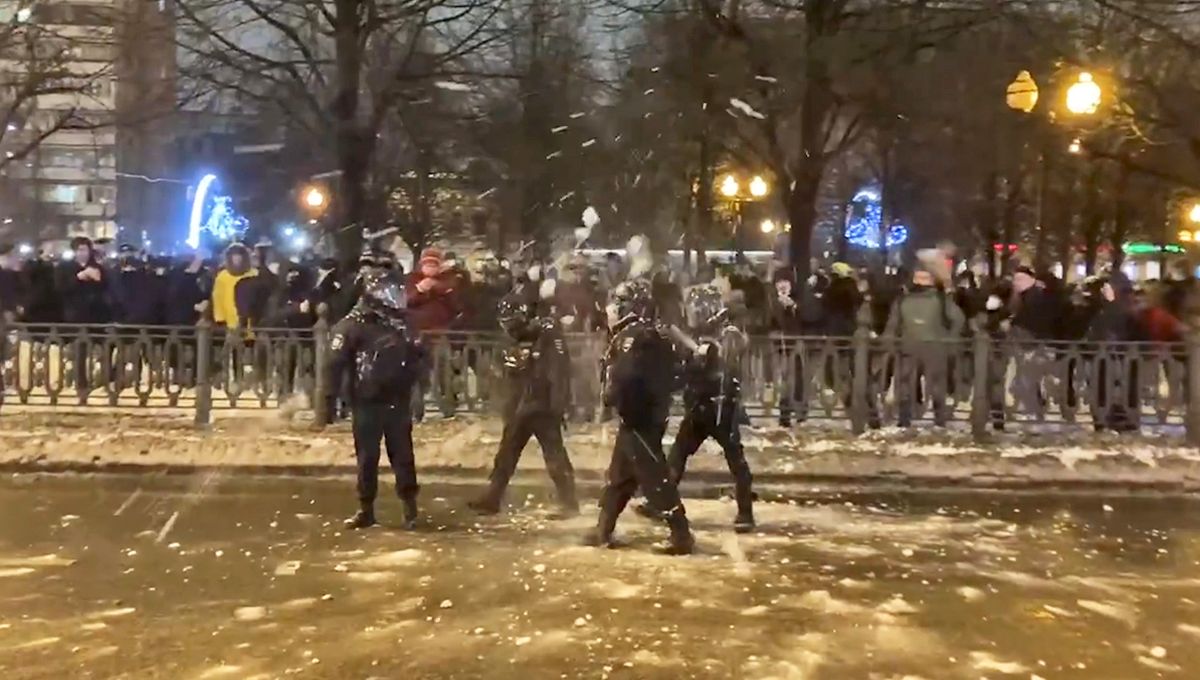
A widely shared video purportedly showing New York City residents pelting Immigration and Customs Enforcement (ICE) agents with snowballs has been debunked as miscaptioned footage from a 2021 protest in Russia.
The video, which circulated across multiple social media platforms in late December 2025, was accompanied by captions such as “New Yorkers pelt ICE agents with Snow Balls” and “New Yorkers letting ICE agents know that they are not welcomed in New York.” Some users specifically framed the incident as “far left protesters” demonstrating against President Donald Trump’s immigration policies.
However, an investigation reveals the footage actually depicts a January 2021 protest in Moscow, where supporters of Russian opposition leader Alexei Navalny confronted police officers during widespread demonstrations against President Vladimir Putin’s government.
The authentic video was originally published by Mediazona, an independent Russian news outlet, on January 23, 2021. The Russian-language caption translated to: “Police officers were pelted with snowballs near the circus on Trubnaya Street, and they clearly lost their composure.” Later that same day, British newspaper The Guardian republished the footage on its YouTube channel with the title: “Russia protests: police pelted with snowballs in Moscow.”
Geolocation analysis confirmed the incident took place at Tsvetnoy Boulevard near Trubnaya Square in Moscow, not in any New York City location. The video also contains audible Russian speech, providing further evidence of its true origin.
The Moscow protests documented in the footage were part of a significant nationwide demonstration in support of Navalny, who had been recently detained upon returning to Russia after recovering from nerve agent poisoning. Mediazona’s live coverage of the events noted: “Security forces began arresting protesters at Trubnaya Square, using batons… The crowd responded with a hail of snowballs and pushed a group of riot police away from the memorial pillar.”
Navalny, a prominent Kremlin critic and anti-corruption activist, later died in February 2024 while serving a prison sentence in Russia, sparking international condemnation and accusations against the Putin regime.
The miscaptioned video is emblematic of a growing trend where authentic footage is repurposed and shared out of context to support political narratives. In this case, the video was weaponized to suggest growing public resistance to immigration enforcement in the United States.
Social media platforms have struggled to contain such misleading content, with this particular video spreading across Instagram, Facebook, Bluesky, Threads, TikTok, X (formerly Twitter), and YouTube before fact-checkers could intervene.
The timing of the video’s circulation is particularly notable, coming during renewed national debates over immigration policy following the 2024 presidential election. Immigration enforcement tactics have remained a contentious political issue throughout the transition to Trump’s second administration.
Digital forensic analysis found no evidence the footage was generated or manipulated using artificial intelligence tools, confirming it is genuine video from the 2021 Moscow protests rather than fabricated content.
This incident serves as a reminder for social media users to verify the authenticity and context of dramatic footage before sharing it, particularly when the content aligns with existing political viewpoints or touches on divisive social issues.
Fact Checker
Verify the accuracy of this article using The Disinformation Commission analysis and real-time sources.

10 Comments
Kudos to the researchers for taking the time to trace the origins of this video and provide a thorough fact check. It’s a valuable lesson in the importance of digging deeper and not accepting everything at face value, especially on sensitive topics.
Exactly. Responsible reporting and fact-checking are essential for maintaining public trust and preventing the spread of misinformation.
Interesting fact check. It’s important to verify the origins of viral videos before jumping to conclusions about what they depict. Spreading misinformation, even inadvertently, can have serious consequences.
Agreed. Fact-checking is crucial in an age of rapid information sharing. This helps prevent the spread of misleading narratives.
This is a good example of why it’s important to be skeptical of viral videos and to verify the information before sharing or commenting. Jumping to conclusions based on limited context can lead to the spread of misinformation.
This is a valuable fact check. It highlights the need to be cautious about instantly believing the framing or captions that accompany viral videos. Taking the time to research the source and context is prudent.
Good to see a thorough investigation into the source of this video. Misattributing footage can contribute to harmful rhetoric and false perceptions. Responsible reporting is vital, especially on sensitive topics like immigration.
Absolutely. Verifying the origins and context of videos is an important step in ensuring accurate and fair coverage of events.
It’s concerning to see how quickly misinformation can spread online, even when the original footage is from a completely different context. Rigorous fact-checking is crucial to combat the proliferation of false narratives.
Agreed. Fact-checking is an essential journalistic practice that helps maintain the integrity of news reporting and public discourse.