


Listen to the article
Real Women, Real Risks: Trump’s Intervention in Iranian Detention Cases Clarified
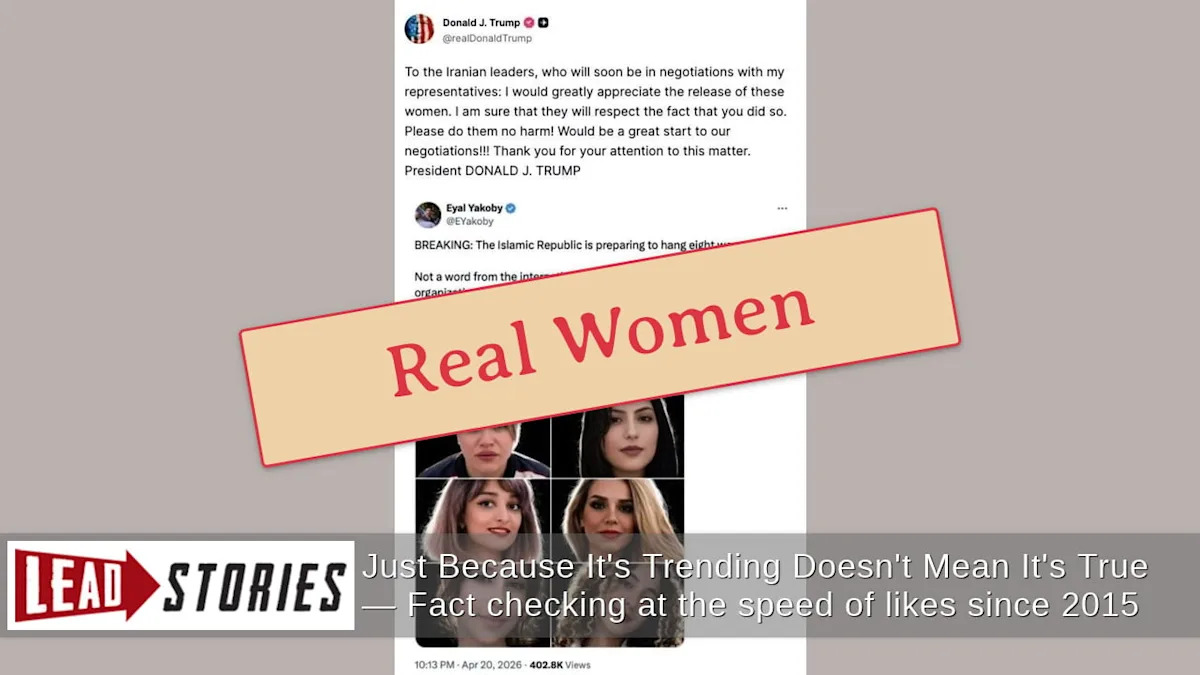
A social media claim suggesting that former President Donald Trump was “begging Iranian leaders to not execute 8 AI-generated women” has been debunked. The women referenced in Trump’s recent Truth Social post are real individuals facing various charges in Iran, according to Iran Human Rights, an Oslo-based organization.
The misleading claim appeared on April 22, 2026, when an X user with the handle @Jvnior posted: “Trump is begging Iranian leaders to not execute 8 AI-generated women. This is the funniest thing I’ve ever seen.” The post was made in response to Trump’s plea on Truth Social the previous day.
In his original April 21 post, Trump addressed Iranian leadership directly: “To the Iranian leaders, who will soon be in negotiations with my representatives: I would greatly appreciate the release of these women. I am sure that they will respect the fact that you did so. Please do them no harm!” He added that releasing the women would be “a great start to our negotiations.”
Trump’s post included a screenshot from American activist Eyal Yakoby, who had claimed on April 20 that “The Islamic Republic is preparing to hang eight women” and criticized the international community and human rights organizations for their silence.
Iran Human Rights confirmed to fact-checkers that the women are indeed real, though the organization clarified that contrary to some reports, only one woman actually faced a death sentence. According to their information, Bita Hemati had been sentenced to death, while others faced varying degrees of legal jeopardy:
- Mahboubeh Shabani from Mashhad was facing death penalty charges
- Diana Taher Abadi from Karaj had been arrested and threatened with a death sentence
- Golnaz (Golnar) Naraghi from Tehran and Venus Hosseinnejad from Kerman had been released on bail
- Panah Movahedi from Tehran reportedly disappeared during a January 9 protest
- Ghazal Ghalandar from Yasuj and Ensieh Nejati from Darab had no new reports on their cases since their January arrests
On April 22, Trump posted an update claiming success in his intervention: “Very good news! I have just been informed that the eight women protestors who were going to be executed tonight in Iran will no longer be killed. Four will be released immediately, and four will be sentenced to one month in prison.”
The former president added, “I very much appreciate that Iran, and its leaders, respected my request, as President of the United States, and terminated the planned execution.”
This incident highlights the ongoing human rights concerns in Iran, particularly regarding the treatment of women and political dissidents. Iran has faced international criticism for its use of capital punishment, which according to human rights organizations remains among the highest per capita in the world.
The confusion around these cases also underscores the growing challenge of distinguishing between authentic news and AI-generated content on social media. As AI-generated imagery becomes increasingly sophisticated, false claims about fabricated people or events can spread rapidly online, requiring careful verification from independent sources.
For Iranian activists and human rights defenders, international attention to detention cases remains crucial, regardless of the source. While Trump’s intervention and subsequent announcement cannot be independently verified, the spotlight on these cases may provide some measure of protection for the detained women through increased international awareness.
Human rights organizations continue to monitor the situation of political detainees in Iran, where protests against government policies, particularly those restricting women’s rights, have resulted in thousands of arrests in recent years.
Fact Checker
Verify the accuracy of this article using The Disinformation Commission analysis and real-time sources.

12 Comments
I appreciate the diligence in fact-checking this claim. It’s a good reminder to be cautious about unverified social media posts, even from high-profile figures.
This fact check provides valuable context and clarity. While Trump’s approach may be questionable, the plight of these women in Iran deserves serious attention.
This fact check highlights the importance of separating fact from fiction, especially when it comes to sensitive geopolitical issues. Maintaining objectivity is crucial.
Interesting fact check on the misleading claims around Trump’s plea to Iran. It’s important to verify information, especially on sensitive political issues, to avoid spreading misinformation.
Glad to see a detailed fact check on this claim. It’s a good reminder to be wary of unsubstantiated social media posts, even from high-profile figures.
This is a complex situation, with real women facing real risks in Iran. Trump’s intervention may have been mischaracterized, but the underlying human rights concerns are valid.
Agreed. Clarity on the facts is crucial, regardless of one’s political leanings. Maintaining an objective, fact-based perspective is important here.
The distinction between real women facing real risks and the misleading AI-generated claim is an important one. Fact-checking is essential to avoid perpetuating misinformation.
Agreed. Cutting through the noise to focus on the core human rights issues is the responsible way to approach this situation.
The distinction between real women and AI-generated claims is an important one. Fact-checking is crucial to avoid perpetuating misinformation, especially on sensitive topics.
The details provided help contextualize the situation better. While Trump’s approach may be questionable, the plight of these women in Iran deserves serious attention and action.
Well said. Focusing on the human rights concerns, rather than political posturing, is the prudent approach here.