


Listen to the article
Trump’s Speech to House Republicans Riddled with False Claims
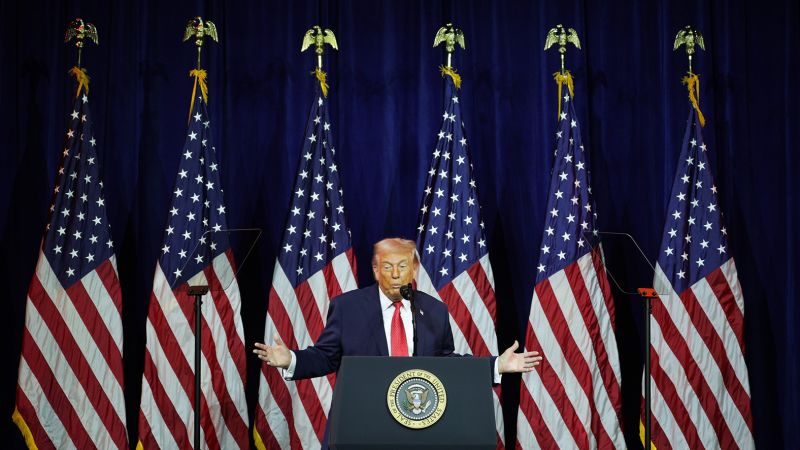
President Donald Trump abandoned his teleprompter during a speech at a House Republican retreat Tuesday, delivering impromptu remarks filled with at least 18 inaccurate statements, most of which have been repeatedly debunked.
The president’s meandering address touched on topics ranging from crime statistics to the 2020 election, but fact-checkers were quick to point out numerous falsehoods throughout his remarks.
One of Trump’s most glaring inaccuracies came when discussing Washington, DC’s crime rate. He claimed the capital hadn’t experienced a single murder “in seven months” following a federal takeover of law enforcement. This assertion is demonstrably false, as police statistics and Washington Post tracking reveal dozens of homicides in the district during that period, including three in the last week of December alone.
Trump further claimed Washington is “now the safest city in the country,” a statement crime data expert Jeff Asher dismissed as “obviously not true.” While the district has seen declining shooting rates, more than 100 people have been shot there in the past four and a half months.
The January 6, 2021, Capitol attack featured prominently in Trump’s remarks. He falsely asserted that the House select committee investigating the incident “didn’t report” his calls for protesters to act “peacefully and patriotically.” In fact, the committee explicitly mentioned this comment in its final report, noting it was a single line in an otherwise combative 70-minute speech.
Trump also repeated a debunked claim about former House Speaker Nancy Pelosi turning down an offer of 10,000 National Guard troops before the Capitol riot. No evidence exists of such an offer, and as president at the time, Trump—not Pelosi—had authority over the District of Columbia National Guard. Video footage from Pelosi’s filmmaker daughter shows the then-Speaker expressing frustration about inadequate security and asking why National Guard forces weren’t deployed sooner, contradicting Trump’s narrative.
On election matters, Trump persisted with his thoroughly discredited claim that the 2020 election was “rigged,” despite overwhelming evidence confirming Biden’s legitimate victory. He falsely stated he had won Minnesota—a state he lost in 2016, 2020, and 2024—and erroneously claimed the United States is “the only country that votes by mail,” when dozens of nations, including Canada, Germany, and the United Kingdom, utilize mail-in voting systems.
The president also misrepresented findings from a commission co-chaired by former President Jimmy Carter, claiming it advised against mail-in voting. While the 2005 report did identify absentee ballots as vulnerable to potential fraud, it also highlighted Oregon’s successful implementation of safeguards and called for further research rather than outright rejection of the practice.
Regarding the 2024 election, Trump complained it was “very unfair” that President Biden dropped out and was replaced by Vice President Kamala Harris, exaggerating his polling lead over Biden as “30 points” when most surveys showed single-digit margins. He similarly inflated former Rep. Tom Rice’s 2022 primary defeat, claiming he lost by 48 points when the actual margin was about 26.5 points.
Trump’s economic claims were equally misleading. He falsely stated he “inherited the greatest inflation in history,” though the 3.0% inflation rate in January 2025 was far below the all-time record of 23.7% set in 1920. His assertion that prescription drug prices were being reduced by “thousands of percent” defies mathematical possibility, as a decrease exceeding 100 percentage points would mean Americans would be paid to acquire medications.
The president also greatly exaggerated investment figures, claiming “$18 trillion being invested in the United States,” when even the White House’s inflated estimate was $9.6 trillion. A detailed CNN analysis found this figure included vague pledges and statements that didn’t qualify as actual investments.
Other false claims included suggestions that California wildfires were connected to water conservation efforts hundreds of miles away, mischaracterizations of Olympic boxers’ gender identities, and a misleading account of his 2019 phone call with Ukrainian President Volodymyr Zelensky that led to his first impeachment.
Throughout the speech, Trump’s departure from prepared remarks highlighted his tendency to make unsubstantiated claims and exaggerations when speaking extemporaneously, providing a stark reminder of the challenge fact-checkers face in addressing presidential misinformation.
Fact Checker
Verify the accuracy of this article using The Disinformation Commission analysis and real-time sources.

7 Comments
This fact-check provides a useful reality check on Trump’s rhetoric. While political discourse can be heated, maintaining factual accuracy is crucial, particularly for those of us tracking industries like mining and energy.
Well said. Sticking to the facts, rather than unsubstantiated claims, is the best way to have a productive dialogue on important issues.
Interesting fact-checking on Trump’s claims. As a mining and energy investor, I’m curious to see how his statements on the economy hold up against the data. Objective analysis is important, regardless of political affiliation.
As an investor focused on the mining and energy sectors, I find the fact-checking on Trump’s statements relevant. Separating truth from fiction is important for making sound decisions, especially on macro issues.
Agreed. Objective, data-driven analysis is essential, especially when it comes to high-stakes topics like the economy and public safety.
This highlights the importance of verifying claims, especially around sensitive topics like crime rates and election issues. While politics can be divisive, staying grounded in facts is crucial for informed public discourse.
I appreciate the thorough debunking of Trump’s false assertions. As someone who follows commodity markets, I’m interested in how economic claims are scrutinized. Maintaining accuracy is key, regardless of the speaker’s political leanings.