


Listen to the article
Bernie Sanders Returns to Michigan, Rallies Support for Progressive Senate Candidate
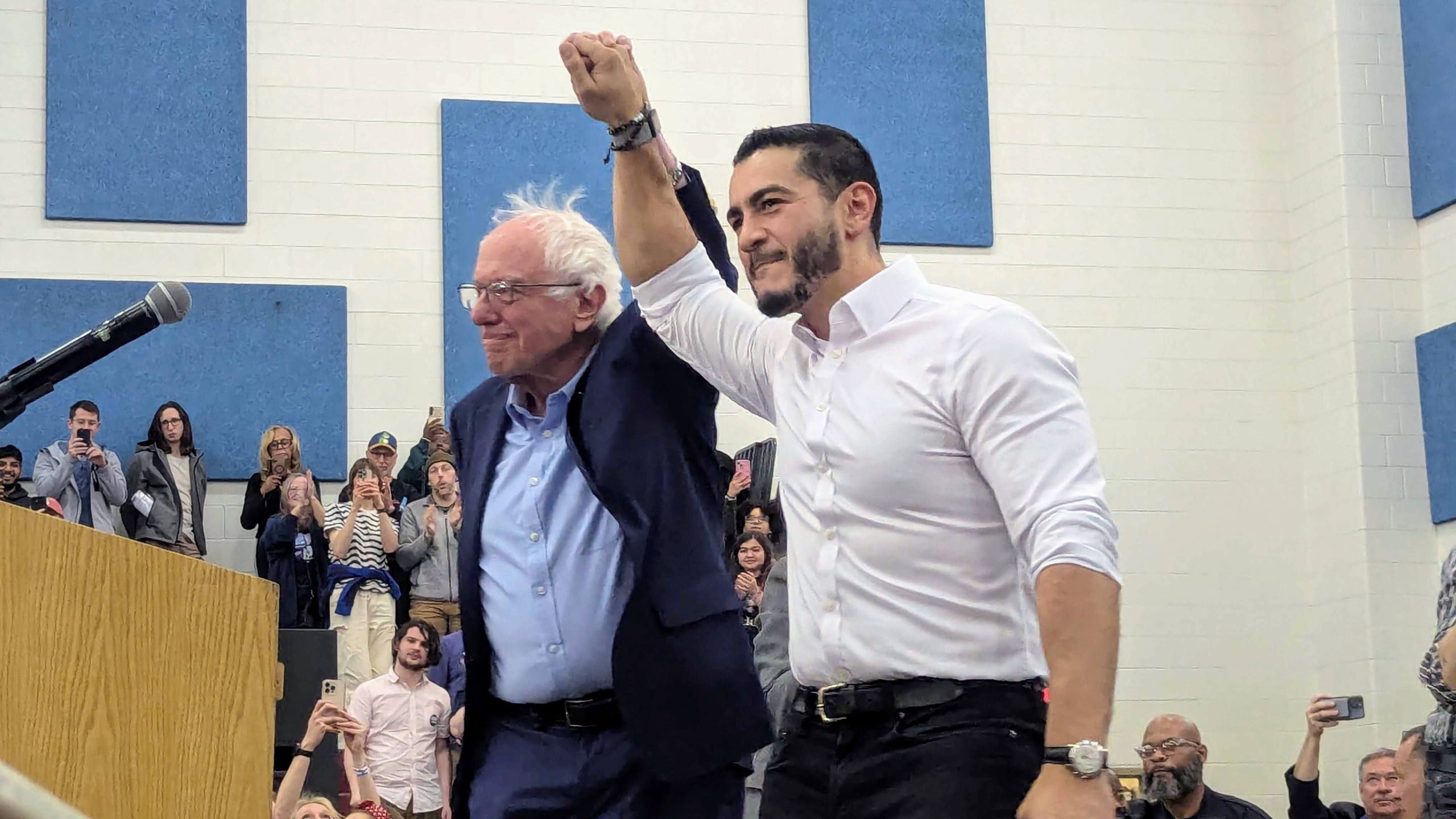
U.S. Sen. Bernie Sanders returned to Michigan Sunday to energize progressive supporters behind Senate candidate Abdul El-Sayed, drawing over 1,300 people to Detroit’s Mumford High School for a rally focused on economic inequality and healthcare reform.
El-Sayed, a former Wayne County health official, is competing in a tight Democratic primary against state Sen. Mallory McMorrow and U.S. Rep. Haley Stevens for the chance to face likely Republican nominee Mike Rogers in November.
“I think we need to tax billionaires,” El-Sayed told the enthusiastic crowd, echoing Sanders’ longtime economic message.
Sanders, who won Michigan’s presidential primary in 2016, emphasized the stark wealth disparity in America, claiming the top 1% holds more wealth than the bottom 93% of Americans. He specifically called out Elon Musk, suggesting the tech billionaire’s reported $800 billion net worth exceeds the combined wealth of the bottom 53% of households.
“Maybe these billionaires should start paying their fair share of taxes,” Sanders said to applause.
Federal Reserve data largely supports Sanders’ claim about the top 1%, which currently holds approximately 32% of the nation’s wealth — equal to the combined wealth of the bottom 90%. However, his claim about Musk appears exaggerated, as the bottom 50% of households had a combined net worth of $4.3 trillion as of late last year, significantly more than Musk’s estimated $800 billion.
Sanders and U.S. Rep. Ro Khanna have proposed a 5% annual wealth tax on billionaires that could generate up to $4.4 trillion over a decade for social programs, though experts at the Tax Foundation caution that avoidance strategies and implementation challenges could substantially reduce collections.
El-Sayed embraced the proposal in his own tax platform. “If you’re a billionaire and I tax you at 8%, you know what you still are? You’re still a billionaire. Your kids’ kids’ kids’ kids are going to be rich,” he said, suggesting such wealth could better serve public education.
Several European countries, including Spain, Norway and Switzerland, currently levy wealth taxes, though others abandoned similar measures in the 1990s and 2000s due to capital flight and low revenue generation.
The rally also highlighted El-Sayed’s distinction as the only candidate in Michigan’s Senate race supporting Medicare for All, the government-run healthcare system Sanders popularized during his 2016 presidential campaign.
“He is a doctor, and he knows firsthand how broken this system is,” Sanders said of El-Sayed, arguing universal healthcare shouldn’t be considered radical in a nation as wealthy as the United States.
The proposed system would eliminate premiums, deductibles and most co-pays for patients. However, health policy experts note single-payer proposals face significant political hurdles, with many voters concerned about government control of healthcare and potential impacts on choice, wait times, and access to treatments.
Cost remains a major obstacle. John Holahan of the Urban Institute estimated Sanders’ Medicare for All plan would require $34 trillion in federal spending over a decade when analyzed in 2020, a figure he now projects would be nearly twice as high accounting for inflation and other factors.
Advocates counter that Americans already pay more for healthcare than residents of other developed nations while receiving fewer benefits, and argue administrative streamlining and government price negotiation could ultimately reduce costs.
The issue has created friction in the Democratic primary. While El-Sayed has recently indicated support for allowing supplemental private insurance through unions or employers, both McMorrow and Stevens favor a “public option” approach they argue is more politically feasible.
Sanders also criticized U.S. involvement in Middle East conflicts, calling the ongoing war with Iran “unconstitutional” and a violation of international law. “Countries do not have the right, unprovoked, to bomb another country,” he said. “This war must end immediately.”
The weekend saw all three Democratic Senate candidates campaigning throughout metropolitan Detroit. Recent polling from the Detroit Regional Chamber shows a close race, with Stevens at 24.9%, El-Sayed at 22.9%, and McMorrow at 16%, while 36% of likely Democratic voters remain undecided.
Republicans were quick to respond to Sanders’ visit, with the National Republican Senatorial Committee releasing a digital ad characterizing El-Sayed and Sanders as too radical for Michigan, and likely GOP nominee Mike Rogers claiming “Michigan Democrats are flocking to the most radical, anti-American figures imaginable.”
Fact Checker
Verify the accuracy of this article using The Disinformation Commission analysis and real-time sources.

12 Comments
Interesting to see Sanders and El-Sayed pushing for a wealth tax. While I’m sympathetic to the goal of reducing inequality, I have concerns about the feasibility and potential downsides of this policy. I’d want to see more details on how they plan to implement it and mitigate any negative impacts on the economy and investment.
Agreed. A wealth tax is a complex proposal that deserves close scrutiny. I hope the candidates provide more specifics on their plans and address the key implementation challenges and potential consequences. Reducing inequality is important, but the policy details are crucial.
While a wealth tax may seem like a simple solution, the reality is likely much more complicated. I’d want to see a robust cost-benefit analysis that considers the potential impacts on investment, innovation, and capital flight before forming an opinion. Addressing inequality is important, but the policy details matter greatly.
Agreed. The devil is in the details when it comes to complex economic policies like a wealth tax. It’s essential to thoroughly evaluate the potential tradeoffs and unintended consequences before endorsing any specific approach to tackling inequality.
Interesting to see Sanders and El-Sayed advocating for a wealth tax. While the wealth gap is concerning, a wealth tax is a complex policy proposal that would face significant legal and implementation challenges. I’m curious to hear more details on their specific plans and how they would address the concerns.
You raise valid points. A wealth tax is a controversial idea, and the details around implementation would be crucial. I’m glad to see these candidates bringing attention to economic inequality, but the feasibility of their proposals is an important consideration.
While I agree that addressing wealth inequality is important, a wealth tax seems like a blunt and potentially counterproductive approach. I’d be more interested in hearing the candidates’ ideas for strengthening social programs, improving access to education and healthcare, and fostering economic mobility. Those types of policies may be more effective and politically viable.
That’s a fair point. Focusing on the social safety net, education, and economic opportunity may be more constructive ways to tackle inequality than a wealth tax. The candidates should outline their full policy agendas and explain how different approaches would work together to address the underlying issues.
I appreciate the focus on addressing income inequality, but a wealth tax is a blunt instrument that could have unintended consequences. Before endorsing such a policy, I’d want to see rigorous analysis of its potential impacts on investment, entrepreneurship, and capital flight. Curious to understand the candidates’ full economic platforms.
That’s a fair perspective. A wealth tax is not a simple solution, and the tradeoffs need to be carefully weighed. I agree that a deeper dive into the candidates’ broader economic plans would be helpful to evaluate their approaches to this complex issue.
Wealth inequality is a major concern, but a wealth tax is a blunt instrument that could face significant legal and practical challenges. I’m more interested in hearing the candidates’ ideas for strengthening the social safety net, improving access to education and healthcare, and creating good-paying jobs. Those seem like more direct ways to address the root causes of inequality.
Those are good points. Addressing inequality through the social safety net, education, and job creation may be more effective and feasible approaches than a wealth tax. It will be interesting to see how the candidates’ full policy platforms evolve on these complex economic issues.