


Listen to the article
False Reports of Sen. Ronald “Bato” Dela Rosa’s Airport Arrest Circulate Online
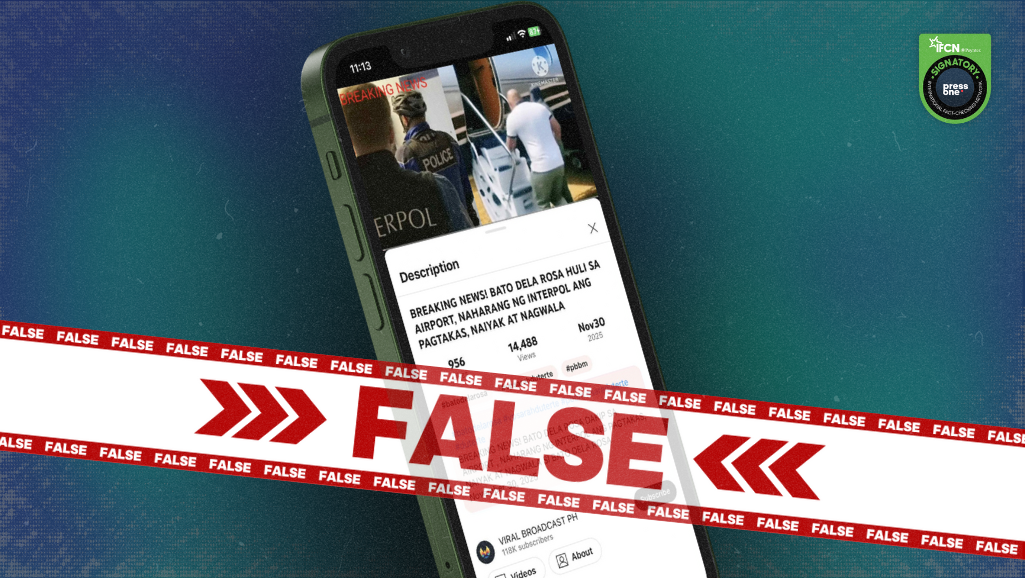
Claims that Senator Ronald “Bato” Dela Rosa was arrested by Interpol at Manila airport have been confirmed to be false, according to official verification. A YouTube video recently published by “VIRAL BROADCAST PH” has been spreading misinformation about the former Philippine National Police chief, generating thousands of views despite containing no factual basis.
The misleading video, uploaded on November 30, alleged that Dela Rosa was apprehended by international police authorities while at Manila’s airport. Its provocative caption, written in Filipino, claimed: “BREAKING NEWS! BATO DELA ROSA HULI SA AIRPORT, NAHARANG NG INTERPOL ANG PAGTAKAS, NAIYAK AT NAGWALA,” which translates to “Breaking news, Bato Dela Rosa is already caught in the airport, Interpol prevents escape, cried and went wild.”
No official statements or documentation from any Philippine government agency have confirmed such an arrest. The video has nonetheless gained significant traction online, accumulating nearly 24,000 views, 134 comments, and 1,600 likes as of the time of verification.
The false claim appears to exploit recent developments concerning Dela Rosa’s legal situation. On November 8, Ombudsman Jesus Crispin Remulla stated that the International Criminal Court (ICC) had issued an arrest warrant for Dela Rosa related to alleged crimes against humanity. This legitimate legal development seems to have provided the context for the fabricated airport arrest scenario.
Dela Rosa’s prominence in Philippine politics makes him a frequent target for misinformation. As the former PNP chief under President Rodrigo Duterte’s administration, he was the primary architect of the controversial “war on drugs” campaign, which has drawn international scrutiny and led to the ICC’s investigation.
The ICC has been examining allegations of systematic human rights violations during the anti-drug operations under Duterte’s presidency. This investigation has become a contentious issue in Philippine politics, with some supporting international accountability while others view it as an infringement on national sovereignty.
Media experts emphasize that such false claims about public figures gain traction during periods of political uncertainty or when related legitimate news events create a plausible context for misinformation. The timing of this false report coincides with increased discussions about the ICC investigation in Philippine political discourse.
Digital misinformation specialists note that sensational false claims about high-profile arrests tend to generate high engagement metrics, incentivizing content creators to fabricate dramatic scenarios involving public figures. The emotional language in the video’s title—suggesting Dela Rosa “cried and went wild”—exemplifies classic clickbait tactics designed to provoke viewer curiosity and emotional response.
The Philippines has been grappling with a surge of political misinformation across social media platforms in recent years. Media literacy advocates emphasize the importance of verifying news through multiple credible sources before accepting claims, particularly those with sensational elements or lacking official confirmation.
Fact-checkers recommend several strategies for identifying false news: consulting established news organizations, checking for official statements from relevant authorities, and being skeptical of content that relies heavily on emotional language rather than verifiable facts.
As this false claim about Dela Rosa continues to circulate online, it highlights the ongoing challenges of combating digital misinformation in the Philippine information ecosystem, particularly concerning politically charged topics like the ICC investigation and the former administration’s anti-drug campaign.
Fact Checker
Verify the accuracy of this article using The Disinformation Commission analysis and real-time sources.

9 Comments
Glad to see the Disinformation Commission taking the time to thoroughly investigate and debunk this false report. It’s a good reminder to be skeptical of unverified information, no matter how widespread it may seem online.
This false report about Sen. Dela Rosa’s arrest highlights the need for increased media literacy and critical thinking when it comes to consuming online content. Fact-checking should be a reflex, not an afterthought.
While it’s concerning to see misinformation spreading so rapidly online, it’s reassuring that the authorities were able to quickly verify and correct the false claims about Sen. Dela Rosa’s arrest. Fact-checking is crucial.
Agreed, the speed at which misinformation can spread online is alarming. But it’s heartening to see responsible journalists and fact-checkers working to counter it.
Interesting to see this fact-check debunking the false reports of Sen. Dela Rosa’s airport arrest. It’s important to rely on official sources and verified information, especially when it comes to high-profile figures and potential legal issues.
Agreed, spreading misinformation, even inadvertently, can have serious consequences. Good to see the authorities quickly addressing and correcting this false claim.
This is a textbook example of why it’s so important to rely on credible, official sources when it comes to news and information, especially around high-profile figures and potential legal issues. Fact-checking is essential.
This underscores the need for caution when consuming online content, especially around politically-charged topics. Fact-checking is crucial to prevent the spread of harmful rumors and speculation.
Absolutely. We should always be vigilant about verifying the accuracy of news and claims, especially when they seem sensational or provocative.