


Listen to the article
Debunking the Myth of “The Black Widow of Louisiana”
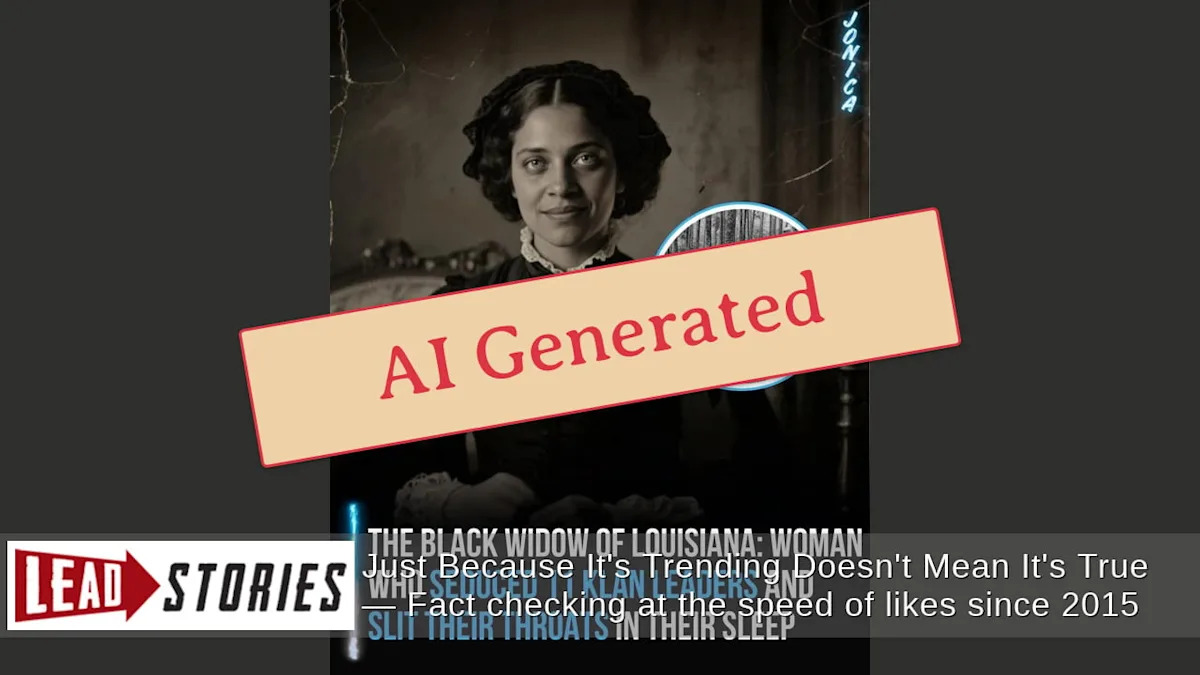
A viral social media story about “Josephine Boudreaux, the Black Widow of Louisiana,” who allegedly seduced and killed 11 Klan members in 1872, has been exposed as an elaborate fabrication with no historical basis.
The tale, which has spread rapidly across Facebook, Instagram, YouTube, and other platforms in recent weeks, appears to be entirely fictional. Extensive historical research reveals no evidence of such a woman or her purported vigilante actions against Ku Klux Klan members in post-Civil War Louisiana.
Digital forensics experts note that all images claiming to show Boudreaux are AI-generated, with many displaying telltale signs of artificial creation. Some images feature Google AI’s distinctive four-pointed sparkle icon in the corner, while others show nearly identical compositions with only slight variations in facial features—a common pattern in AI-generated imagery.
“This is a classic case of historical misinformation enabled by modern technology,” said Dr. Elaine Richardson, a professor of American history at Tulane University. “The ability to create convincing historical narratives complete with seemingly authentic photographs has made it increasingly difficult for the public to distinguish fact from fiction.”
What makes the hoax particularly convincing is the attention to detail in the fabricated images. Many photos feature artificially aged effects to mimic vintage photography, complete with simulated wear patterns and fading. The consistent visual style across different posts has helped lend credibility to the narrative.
Most tellingly, a comprehensive Google search for “1872 AND Louisiana AND ‘Josephine Boudreaux'” yields only recent social media posts, all appearing suddenly and simultaneously. When the search parameters are limited to published books or academic sources, no results appear whatsoever—something virtually impossible for a historical figure of such supposed significance.
The real Josephine Boudreaux, as it happens, was an accomplished musician who lived from 1898 to 1993, nearly a century after her fictional namesake allegedly operated. According to archives and a 2019 article in Arts and Culture Texas, the genuine Boudreaux served as the first female concertmaster of the Houston Symphony from 1931 to 1937, breaking barriers in classical music rather than engaging in vigilante justice.
The spread of this fabricated historical narrative highlights growing concerns about AI-generated content online. Numerous YouTube channels have capitalized on the story, creating lengthy videos with AI-narrated scripts that expand the fictional tale while presenting the fabricated images as historical evidence.
“We’re seeing an explosion of this type of content,” said Marcus Henderson, a digital media researcher who tracks misinformation trends. “The Black Widow story taps into existing historical tensions around race and justice in post-Civil War America, making it especially appealing for sharing, despite having no factual basis.”
Social media analysis shows the story appeared suddenly in early 2024, with virtually no mentions of this supposed historical figure before that time—a red flag for misinformation researchers. When Facebook searches are limited to posts from previous years, the “Black Widow of Louisiana” simply doesn’t exist.
The case illustrates the challenges facing both social media companies and users in an era where convincing historical hoaxes can be created and disseminated rapidly. Experts recommend basic verification steps like checking multiple credible sources and being skeptical of dramatic historical narratives that appear exclusively on social media.
As digital tools make fabricating history increasingly easy, the responsibility falls more heavily on readers to approach viral historical claims with healthy skepticism—especially those accompanied by suspiciously perfect “vintage” photographs and dramatic, previously undocumented narratives.
Fact Checker
Verify the accuracy of this article using The Disinformation Commission analysis and real-time sources.

10 Comments
This debunking of the ‘Black Widow of Louisiana’ myth is a timely reminder of the need for critical thinking and fact-checking, especially when it comes to online content. The ability of AI to create seemingly authentic historical narratives is a concerning development that requires vigilance.
Agreed. The proliferation of misinformation enabled by AI-generated content is a real challenge. This case highlights the importance of verifying claims, even when they seem plausible, and relying on reputable sources when assessing historical narratives.
Impressive work by the Disinformation Commission in exposing this fictional ‘Black Widow’ story. The use of AI-generated imagery to lend an air of authenticity is a concerning trend we’ll likely see more of. Maintaining a healthy skepticism and relying on credible sources is key.
This highlights the need for rigorous historical research and verification, especially with sensational stories that go viral online. Fabricated tales can gain traction quickly, making it challenging to debunk them later. Kudos to the researchers for uncovering the truth behind this myth.
Absolutely. Fact-checking and separating fact from fiction is critical, especially when it comes to historical claims. This serves as a good reminder to be skeptical of unverified stories, no matter how compelling they may seem.
Interesting to see this debunking of the ‘Black Widow of Louisiana’ myth. It’s a cautionary tale about the ease with which fictional narratives can spread in the digital age, especially when bolstered by AI-generated visuals. Fact-checking is crucial to separating truth from fiction.
I agree, the ability to create convincing historical narratives using AI is concerning. It’s important we remain vigilant and rely on authoritative sources when assessing claims about the past.
Fascinating to see how this fictional ‘Black Widow’ story managed to spread so widely online. The use of AI-generated imagery to lend an air of authenticity is a worrying trend. Fact-checking and relying on authoritative sources is crucial in an age of rampant misinformation.
The ease with which misinformation can spread online is alarming. This ‘Black Widow’ tale is a prime example of how fictional narratives can gain traction, bolstered by the use of AI-generated visuals. Kudos to the researchers for their diligent work in uncovering the truth.
I agree, the proliferation of AI-generated content is a real challenge when it comes to discerning fact from fiction. This story serves as an important reminder to always verify claims, especially those that seem too sensational to be true.