


Listen to the article
Domain Redirecting to DHS Website Sparks Controversy Over Immigration Enforcement
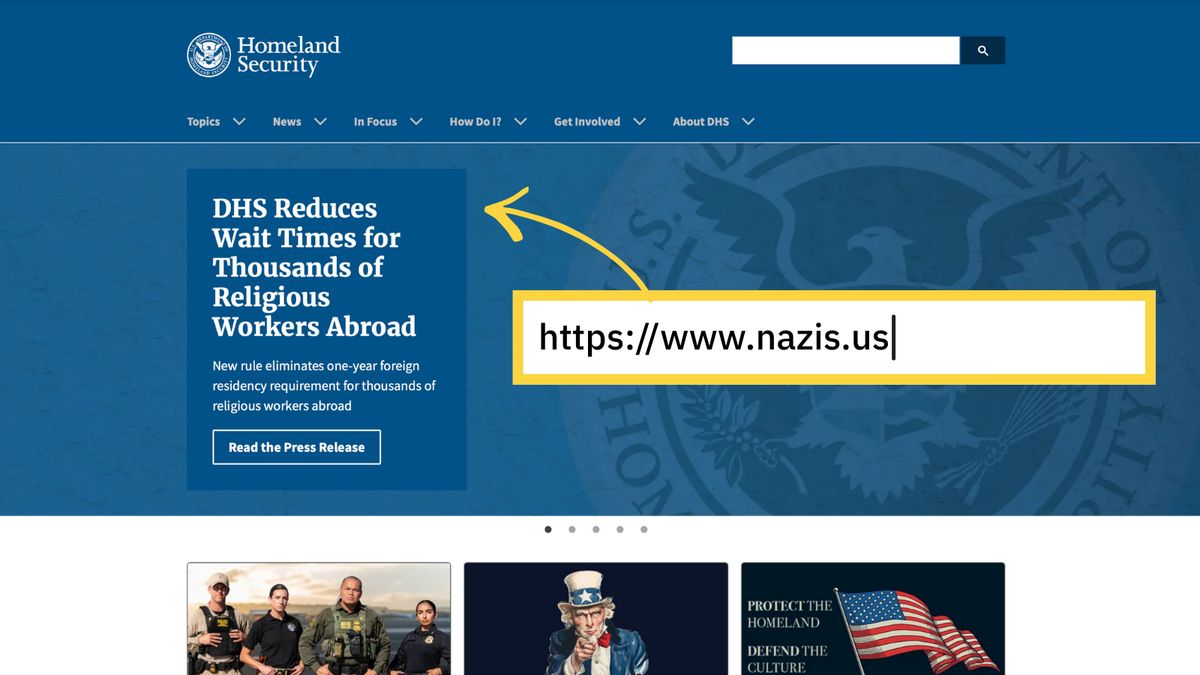
In a controversial digital move, typing the domain “nazis.us” into web browsers currently redirects users to the official website of the U.S. Department of Homeland Security (DHS.gov), Snopes has confirmed after investigating widespread social media claims.
The redirection works universally across major browsers including Safari, Chrome, and Firefox on both Mac and PC operating systems, lending credence to posts that began circulating in mid-January 2026 across platforms like X, Threads, Facebook, and BlueSky.
The domain registration appears to be a deliberate political statement regarding the Trump administration’s recent immigration enforcement tactics. The provocative domain name alludes to comparisons some critics have drawn between current DHS operations and historical authoritarian regimes.
According to a Whois lookup investigation conducted by Snopes, the domain was registered on January 13, 2026, through GoDaddy for a one-year period. The registrant information pointed to Mark Davis, an independent candidate running for Congress in Florida’s 16th Congressional District.
All administrative fields in the domain registration contained “markdavisforcongress.com donate” with the contact email listed as “mark.davis@markdavisforcongress.com,” establishing a clear link to Davis’ campaign. On January 15, Davis’ campaign account on X appeared to acknowledge responsibility, posting: “Whoever did that, give them a donation,” with a link to his campaign fundraising page.
The digital protest comes amid heightened tensions over immigration enforcement policies. President Trump’s administration has deployed DHS operatives, including Immigration and Customs Enforcement (ICE) agents, across numerous Democratic-led states in recent months. These operations have drawn intense criticism from immigration advocates and civil liberties organizations.
Some opponents of the current immigration enforcement approach have made explicit comparisons between ICE operations and tactics used by the Gestapo, the secret police of Nazi Germany. This controversial comparison has been debated among historians, political analysts, and human rights advocates.
Recent data analysis by CNN revealed striking differences in how ICE conducts arrests in Republican versus Democratic states, fueling concerns about potentially partisan enforcement of immigration laws. According to their August 2025 report, tactics and targeting priorities show significant variations depending on state political leadership.
Dana Leigh Marks, a trailblazing former immigration judge, spoke out in September 2025, comparing some ICE tactics to those of the Gestapo in an interview with The Guardian. Her comments reflected growing alarm among some legal professionals about enforcement methods.
Holocaust scholar Daniel H. Magilow noted in a July 2025 analysis that while Nazi comparisons remain common in American political discourse, they carry significant risks and can be polarizing. However, he explained that such analogies often emerge when people harbor deep fears about institutional overreach.
The domain redirection represents a new front in the digital activism landscape, where political statements can be made through creative use of web technologies. While the gesture has gained attention across social media, it also raises questions about the effectiveness and appropriateness of such tactics in political discourse.
Davis, whose campaign website emphasizes independent positions, has leveraged the attention from this digital maneuver to boost his campaign visibility as he seeks to represent Florida’s 16th District in Congress without major party affiliation.
As immigration policies continue to be a divisive issue in American politics, symbolic gestures like this domain redirection highlight the emotional intensity surrounding the debate and the various ways activists and political candidates are finding to express their viewpoints in the digital age.
Fact Checker
Verify the accuracy of this article using The Disinformation Commission analysis and real-time sources.

13 Comments
This is a complex issue with strong political undertones. While the domain redirect is concerning, we should withhold judgment until all the facts are clear. Responsible reporting is crucial when dealing with sensitive topics like this.
Well said. It’s important to avoid jumping to conclusions and to examine the evidence objectively. I hope further investigation can shed light on the motives behind this domain redirect.
Interesting investigation into the origin of that controversial domain redirect. Seems like a deliberate political statement, though the connection to DHS immigration tactics is a bit tenuous. Curious to see if there are any further developments on this story.
I agree, the domain name is certainly provocative and the timing suggests a political motive. It will be important to see if the registrant’s identity and intentions are verified.
The fact that this domain redirect is connected to a political candidate running for Congress adds an interesting layer to the story. I’m curious to learn more about the registrant’s intentions and whether there are any broader implications for online political discourse and government transparency.
This case highlights the importance of maintaining the integrity and trust of official government websites. While the domain redirect may be intended as a political statement, the potential for confusion or misuse is concerning. I hope the investigation can provide clarity and lead to appropriate accountability.
The connection between the domain name and DHS immigration tactics is certainly thought-provoking. However, I think it’s important to avoid making assumptions and to wait for a more complete understanding of the situation. Responsible reporting and transparency will be key in navigating this sensitive issue.
This is a complex and sensitive issue that deserves careful examination. While the domain redirect is certainly provocative, I’m hesitant to draw firm conclusions without a more complete understanding of the situation. Transparent and ethical journalism is crucial in cases like this.
The connection between the domain name and DHS immigration tactics is troubling, but the details of this case are still murky. I’m curious to learn more about the registrant’s background and potential political agenda.
You’re right, more information is needed to fully understand the context and implications here. This appears to be a sensitive and politically charged issue that deserves a careful, fact-based approach.
The revelation that this domain redirect appears to be a deliberate political statement is eye-opening. However, I think it’s important to withhold judgment until we have a clearer picture of the registrant’s motivations and the full context. Responsible reporting is essential here.
This is a concerning development that raises questions about government oversight and transparency. While the domain redirect may be intended as a political statement, the potential misuse of government websites is worrying. I hope the investigation can provide clarity.
I share your concerns about the potential misuse of government websites. It’s critical that the public can trust the integrity of official online presences. Thorough investigation and accountability will be important in this case.