


Listen to the article
Trump Meets Former Al-Qaida Leader at White House in Historic Diplomatic Shift
In a remarkable diplomatic turn, U.S. President Donald Trump welcomed Syrian interim President Ahmed al-Sharaa to the White House on November 10, 2025, marking the first time a Syrian president has visited the executive mansion in Washington, D.C.
The meeting, which was closed to outside press, drew significant attention not for its historic nature alone, but because al-Sharaa previously led al-Nusra Front, al-Qaida’s affiliate in Syria, before reportedly severing ties with the terrorist organization in 2016.
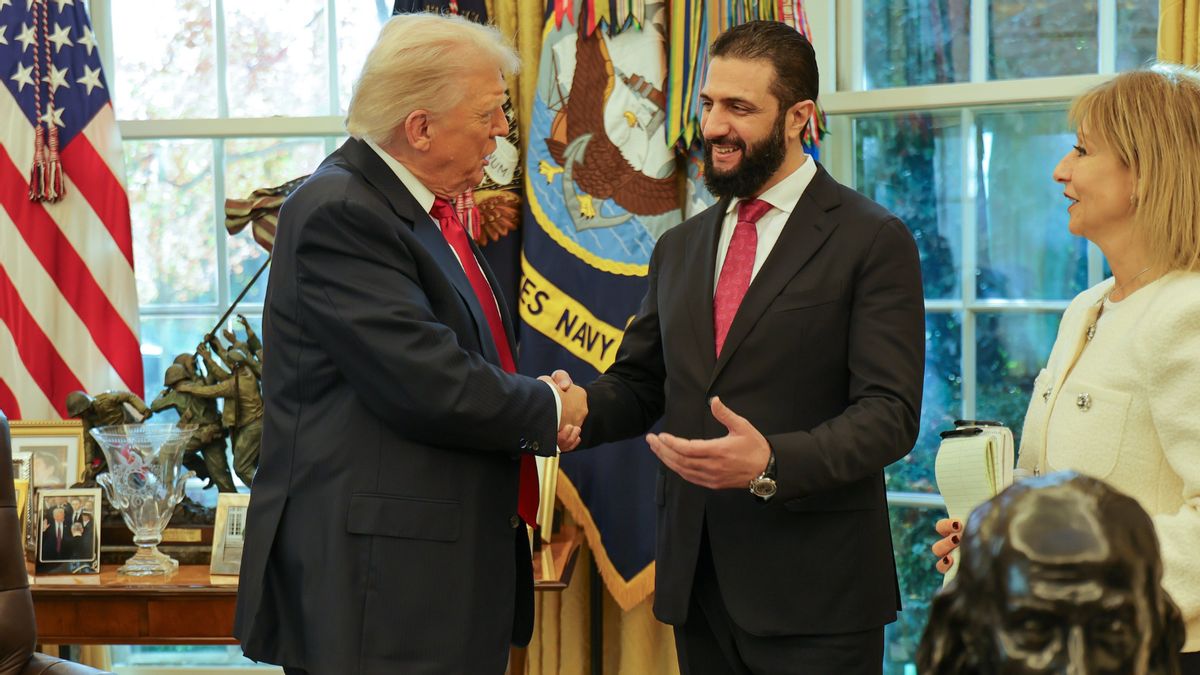
Images of the encounter showed the two leaders shaking hands in the Oval Office, with photos released by the Syrian Presidency’s verified X account and distributed by major news agencies including Getty Images, The Associated Press, and Reuters.
Al-Sharaa’s journey from designated terrorist to White House guest represents one of the most dramatic political transformations in recent Middle East history. The U.S. State Department designated him as a terrorist in 2013 under his former name, Mohammad al-Golani, and offered a $10 million reward for information leading to his capture.
During a 2021 interview with PBS, al-Sharaa admitted to traveling to Iraq shortly before the 2003 U.S. invasion and acknowledged his involvement with al-Qaida. U.S. troops reportedly detained him between 2005 and 2011. Following his release, he met with Abu Bakr al-Baghdadi, then-leader of the Islamic State group, securing resources to establish al-Nusra Front in Syria.
By early 2017, al-Sharaa had rebranded, leading Hayat Tahrir al-Sham (HTS), a coalition of groups fighting to overthrow President Bashar Assad’s government in Syria. The gambit succeeded in December 2024 when HTS toppled the Assad regime, ending the family’s five-decade rule over Syria. Al-Sharaa was subsequently elected interim president.
Just four days before his White House visit, the United Nations Security Council lifted terrorism-related sanctions on al-Sharaa, clearing a diplomatic path for his meeting with Trump.
After their talks, Trump expressed confidence in al-Sharaa’s leadership abilities despite acknowledgment of his controversial background. During a live-streamed swearing-in ceremony for the incoming U.S. ambassador to India, Trump told reporters: “We want to see Syria become a country that’s very successful and I think this leader can do it, I really do. And people said he’s had a rough past, we’ve all had rough pasts, but he has had a rough past, and I think, frankly, if you didn’t have a rough past, you wouldn’t have a chance.”
This wasn’t the first meeting between the two leaders. Trump previously met al-Sharaa in Saudi Arabia in May 2025, describing him as a “young, attractive guy — tough guy” with a “strong past.”
White House officials confirmed that Syria would join a global coalition to fight the Islamic State group as part of the agreement reached during their meeting. The U.S. also pledged to work toward lifting sanctions against Syria that had been imposed during the Assad regime.
The diplomatic rapprochement represents a significant shift in U.S.-Syria relations. The last time a U.S. president met with a Syrian counterpart was in 2000, when then-President Bill Clinton met Hafez Assad, Bashar Assad’s father, in Geneva.
Following HTS’s victory over the Assad government, al-Sharaa has moved to consolidate power through institutional means. He reportedly announced plans to disband the armed groups that overthrew Assad and instead train their fighters to join Syria’s new defense ministry, signaling a potential transition from insurgent leader to state builder.
The Trump-al-Sharaa meeting has generated both support and criticism. While some view it as pragmatic engagement with Syria’s new reality, others question the propriety of hosting a former al-Qaida leader at the White House, especially given the group’s responsibility for the September 11, 2001 attacks that killed nearly 3,000 Americans.
The European Union has also moved to normalize relations with the new Syrian government, lifting economic sanctions in May 2025 following a political agreement with al-Sharaa’s administration.
Fact Checker
Verify the accuracy of this article using The Disinformation Commission analysis and real-time sources.

22 Comments
This seems like a high-stakes gambit by the Trump administration, betting on the possibility of political transformation. The security implications will need to be thoroughly examined.
Agreed, there are major risks involved. The White House will face tough questions about its vetting process and diplomatic strategy.
While diplomatic outreach is important, engaging with a former al-Qaida leader seems like an extremely risky and controversial move. I hope the administration has a well-thought-out plan to address the significant security concerns.
Agreed, the security risks appear to far outweigh any potential benefits. The administration will need to provide a very compelling justification to gain public trust on this issue.
Fascinating diplomatic shift, though meeting with a former al-Qaida leader raises understandable concerns. Curious to learn more about the context and rationale behind this engagement.
Yes, it’s a complex and delicate situation that requires careful consideration of all factors. The public will likely scrutinize this meeting closely.
This is a remarkable diplomatic shift, though the optics and security implications are highly concerning. I’m curious to learn more about the administration’s strategic rationale and risk mitigation measures.
Absolutely, the public will be closely watching to see how the administration handles this delicate situation and communicates its objectives and safeguards.
This meeting is certainly a newsworthy diplomatic development, but it also raises serious concerns about national security and the White House’s judgment. Careful vetting and transparency will be essential.
I share your concerns. The administration will face tough questions from Congress and the public about the decision-making process and potential implications.
Curious to see how this meeting and potential diplomatic realignment will impact U.S. relations with allies in the region. There are likely complex regional power dynamics at play.
Definitely, this move could have far-reaching geopolitical implications that will need to be carefully considered. Allies may have serious concerns about the shift.
Engaging with a former al-Qaida leader is a major departure from standard U.S. counterterrorism policy. I’m curious to see how this plays out and what the administration’s long-term objectives are.
Absolutely, this is a significant shift that warrants close scrutiny. The administration will need to clearly articulate its strategic vision and risk mitigation approach.
Remarkable that the U.S. is now engaging with someone who was previously a designated terrorist. This represents a major shift in regional geopolitics and counterterrorism efforts.
You’re right, this is a dramatic turnaround. It will be critical for the administration to transparently explain its reasoning and risk mitigation strategy.
Meeting with a former al-Qaida leader in the Oval Office is certainly a dramatic development, but it also raises serious questions about the White House’s judgment and commitment to counterterrorism efforts. Transparency will be crucial going forward.
You raise valid points. The administration will face intense scrutiny over this decision and must provide a clear, evidence-based justification to maintain credibility on national security matters.
While diplomacy is important, this seems like an extremely risky and controversial decision. I hope the administration has robust safeguards and a clear endgame strategy.
Agreed, the risks appear to outweigh the potential rewards here. Transparency and a coherent rationale will be crucial for the White House.
While diplomacy is important, meeting with a former terrorist leader is extremely controversial. I hope the administration has solid intelligence and a clear strategic rationale for this outreach.
Absolutely, the optics alone are very challenging. The White House will need to provide compelling justification to gain public trust on this issue.