


Listen to the article
Fake Dawn Headline About AI Platform Circulates on Social Media
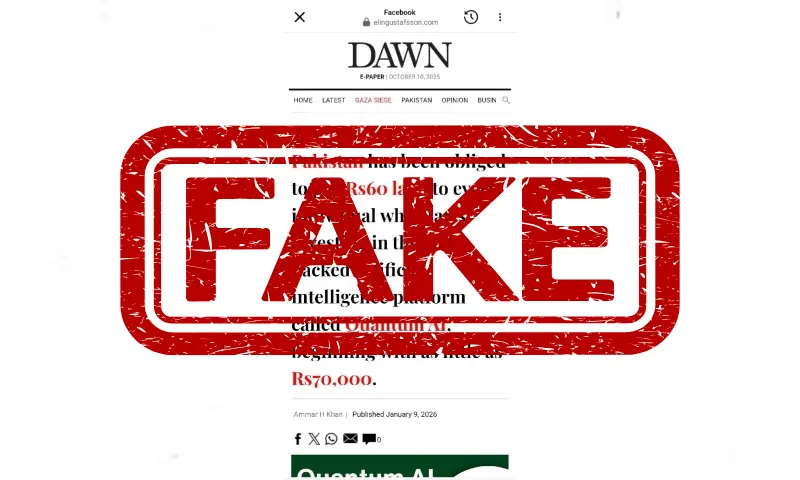
Social media users have been sharing a fraudulent screenshot claiming to be from Dawn newspaper, falsely suggesting that the Pakistani government would pay citizens to invest in an artificial intelligence platform, Dawn confirmed on Friday.
The fabricated image displays a headline stating: “The Parliament of Pakistan has been obliged to pay Rs6o lakh to every individual who starts investing in the state-backed artificial intelligence platform called Quantum AI, beginning with as little as Rs70,000.”
Dawn officials quickly identified multiple inconsistencies in the fake screenshot. The headline’s formatting and unusual length deviate significantly from the publication’s established style guide, particularly with certain words appearing in red text – a format not used by the newspaper.
Further analysis revealed that the web address shown in the image does not match Dawn’s official domain. Perhaps most tellingly, the date displayed beneath the masthead shows “October 2025,” suggesting the creators superimposed their fraudulent headline over an existing screenshot of the publication’s website.
This appears to be part of a growing trend of scammers exploiting the credibility of established news organizations to promote questionable investment schemes. The mention of a modest initial investment (Rs70,000) followed by promises of substantial returns (Rs60 lakh) bears hallmarks of typical investment scams.
The false headline specifically mentions “Quantum AI,” a term that combines two buzzworthy technologies to potentially lend an air of sophistication to the fraudulent scheme. In reality, Pakistan’s government has announced no such nationwide artificial intelligence investment initiative.
Dawn has urged its readers to exercise caution when encountering such content and to verify information by visiting the newspaper’s official website directly rather than relying on shared screenshots or links.
This isn’t the first recent attempt to misuse Dawn’s reputation. Earlier this week, another fraudulent webpage impersonating the publication circulated false claims about Defence Minister Khawaja Asif, suggesting he had criticized the Punjab government over governance issues and rising crime rates. No such article was published by Dawn.
The proliferation of such sophisticated fake news attempts highlights the growing challenge faced by media organizations and readers alike in distinguishing legitimate reporting from fraudulent content. Media literacy experts recommend checking publication dates, URLs, and unusual formatting as quick ways to identify potential misinformation.
Authorities in Pakistan have previously warned about investment scams targeting citizens through social media, particularly those promising unrealistically high returns with minimal investment. The Pakistan Telecommunication Authority and the Federal Investigation Agency’s cybercrime wing have urged citizens to report such fraudulent schemes.
For legitimate news, readers are encouraged to access Dawn and other reputable publications through their official websites or verified social media accounts rather than relying on forwarded content or screenshots which can easily be manipulated.
The incident underscores the importance of critical evaluation of news sources in an era where digital manipulation tools have made creating convincing fake content increasingly accessible to those with malicious intent.
Fact Checker
Verify the accuracy of this article using The Disinformation Commission analysis and real-time sources.

8 Comments
While the lure of easy money can be enticing, it’s always wise to be skeptical of claims that seem too good to be true. I’m glad Dawn is proactively addressing this misinformation to prevent people from falling for the scam.
It’s disheartening to see how quickly and widely false narratives can spread on social media. I hope this incident serves as a reminder for people to fact-check information, especially when it comes to financial or investment-related claims.
Agreed. Disinformation campaigns can have real-world consequences, so it’s crucial that news outlets and fact-checkers remain vigilant in debunking these kinds of stories.
The idea of the government paying citizens to invest in an AI platform does seem rather far-fetched. I’m curious to learn more about Dawn’s investigation and how they were able to conclusively identify this as a fabrication.
This is a valuable case study in the importance of media literacy and critical thinking. Kudos to Dawn for their thorough investigation and swift response in setting the record straight.
The level of detail in this fabricated screenshot is quite impressive, though of course that doesn’t make it any less misleading. It’s important for people to be vigilant about checking the source and veracity of news they encounter online.
Absolutely. With the prevalence of deepfakes and other advanced editing techniques, it’s crucial to approach any seemingly sensational news with a critical eye.
Interesting that this fake news story is circulating on Pakistani social media. It’s concerning how misinformation can spread so quickly online these days. I’m glad Dawn was able to quickly identify and debunk this fabricated headline.