


Listen to the article
Nigerian Immigrant Welfare Claims Debunked by Economic and Statistical Evidence
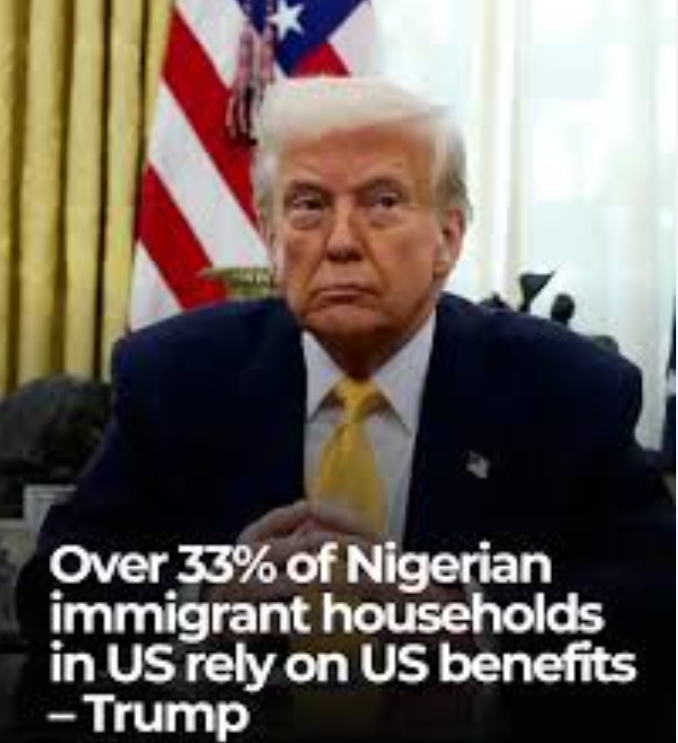
A viral claim suggesting that 33.3% of Nigerian immigrant households in the United States rely on welfare has been thoroughly discredited by comprehensive data analysis from leading immigration research organizations.
The statistic, recently amplified when shared by President Donald Trump, presents a misleading picture of Nigerian immigrants’ economic contributions to American society, according to multiple independent analyses. The figure’s primary flaw lies in its methodology – counting entire households as “welfare recipients” if any individual member, including U.S.-born children, accesses any government program.
Immigration experts point out that this household-based calculation creates a fundamental distortion. When U.S.-born children of Nigerian immigrants – who are American citizens by birthright – receive services like school lunches or routine health checkups, their entire household is classified as welfare-dependent, regardless of the parents’ economic self-sufficiency or taxpayer status.
This statistical approach obscures a crucial legal reality: most legal permanent residents face a mandatory five-year waiting period before becoming eligible for federal assistance programs like SNAP (formerly food stamps) or Medicaid. Many immigrants never qualify for these benefits at all, creating what analysts describe as a statistical paradox – how can a population be labeled “dependent” on systems they largely cannot access?
Data from the Cato Institute directly contradicts the dependency narrative, showing immigrants collectively consume approximately 21% less in government benefits than native-born Americans. For Nigerian immigrants specifically, the economic contributions are particularly notable.
The Migration Policy Institute has consistently documented that sub-Saharan African immigrants, with Nigerians at the forefront, rank among America’s most educated demographic groups. They are significantly more likely to hold bachelor’s or advanced degrees than the general U.S. population and are disproportionately represented in essential sectors including healthcare, engineering, and education.
“The economic contribution of these individuals is a two-way street that the viral chart conveniently ignores,” explains Odimegwu Onwumere, Chairman of the Advocacy Network On Religious And Cultural Coexistence. “Through payroll, property, sales, and income taxes, Nigerian immigrants contribute billions to the very programs they are accused of draining.”
Even undocumented immigrants often contribute to federal programs they cannot access, using Taxpayer Identification Numbers to pay into Social Security and Medicare systems they may never benefit from. This reality transforms many immigrant households into net contributors to government coffers rather than financial burdens.
Questions also surround the methodological integrity of the 33.3% figure itself. The statistic was presented without verifiable citation from any peer-reviewed study or recognized government agency like the U.S. Census Bureau. Without transparency regarding data collection year, specific programs counted, or income thresholds applied, experts consider the number statistically unreliable.
The welfare dependency narrative also creates a troubling double standard. Public assistance programs are designed as temporary support systems – helping families navigate medical emergencies, employment transitions, or child-rearing costs. When native-born Americans access these systems, they’re viewed as social safety nets functioning as intended. When immigrants use the same programs, the narrative often shifts to one of dependency or burden.
The actual economic story of Nigerian immigrants in America is found in their outsized contributions to critical sectors of the economy. From staffing rural hospitals to teaching at prestigious universities and launching businesses that revitalize communities, these immigrants represent a significant economic engine rather than a drain.
Professional achievements, entrepreneurship rates, and tax contributions tell a consistent story: Nigerian immigrants in America represent one of the country’s most successful immigrant communities, contradicting simplistic narratives of dependency or economic burden.
“The real value of immigrant communities can’t be reduced to a single, context-free percentage,” notes Onwumere. “When you examine the complete economic picture, Nigerian immigrants aren’t taking from the system – they’re one of the most vibrant forces keeping it running.”
Fact Checker
Verify the accuracy of this article using The Disinformation Commission analysis and real-time sources.

12 Comments
The fact that legal permanent residents face restrictions on accessing welfare programs is an important context that seems to have been overlooked in these misleading claims. Good to see independent analyses pushing back on the inaccurate statistics.
Absolutely, the legal realities around welfare eligibility for immigrants need to be properly accounted for. Glad to see this debunking based on thorough data and expertise.
Interesting analysis of the misleading welfare claims about Nigerian immigrants. Seems the methodology was flawed, as it counted entire households as ‘welfare recipients’ even if just the US-born children accessed basic services. Important to look at the full picture and economic contributions of this group.
Agreed, using household-based calculations can really distort the reality. Looking at individual circumstances and taxpayer status is key to getting an accurate understanding.
This article does a nice job of breaking down the problems with the 33% welfare claim and putting it in proper context. Appreciate the balanced, fact-based approach to addressing a politically charged narrative.
Agreed, a measured, evidence-based response is crucial when countering inflammatory claims, especially those amplified by public figures. Kudos to the researchers for their thorough and objective analysis.
Interesting to see how a seemingly straightforward statistic can be misleading due to flawed methodology. This highlights the need to critically examine data sources and analysis approaches, especially on sensitive topics like immigration.
Absolutely, the devil is often in the details when it comes to statistics. Good to see this fact check unpacking the nuances and providing a more accurate picture.
This is a useful fact check on an inflammatory claim that was amplified by a political figure. Rigorous analysis from immigration experts is crucial to counter misinformation and ensure public discourse is grounded in facts.
Agreed, fact-checking viral claims, especially those with political overtones, is so important to maintain an informed public dialogue. Appreciate the diligence in getting the real data and context on the record.
It’s encouraging to see comprehensive, independent analyses debunking these kinds of misleading statistics. Rigorous fact-checking is essential to maintaining an informed public discourse, even on contentious topics like immigration.
Absolutely, relying on credible, non-partisan data sources is key. This fact check does a great job of cutting through the noise and getting to the heart of the issue.