


Listen to the article
Immigration figures released by the Office for National Statistics (ONS) yesterday revealed a complex picture of Britain’s migration trends. While net migration fell to approximately 200,000 in the year ending June, this decline was largely attributed to an unusually high number of departures, with 693,000 people leaving the UK during this period. A significant proportion of those departing were under 30 years old.
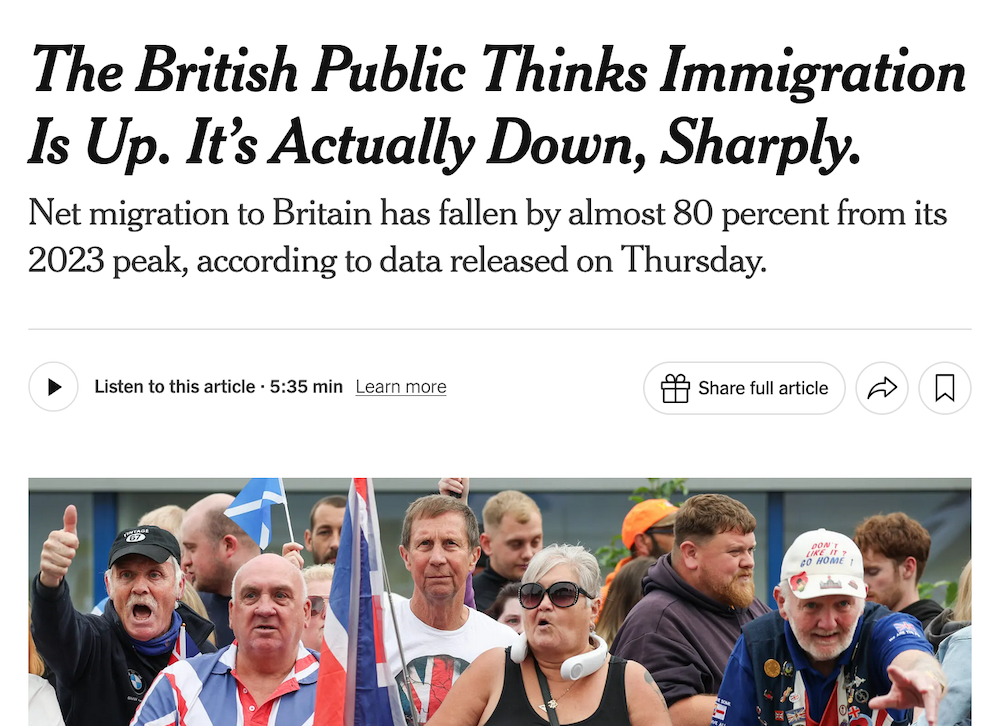
The New York Times published a response to these figures with a headline declaring: “The British Public Thinks Immigration Is Up. It’s Actually Down, Sharply.” The article featured imagery of anti-migration protesters in Scotland, suggesting a disconnect between public perception and statistical reality in Britain.
The American newspaper criticized several British political figures, including Home Secretary Shabana Mahmood, whose “fiery rhetoric,” it claimed, did not align with migration data. Similar criticism was directed at Reform UK’s Nigel Farage and Conservative leadership candidate Kemi Badenoch.
“Britain’s political elites are focusing the public’s attention on migration in ways that are not always accurate, especially when it comes to describing the scale of the flow of people into the country, experts say. That is helping to create a gap between how people perceive immigration in Britain and the facts,” the NYT article stated.
However, a deeper examination of the ONS figures reveals nuances that the NYT’s coverage appears to overlook. While the newspaper correctly noted immigration decreased from 1.3 million to approximately 898,000, this contextual framing deserves scrutiny.
The current immigration level of 898,000 remains extraordinarily high by historical standards. The recent decline only appears sharp when compared to the unprecedented peak of 1.4 million recorded in 2023, following the post-Brexit and post-pandemic policy changes implemented during Boris Johnson’s premiership.
In fact, excluding the exceptional immigration surge that occurred after 2020 (sometimes referred to as the “Boriswave”), last year’s immigration figures would represent the highest on record since the UK began collecting such data.
This historical context suggests that public concerns about high immigration levels may be better grounded in reality than the NYT article implies. While immigration has technically decreased year-on-year, the absolute numbers remain at historically elevated levels that would have been considered extraordinary just a few years ago.
The disconnect between raw immigration figures (people arriving) and net migration (arrivals minus departures) further complicates the narrative. The notable decline in net migration was significantly influenced by departures rather than by a dramatic reduction in new arrivals.
Immigration remains a politically sensitive issue in the UK, particularly following the 2016 Brexit referendum when reducing migration was a key campaign promise. The Labour government, which took office in July, has pledged to tackle both legal and illegal migration, though their specific approaches differ from their Conservative predecessors.
The ONS data also raises questions about demographic shifts, with the high departure rate of younger individuals potentially impacting the UK’s workforce and economy in coming years. This aspect of migration patterns merits closer attention as policymakers grapple with labor market challenges and public service provision.
As migration continues to feature prominently in British political discourse, the interpretation of statistics will remain contentious. What’s clear is that understanding migration trends requires looking beyond headline figures to examine historical context, absolute numbers, and demographic patterns that shape Britain’s changing population.
Fact Checker
Verify the accuracy of this article using The Disinformation Commission analysis and real-time sources.

12 Comments
The data on increased departures, especially among younger Britons, is quite intriguing. I wonder what factors might be driving this trend and how it could impact the UK’s workforce and demographics going forward.
This is a sensitive topic that requires careful, impartial examination. While the NYT article raises valid concerns, I’d be interested to hear perspectives from a range of experts and stakeholders to get a more complete picture.
Agreed. Balanced reporting that incorporates diverse viewpoints and in-depth analysis is crucial when dealing with complex, politically charged issues like immigration.
Interesting to see the nuances in UK immigration data. While net migration fell, there was a significant increase in departures, especially among the younger population. It’ll be important to analyze this data in context and avoid oversimplification.
Agreed. The public perception and political rhetoric don’t always align with the statistical reality. A balanced analysis is needed to properly understand the complexities of migration trends.
This report highlights the importance of distinguishing between net migration and other migration figures when analyzing trends. Oversimplifying the data can lead to misleading conclusions, as the NYT article seems to suggest.
Absolutely. Digging deeper into the nuances of the data is crucial to avoid perpetuating inaccurate narratives, whether from politicians or the media.
It’s encouraging to see the Disinformation Commission fact-checking the claims made by NYT experts on UK immigration. Maintaining a critical eye on the accuracy of reporting, especially on sensitive political issues, is vital for public discourse.
The NYT’s critique of British political figures’ rhetoric on immigration seems warranted, based on the data presented. However, it’s important to understand the broader context and factors driving public perception on this issue.
Good point. Simplistic comparisons between statistics and rhetoric can overlook the complex social and economic dynamics at play. A more holistic analysis would be valuable.
This report raises valid questions about how migration data is portrayed and interpreted by policymakers and the media. It’s crucial to examine the facts objectively and avoid partisan narratives on such a sensitive issue.
Absolutely. Fact-checking and nuanced reporting are essential to avoid fueling misinformation or exaggerated claims, regardless of political affiliation.