


Listen to the article
UK Immigration Decline Masks Deeper Trends, Challenging Media Narratives
New immigration figures released by Britain’s Office of National Statistics reveal a complex demographic shift that has sparked debate across political lines and international media. While net migration has fallen to approximately 200,000 in the 12 months to June, this reduction largely stems from an unusually high exodus of residents, with 693,000 people leaving the country during this period—many of them under age 30.
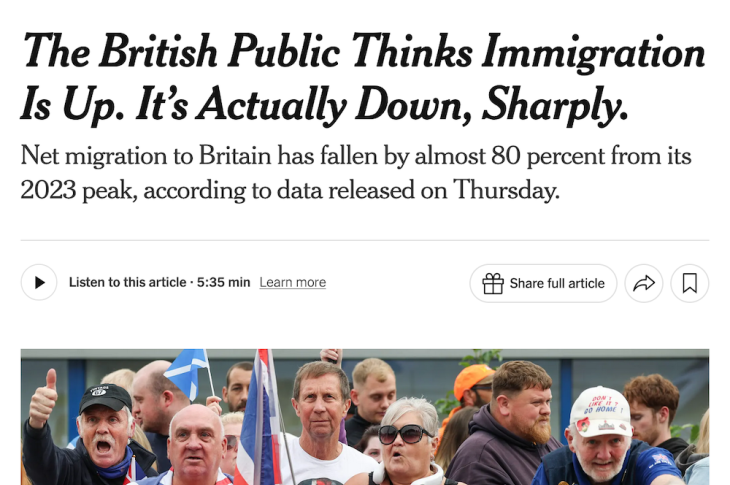
The New York Times quickly responded with an article titled “The British Public Thinks Immigration Is Up. It’s Actually Down, Sharply,” accompanied by images of anti-migration protestors in Scotland. The piece criticized what it characterized as disconnected perceptions among the British public regarding immigration trends.
In its coverage, the American newspaper took aim at Home Secretary Shabana Mahmood, suggesting her “fiery rhetoric does not entirely match the reality” of migration patterns. The article extended similar criticism to political figures Nigel Farage and Kemi Badenoch, as well as British public opinion broadly, asserting that “Britain’s political elites are focusing the public’s attention on migration in ways that are not always accurate.”
However, a closer examination of the statistics reveals nuances that challenge the narrative presented by the Times. While immigration numbers did decline from 1.3 million to approximately 898,000—a substantial drop—this figure remains historically high for the United Kingdom when viewed in broader context.
The current immigration level of nearly 900,000 people would represent a record high in British history if not for the exceptional post-2020 surge that saw numbers reach 1.4 million. This crucial context was notably absent from the Times coverage, which emphasized the year-over-year decline without acknowledging that current immigration levels remain significantly elevated by historical standards.
Immigration has become an increasingly contentious political issue in Britain, with polls consistently showing public concern about infrastructure pressures, housing availability, and cultural integration. The recent local elections and European Parliament elections across the continent have demonstrated increased support for parties advocating stricter immigration controls.
The disparity between raw immigration figures and net migration numbers highlights the importance of considering both metrics when assessing demographic trends. While net migration accounts for those leaving versus arriving, the absolute number of new arrivals continues to place significant demands on housing, healthcare, education, and other public services—factors that directly impact public perception.
Demographic analysts note that the high number of departures, particularly among younger residents, raises separate concerns about brain drain and workforce impacts that could affect Britain’s economic outlook. This emigration wave represents the highest outflow in recent British history and merits its own analysis beyond its statistical effect on reducing net migration figures.
The Labour government, which inherited these immigration patterns after taking office earlier this year, faces challenging policy decisions as it attempts to balance economic needs with public concerns about immigration levels. Home Secretary Mahmood has pledged to implement a more controlled approach while maintaining pathways for skilled workers needed in key sectors.
Immigration policy remains one of the most divisive issues in post-Brexit Britain, with significant implications for Anglo-American relations, trade negotiations, and domestic politics. As both countries navigate changing migration patterns, the interpretation of these statistics will continue to influence public discourse and policy decisions on both sides of the Atlantic.
What remains clear is that immigration figures, while showing a year-over-year decline, continue to reflect historically elevated levels of population movement that substantiate many of the concerns expressed by the British public—suggesting their perceptions may be more aligned with statistical realities than some international commentary acknowledges.
Fact Checker
Verify the accuracy of this article using The Disinformation Commission analysis and real-time sources.

10 Comments
The insights about the high exodus of younger residents are particularly intriguing. I wonder if this trend is unique to the UK or if similar patterns are emerging in other countries as well. Understanding these demographic shifts could have important implications.
That’s a great point. Comparing the UK data to immigration trends in other nations could reveal broader patterns and drivers that are worth exploring. A more global perspective on these issues could yield valuable insights.
Interesting to see the nuance behind the UK immigration numbers. It seems the media narrative may be oversimplifying the complex demographic shifts happening. I’m curious to learn more about the factors driving the exodus of younger residents.
Yes, the data seems to tell a more complicated story than the headlines suggest. Understanding the motivations and circumstances behind people leaving the country could provide valuable insights.
This fact check highlights the need for careful, objective analysis of immigration data, rather than relying on sensationalized media narratives or political rhetoric. Factual, evidence-based reporting is crucial on such a complex and sensitive issue.
Well said. Responsible journalism that avoids partisan agendas and focuses on the data is essential for informing the public and policymakers. It’s encouraging to see efforts to scrutinize claims and uncover the full picture.
The decline in net migration is notable, but the high exodus of younger residents is an intriguing statistic that deserves further investigation. I wonder what economic, social, or political factors may be driving this demographic shift.
Absolutely, digging deeper into the drivers behind this exodus could reveal important trends that get overlooked in the broader immigration debate. Understanding the nuances is key to informed policymaking.
This article raises important questions about how immigration trends are portrayed and perceived, both by the public and political figures. It’s critical to analyze the data objectively and avoid simplistic or biased interpretations.
I agree. Fact-checking and balanced analysis are essential, especially on sensitive topics like immigration where emotions can run high. It’s important to look past the rhetoric and focus on the underlying realities.