


Listen to the article
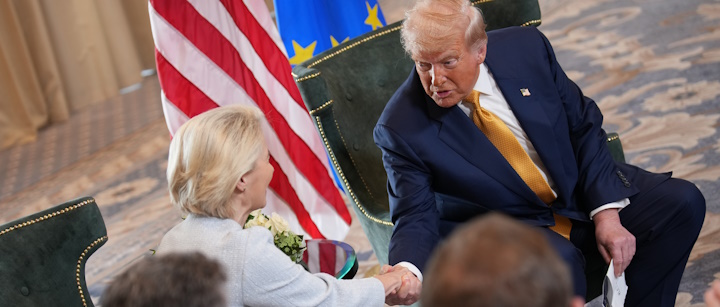
In a significant diplomatic development, the United States and European Union have reached a preliminary trade agreement that averts a threatened 30% tariff on EU imports. The deal, announced by former President Donald Trump on July 27 after meeting with European Commission President Ursula von der Leyen in Scotland, instead establishes a 15% tariff on most goods from the 27-nation bloc.
The agreement comes after weeks of heightened trade tensions following Trump’s July 11 letter to von der Leyen, which threatened the higher tariffs beginning August 1. Trump had claimed EU tariffs and non-tariff policies were responsible for the “large and unsustainable trade deficits” between the U.S. and EU, which he characterized as “a major threat to our economy and, indeed, our National Security.”
According to Trump, the new arrangement includes commitments from the EU to purchase $750 billion worth of U.S. energy, invest $600 billion in the American economy, and buy unspecified amounts of American-made military equipment. He also claimed the deal would allow U.S. goods to enter European markets tariff-free, though European Commissioner for Trade Maroš Šefčovič later clarified that zero tariffs would apply only to “a significant list of goods,” not all products.
That list reportedly includes aircraft parts, certain generic drugs and chemicals, natural resources, and some agricultural products. The complete terms remain undisclosed, and the agreement still requires approval from all individual EU member states.
Economic experts, however, dispute Trump’s assertion that EU trade policies are the primary cause of the trade imbalance. The U.S. exported $666.7 billion in goods and services to the EU in 2024, while importing more than $815.1 billion, creating a deficit of approximately $148.4 billion – the largest in records dating back to 1999, according to Bureau of Economic Analysis data.
“One reason the US runs a large bilateral trade deficit with Europe is that we have a large multilateral deficit overall,” explained Robert C. Johnson, an associate professor of economics at Notre Dame University. This multilateral deficit reflects broader macroeconomic factors, particularly Americans investing more in the U.S. economy than they save, leading to foreign borrowing to cover the difference.
Gene M. Grossman, professor of economics at Princeton University, called it “absurd” to blame EU tariffs for the deficit, noting that “the average tariff on US exports to the EU is low and very similar to the average tariff on EU imports to the US.” According to the European Commission, the practical average tariff rate between the two economies is approximately 1%.
While a Federal Reserve Bank of St. Louis analysis found that the EU does employ non-tariff measures more extensively than the U.S. across most sectors, Johnson pointed out these policies aren’t “explicitly targeted at the U.S.” but apply to all suppliers in the EU market.
The Congressional Research Service has noted that many economists attribute the U.S. goods trade deficit “more to macroeconomic variables, such as a relatively low savings rate and relatively high consumer spending in the United States compared to other economies, than trade practices.”
Experts also questioned whether increasing tariffs would achieve Trump’s goal of balancing trade. Johnson suggested that higher tariffs on EU goods might decrease the deficit with Europe by diverting U.S. import demand to alternative trading partners, but this could simply shift the deficit to other countries.
“Historically, tariffs have been associated with, on average, a small reduction in trade deficits, but not consistently,” Grossman noted, adding that outcomes depend on whether tariffs are temporary or permanent.
Johnson further emphasized that bilateral trade deficits shouldn’t be overinterpreted: “Even with balanced trade overall, we would likely run deficits with some countries and surpluses with others. There is no reason why trade ought to be balanced at the bilateral level.”
As negotiations continue toward finalizing this agreement, its broader economic impact remains to be seen in an already complex global trade landscape.
Fact Checker
Verify the accuracy of this article using The Disinformation Commission analysis and real-time sources.

9 Comments
Interesting to see the back-and-forth between the U.S. and EU on trade tariffs. Curious to learn more about the details of this new agreement and whether it can help address the trade deficit concerns.
Yes, the tariff reduction is a positive step, but the details around energy, investment, and military equipment purchases will be important to watch.
The timing of this deal, right before the Trump administration left office, raises some questions about the motivations and long-term viability of the agreement. I’ll be curious to see if the Biden administration maintains this approach.
Good observation. The political transitions could definitely impact the implementation and continuity of this trade deal.
This deal seems like a compromise between the two sides. I wonder how it will impact commodity prices and the mining/energy sectors, which are often affected by trade policies.
Good point. Reduced tariffs could benefit certain industries, but the broader economic impact remains to be seen.
It’s good to see diplomatic efforts to de-escalate trade tensions, but I’m a bit skeptical of the claimed $750 billion in EU energy purchases and $600 billion in U.S. investments. Those figures sound quite high.
Agreed, those numbers seem inflated. I hope the actual commitments and outcomes can be verified independently.
As an investor in mining and energy stocks, I’m hoping this agreement can provide some stability and predictability in the markets, which have been volatile due to trade policy uncertainty.