


Listen to the article
In a disturbing example of misinformation spreading online, recent claims suggesting that newly released Epstein documents contain evidence that Ellen DeGeneres murdered and cannibalized actress Anne Heche have been thoroughly debunked by fact-checkers.
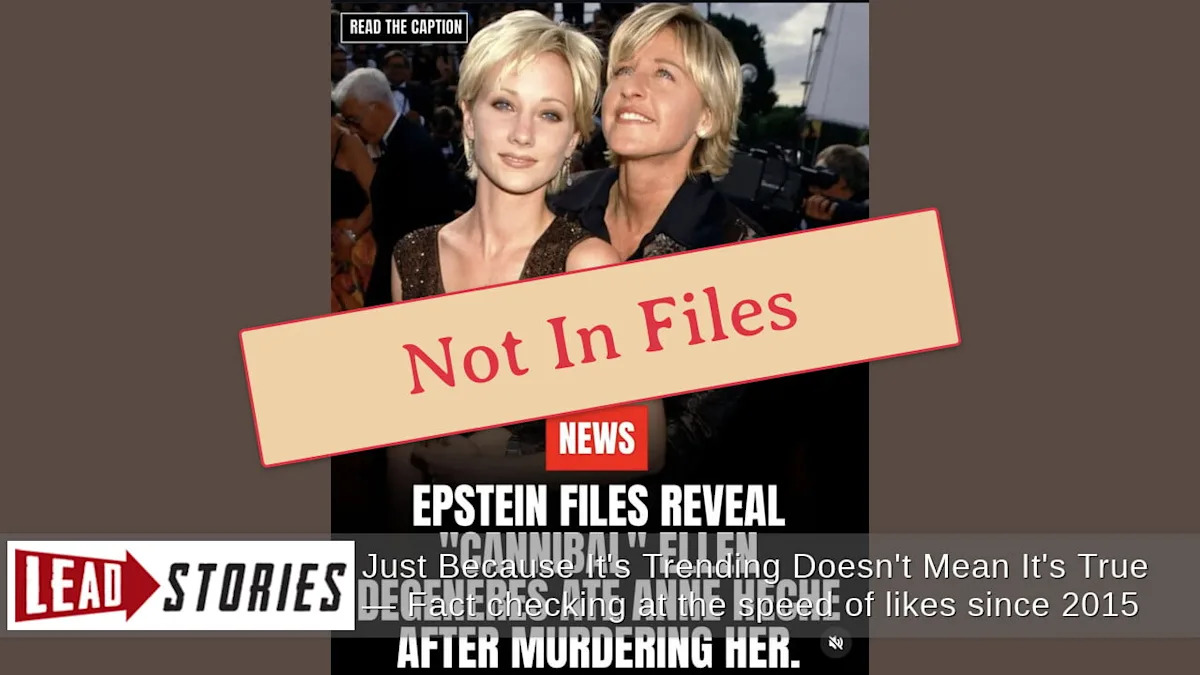
The false claim appeared on March 3, 2026, in a post on X (formerly Twitter) from the account @JeckovKanani with the caption “The files are a horror movie 😢” alongside an image of DeGeneres and Heche with text claiming “EPSTEIN FILES REVEAL ‘CANNIBAL’ ELLEN DEGENERES ATE ANNE HECHE AFTER MURDERING HER.”
An examination of the Department of Justice (DOJ) documents related to Jeffrey Epstein reveals this claim is entirely fabricated. Heche’s name appears only once in the files—in a newspaper headline visible in the sidebar of another article on page 28 of the documents. There is absolutely no mention of DeGeneres being a “cannibal” or any suggestion that she was involved in Heche’s death.
Digital forensics experts have confirmed that keyword searches for “Ellen DeGeneres cannibal” within the documents yield no results, further proving the claim is manufactured.
The actual circumstances of Heche’s death are well-documented. The actress died in August 2022 following a severe car accident in Los Angeles. After being hospitalized with critical injuries including severe burns and brain damage, she was taken off life support several days after the crash. Her death was extensively covered by mainstream media outlets at the time.
This fabrication appears to be part of a growing trend of sensationalist misinformation related to the Epstein documents. Since their release, social media platforms have seen a surge in false claims attempting to link celebrities and public figures to salacious or criminal activities allegedly documented in the files.
Media literacy experts warn that such false information spreads rapidly on social media platforms where shocking claims generate high engagement through shares and comments, regardless of their veracity. The inclusion of actual public figures with a known relationship—DeGeneres and Heche dated from 1997 to 2000—lends a veneer of plausibility to otherwise outlandish claims.
“These types of fabrications are particularly harmful because they exploit real tragedies and real people,” said Dr. Melissa Zimdars, associate professor of communication at Merrimack College. “Not only do they dishonor the memory of someone who died tragically, but they also create harmful conspiracy theories around living individuals.”
The spread of such misinformation highlights the importance of consulting reliable news sources and fact-checking organizations before sharing sensational claims found on social media. Major news outlets worldwide would have reported on such explosive revelations had they actually appeared in official documents.
Social media platforms continue to struggle with effectively moderating false information, despite implementing various fact-checking partnerships and content warning systems. Users are encouraged to verify information through multiple credible sources before sharing potentially harmful content.
This case serves as a stark reminder that even documents related to legitimate legal proceedings can become the foundation for completely fabricated narratives that bear no relation to their actual contents.
Fact Checker
Verify the accuracy of this article using The Disinformation Commission analysis and real-time sources.

12 Comments
The false claim about Ellen DeGeneres and Anne Heche in the Epstein files is a concerning example of how misinformation can spread online. I’m glad the fact-checkers were able to quickly disprove this fabricated story.
Absolutely. It’s a good reminder that we need to be critical consumers of information, especially when it comes to high-profile individuals and sensitive topics. Fact-checking is crucial to combat the spread of misinformation.
It’s disappointing to see such blatantly false claims being made about the Epstein files. I’m glad the fact-checkers were able to thoroughly debunk this particular conspiracy theory. We need to be vigilant in calling out misinformation when we see it.
Agreed. Misinformation can be incredibly harmful, especially when it involves serious allegations against public figures. It’s important to rely on credible sources and fact-based reporting to get the full picture.
This false claim about Ellen DeGeneres and Anne Heche is a disturbing example of the kind of misinformation that can proliferate online. I’m glad the fact-checkers were able to thoroughly debunk it and expose the truth.
Agreed. It’s important that we all remain vigilant and verify information before sharing it, especially when it comes to sensitive topics or high-profile individuals. Fact-checking is essential to maintaining the integrity of public discourse.
This is a concerning example of how misinformation can quickly spread online, even about high-profile individuals. It’s crucial that we rely on reputable sources and fact-checking efforts to separate truth from fiction.
Absolutely. The false claim about DeGeneres and Heche is a stark reminder of the importance of critical thinking and verifying information before sharing it. We all have a responsibility to combat the spread of misinformation.
I’m glad the fact-checkers were able to thoroughly debunk this false claim. It’s a good reminder that we should be skeptical of sensational stories, especially ones that seem too outrageous to be true.
Agreed. The details in the Epstein files have been carefully examined, and there’s no evidence to support the cannibal claim. We need to be responsible consumers of information and not spread unverified rumors.
The false claim about Ellen DeGeneres and Anne Heche in the Epstein files is clearly fabricated. It’s disturbing to see such blatant misinformation spreading online. We need to be vigilant in verifying information, especially around high-profile figures.
Absolutely. Fact-checking is crucial to combat the spread of these kinds of conspiracy theories. It’s important to rely on credible sources and not jump to conclusions based on unsubstantiated claims.