


Listen to the article
Veterans in Congress Call for Military to Uphold Constitutional Duty to Refuse Illegal Orders
A group of Democratic lawmakers with military backgrounds has sparked controversy with a video message urging service members to refuse illegal orders, prompting accusations of sedition from critics who mischaracterized their statement.
Senators Mark Kelly and Elissa Slotkin, along with Representatives Chris Deluzio, Maggie Goodlander, Jason Crow, and Chrissy Houlahan – all veterans of military or intelligence service – released a video on November 18 addressing current service members amid growing political tensions.
The lawmakers emphasized that military personnel “must refuse illegal orders” that violate the Constitution or U.S. laws – a principle enshrined in military law, not a call for insubordination as some critics have claimed.
“You all swore an oath to protect and defend this constitution,” the lawmakers stated in their joint message. “Right now, the threats to our constitution aren’t just coming from abroad, but from right here at home. Our laws are clear. You can refuse illegal orders, you must refuse illegal orders.”
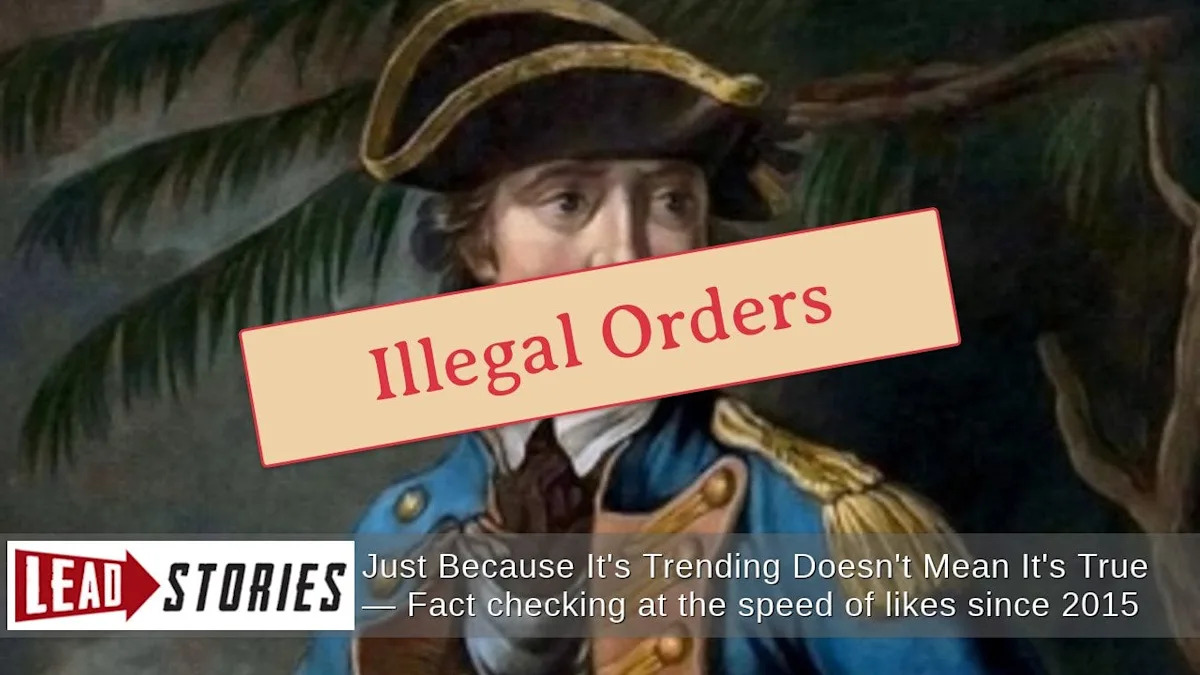
The message quickly became a flashpoint on social media, where critics misrepresented the content by claiming the lawmakers were urging soldiers to disobey legal orders. One viral post on X (formerly Twitter) featured an image of Revolutionary War traitor Benedict Arnold with text alleging: “Several members of congress suggested the Military refuse Legal orders. This is Seditious and Traitorous Behavior.”
This characterization directly contradicts the actual content of the video, which exclusively references illegal orders – not legal ones – and aligns with longstanding military doctrine and law.
The Uniform Code of Military Justice, which governs conduct for all U.S. military personnel, clearly establishes that service members must obey lawful orders from superiors while also maintaining their oath to “support and defend the Constitution of the United States against all enemies, foreign and domestic.”
Military legal experts point out that the duty to disobey illegal orders has been a cornerstone of military justice for generations. The principle was firmly established in American jurisprudence following World War II and reaffirmed in cases like that of Army Lt. William Calley, whose conviction for murdering 22 civilians during the My Lai Massacre was upheld despite his claim that he was following orders.
In that landmark 1973 case, the U.S. Court of Military Appeals ruled: “For 100 years, it has been a settled rule of American law that even in war the summary killing of an enemy, who has submitted to, and is under, effective physical control, is murder.”
The current military oath, largely unchanged since 1789, requires service members to “obey the orders of the President of the United States and the orders of the officers appointed over me, according to regulations and the Uniform Code of Military Justice.”
The crucial phrase “according to regulations” establishes that obedience is conditional on orders conforming to established law – precisely the principle the lawmakers were reinforcing.
The controversy reflects growing political polarization as the incoming administration prepares for the transition of power, with some observers expressing concern about potential conflicts between political directives and constitutional obligations.
Legal scholars note that the lawmakers’ message essentially restates principles taught to all military personnel during basic training, though the current political context has made what would typically be an uncontroversial statement of military ethics into a lightning rod for criticism.
For their part, the lawmakers concluded their message with encouragement for those serving: “We know this is hard and that it’s a difficult time to be a public servant, but whether you’re serving in the CIA, the Army or Navy, the Air Force, your vigilance is critical, and know that we have your back.”
Fact Checker
Verify the accuracy of this article using The Disinformation Commission analysis and real-time sources.

12 Comments
While the language may be provocative, the core message here is about preserving the integrity of the military and its commitment to the rule of law. It’s a complex topic, but one that deserves serious consideration.
This is an important clarification. Members of Congress have a duty to uphold the Constitution and remind the military to refuse illegal orders, not legal ones. It’s a fundamental principle of military law and ethics.
While the message may be controversial, it’s important to understand the context. These members of Congress are not encouraging insubordination, but rather reinforcing the duty to disobey unlawful directives, which is well-established in military doctrine.
It’s encouraging to see members of Congress with military experience speaking up on this issue. Maintaining the military’s ethical standards and respect for the Constitution should be a top priority, even in politically charged times.
Interesting to see this debate unfold. I wonder what the broader implications are for civil-military relations and the role of elected officials in providing oversight and guidance to the armed forces.
This is a delicate issue, but I believe the lawmakers are acting responsibly by reaffirming the fundamental principles of military service and the rule of law. Soldiers should not be compelled to follow orders that violate their oaths.
I agree. It’s crucial that the military maintain its professionalism and ethical standards, even in the face of political pressures. This message helps reinforce those values.
I appreciate that these lawmakers, who have military experience, are providing clear guidance to service members on their obligations. Refusing unlawful orders is a core responsibility, not a threat to the chain of command.
Exactly, this is about upholding the rule of law, not undermining military authority. Soldiers should be able to distinguish legal from illegal orders without fear of repercussions.
This is a sensitive issue, but I believe the lawmakers are acting in good faith to provide clarity and guidance to service members. Refusing unlawful orders is a fundamental responsibility, not an act of sedition.
The distinction between legal and illegal orders is a critical one. These members of Congress appear to be providing a timely reminder to the military, not undermining its authority. It’s a nuanced but important issue.
Absolutely. Upholding the Constitution should be the highest duty for both elected officials and the military. This message seems aimed at reaffirming that principle.