


Listen to the article
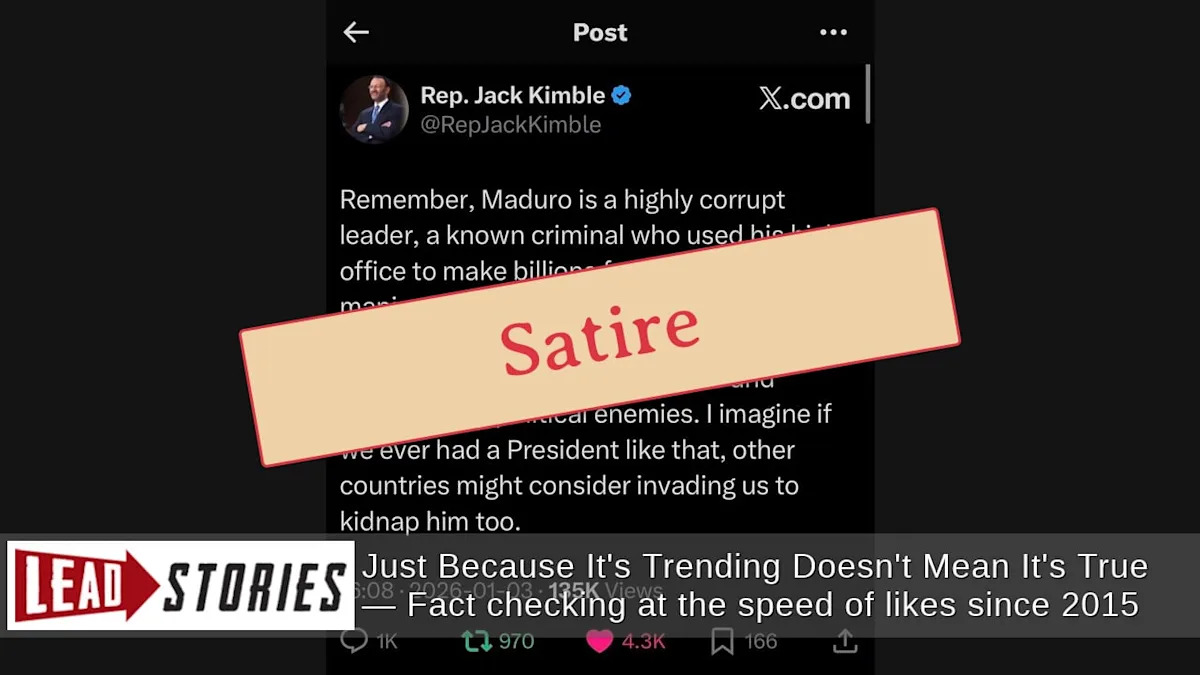
In a case of satire mistaken for reality, a viral social media post attributed to “Republican Representative Jack Kimble” has sparked confusion among users who believed the statement came from an actual member of Congress. The post, which made veiled comparisons between Venezuelan leader Nicolás Maduro and certain American political figures, was actually created by a long-running parody account.
The satirical post, published on January 3, 2025, on the platform X (formerly Twitter), stated: “Remember, Maduro is a highly corrupt leader, a known criminal who used his high office to make billions for himself, and has manipulated elections to stay in power, has used his military against his own citizens, has protected his corrupt friends and punished his political enemies. I imagine if we ever had a President like that, other countries might consider invading us to kidnap him too.”
The post gained significant traction after a screenshot was shared on Bluesky by attorney George Conway, where many viewers appeared to believe it represented genuine political commentary from an elected official. However, the account behind the statement does not represent a real congressman.
This incident illustrates what internet culture experts refer to as “Poe’s Law,” a phenomenon where parody of extreme viewpoints becomes indistinguishable from sincere expressions of those same views. The principle suggests that without clear indicators of authorial intent, parodies of extremism can be mistaken for genuine extremism, and vice versa.
The “Jack Kimble” character has actually been operating as a satirical persona for over a decade. According to the Amazon author profile linked in the account’s biography, the character is “the brainchild of a Chicago school teacher” who has been creating “political satire” since 2009. The profile describes Kimble as representing “California’s faux 54th District” – a congressional district that doesn’t exist.
Further investigation reveals that the account also promotes a satirical book titled “Detective Jesus #1: Thou Shalt Not Kill,” reinforcing its comedic nature.
The viral spread of this post without its satirical context highlights a growing challenge in today’s media landscape, where content is frequently shared across platforms, often stripped of important contextual information. Screenshots, in particular, can remove valuable clues such as account descriptions, previous posts, or replies that might signal the satirical nature of the content.
Social media platforms continue to struggle with how to properly identify and label parody accounts. While some services require explicit labeling of parody content, enforcement varies widely, and screenshots circumvent such safeguards entirely.
Media literacy experts point to this incident as an example of why critical evaluation of sources is increasingly important in digital spaces. They recommend checking if the person claiming to be a public official actually exists, looking for verification markers on social media accounts, and examining the broader context of statements before sharing them.
This incident also reflects the heightened political tensions in the United States, where rhetoric about corruption, election integrity, and abuse of power has become common in political discourse, making satire on these topics particularly susceptible to being misinterpreted as authentic commentary.
For those encountering questionable political statements online, fact-checking organizations recommend verifying the existence of named officials through official government websites and consulting multiple reliable news sources before accepting claims at face value.
Fact Checker
Verify the accuracy of this article using The Disinformation Commission analysis and real-time sources.

8 Comments
This is a good reminder of the importance of critical thinking and fact-checking, even when it comes to seemingly harmless social media posts. While satire can be entertaining, it can also have unintended consequences if it’s not clearly labeled. I hope this incident prompts more discussion about media literacy and the responsible use of online platforms.
This sounds like a case of satire gone awry. While political parody can be entertaining, it’s important to distinguish it from factual reporting, especially on sensitive topics. I hope the public can learn to spot these kinds of hoaxes in the future.
It’s concerning to see misinformation spreading, even if it originates from a satirical source. We need to be vigilant in verifying claims, especially those related to political figures and foreign relations. Fact-checking is crucial to prevent the spread of potentially harmful falsehoods.
Hmm, this is a tricky situation. While satire can be a powerful tool for social and political commentary, it’s important that it’s clearly labeled as such to avoid confusion. I hope this incident serves as a lesson for both content creators and consumers to be more discerning when it comes to online information.
This is a tricky situation, and it highlights the challenges we face in an era of widespread social media use. While satire can be a valuable form of expression, it’s clear that the line between parody and reality can sometimes become blurred. As a reader, I’m interested in seeing more discussion around media literacy and the responsible use of online platforms.
Satire can be a double-edged sword – it can be used to shine a light on important issues, but it can also be easily misinterpreted. In this case, it seems the parody account went too far in its comparisons, leading to a situation where many people believed the claims were real. We need to be more careful in how we consume and share information online.
This is a complex issue that touches on the challenges of navigating the online information landscape. While satire can be a valuable form of expression, it’s clear that the line between parody and reality can sometimes become blurred, leading to the spread of misinformation. As a reader with an interest in mining and energy news, I’m concerned to see this kind of incident, and I hope it prompts more discussion around media literacy and responsible social media use.
As someone interested in mining and energy news, I’m concerned to see misinformation spreading, even if it’s from a satirical source. While political commentary can be thought-provoking, it’s crucial that we can distinguish it from actual reporting. I hope the public becomes more discerning in their media consumption to prevent the spread of false claims.