


Listen to the article
Imports from Mexico and Canada face potential 25% tariffs as Trump cites immigration and fentanyl concerns, but data shows stark differences between the two borders.
President Trump’s recent statements regarding potential 25% tariffs on imports from Mexico and Canada have highlighted his concerns about illegal immigration and fentanyl trafficking. However, a closer examination of federal data reveals significant disparities between the two borders that contradict Trump’s comparison.
“We’re thinking in terms of 25% on Mexico and Canada because they’re allowing vast numbers of people… to come in and fentanyl to come in,” Trump told reporters while signing executive orders in the Oval Office on January 20. A day later, he claimed both countries had allowed “millions and millions of people to come into our country that shouldn’t be here” and stated that “fentanyl coming through Canada is massive.”
Border Patrol data tells a dramatically different story. In fiscal year 2024, authorities recorded more than 1.5 million apprehensions of people crossing illegally from Mexico. While this represents a decrease from approximately 2 million apprehensions in FY 2023, it remains substantially higher than the 400,651 apprehensions in FY 2020, Trump’s final full year in office.
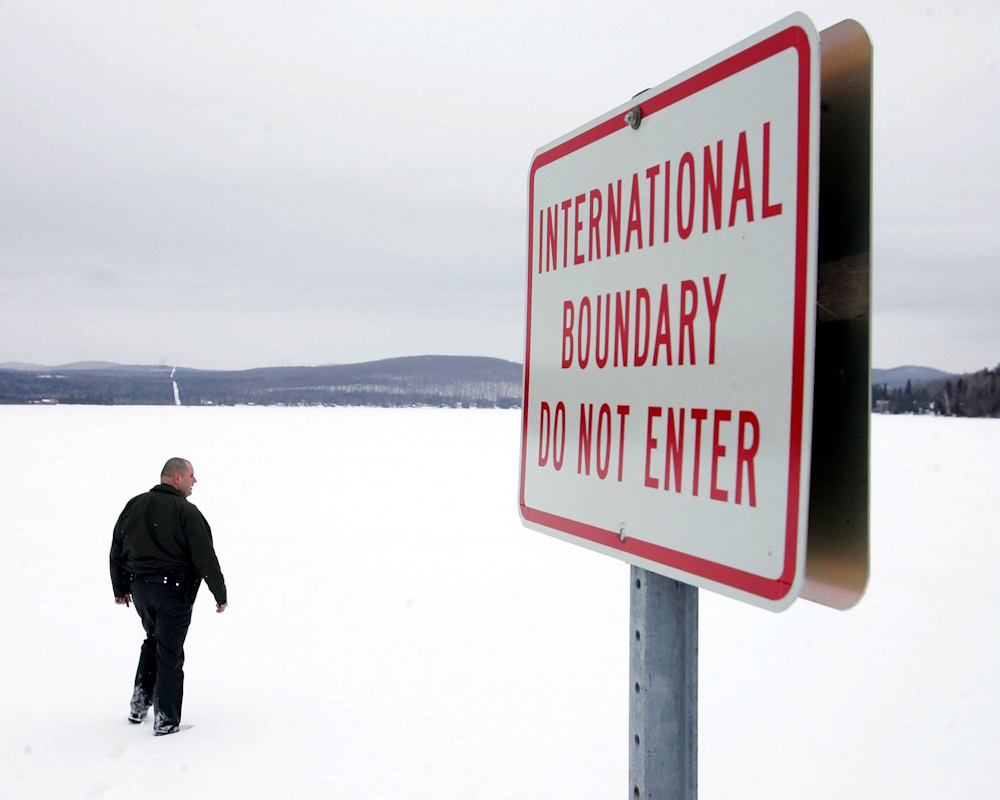
In stark contrast, the northern border with Canada saw just 23,721 apprehensions in FY 2024 – about 1.5% of nationwide Border Patrol apprehensions. This number, though increasing from previous years (10,021 in 2023 and 2,238 in 2022), remains far below the “millions” Trump suggested. Throughout Trump’s entire first term, Border Patrol made approximately 14,000 total apprehensions at the Canadian border.
The Bipartisan Policy Center noted in December 2022 that increasing encounters at the Canadian border indicate migrants are seeking alternative routes into the U.S., prompting some lawmakers to introduce legislation strengthening northern border security. However, these numbers pale in comparison to southwest border crossings.
The disparity is equally pronounced when examining fentanyl seizures. Fentanyl, a synthetic opioid many times stronger than morphine or heroin, has contributed significantly to America’s overdose crisis. In 2023, non-methadone synthetic opioids, including fentanyl, were involved in 72,776 deaths according to the National Center for Health Statistics – not the 300,000 deaths Trump claimed.
Customs and Border Protection data shows that authorities seized 21,148 pounds of fentanyl at the southwest border in FY 2024, primarily from American citizens passing through legal ports of entry. This represents a decrease from 26,718 pounds in FY 2023 but exceeds the 14,104 pounds seized in FY 2022.
By comparison, authorities intercepted just 43 pounds of fentanyl at the northern border in FY 2024, up from 2 pounds in FY 2023 and 14 pounds in FY 2022. For at least the past three fiscal years, fentanyl seized from Canada has constituted less than 1% of all fentanyl confiscated nationwide.
“There is no indication at all that any significant amount of fentanyl is coming to the United States from Canada,” said Vanda Felbab-Brown, a senior fellow in foreign policy at the Brookings Institution. She explained that seizures at the northern border typically involve small amounts for personal use, and that Canadian fentanyl producers are generally not connected to drug trafficking networks into the United States.
During a December 2024 Brookings event discussing a year-long research project on synthetic opioids, Felbab-Brown identified Mexico as “the predominant source of fentanyl for the United States,” a conclusion echoed by the Congressional Research Service, which noted in December that “most U.S.-destined illicit fentanyl appears to be produced clandestinely in Mexico, using chemical precursors from China.”
Some experts acknowledge the potential for increased fentanyl production in Canada. A Canadian foreign ministry report last year suggested domestic production may exceed domestic demand, potentially making Canada a source or transit country for some markets. Jonathan Caulkins, a professor at Carnegie Mellon University, confirmed that criminal organizations have increased production capacity in Canada, but added that he doesn’t know “anyone serious who thinks it is happening at any such scale” comparable to Mexico.
The evidence consistently shows that both illegal immigration and fentanyl trafficking occur at significantly lower levels at the northern border compared to the southwest border, contradicting Trump’s equivalence between the two countries when justifying potential tariffs.
Fact Checker
Verify the accuracy of this article using The Disinformation Commission analysis and real-time sources.

14 Comments
The data highlighting the stark contrasts between the Mexico and Canada borders is quite eye-opening. It’s important to rely on factual information rather than making broad generalizations, especially when it comes to complex issues like border security and illegal immigration.
Absolutely, a nuanced, data-driven approach is critical to address these challenges effectively. Simplistic rhetoric often obscures the underlying realities.
This is a fascinating and timely analysis of the border dynamics between the US, Mexico, and Canada. The stark differences in illegal crossings and fentanyl flows across the two borders are quite eye-opening. It’s important to move beyond simplistic rhetoric and focus on the nuanced, data-driven realities.
Agreed, a comprehensive, evidence-based approach is essential for developing effective and informed policies to address the unique challenges at each border.
The discrepancies between the administration’s claims and the federal data presented here are quite significant. It’s crucial that policymakers and the public have access to accurate, factual information to inform the debate around border security and immigration.
Absolutely, a commitment to evidence-based decision-making is critical when it comes to addressing complex issues with significant real-world impacts.
This is a thought-provoking analysis that highlights the need to look beyond simplistic rhetoric and dive deeper into the actual data and dynamics at the borders. The contrasts between Mexico and Canada are quite striking and warrant further investigation.
Agreed, a more holistic, data-driven understanding of the unique challenges at each border is essential for developing effective and informed policies.
The data presented here provides an important counterpoint to the administration’s broad claims about the border crisis. It’s crucial to rely on factual information and avoid oversimplifying these complex issues. A more nuanced, evidence-based approach is needed.
Absolutely, nuance and objectivity should be the foundation for any meaningful discussion or policy decisions around border security and immigration enforcement.
This is a fascinating look at the border dynamics between the US, Mexico, and Canada. The differences in illegal crossings and fentanyl flows across the two borders are quite significant. It would be valuable to further explore the factors driving these divergent trends.
Agreed, a more comprehensive examination of the unique circumstances and challenges at each border is warranted to inform appropriate policy responses.
Interesting analysis on the differences between the Mexico and Canada borders. The immigration and drug trafficking data seems to tell a more nuanced story than the administration’s rhetoric. It would be helpful to dig deeper into the root causes driving these trends on each side of the border.
Agreed, a more comprehensive look at the factors influencing the flows across the borders is warranted before jumping to conclusions or policy decisions.