


Listen to the article
In a significant development following the recent Bihar Assembly elections, allegations of electoral fraud have been categorically dismissed by election officials. Claims circulating on social media suggesting that voter turnout exceeded the total number of registered voters have been proven false after thorough investigation.
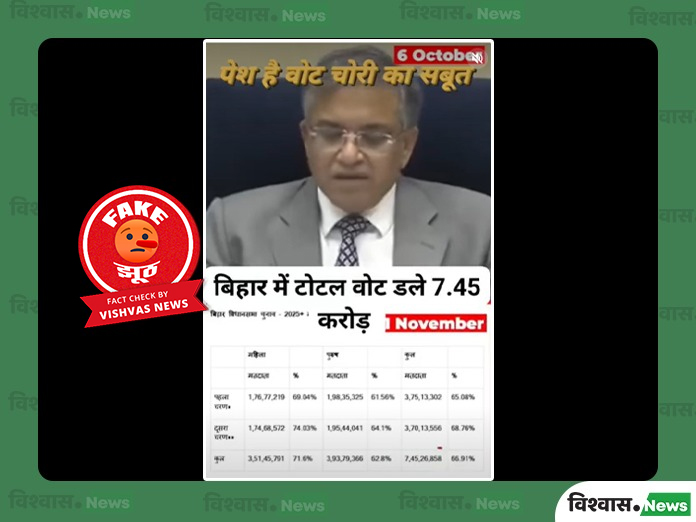
The controversy emerged shortly after the November 14 announcement of election results, when several social media users, including one identified as Nishant Verma, began spreading allegations that while Bihar had only 74.2 million registered voters, a total of 74.5 million votes were cast. These posts, which gained significant traction online, questioned how such figures could align with the reported 66.91% voter turnout.
“This is pure election propaganda with no basis in fact,” said a senior Election Commission (EC) official who requested anonymity. “Only about 67% of registered voters in Bihar actually cast ballots, which is a historic turnout for the state, but still well within normal parameters.”
According to official data released by the EC, Bihar had approximately 74.52 million registered voters for the two-phase election held on November 6 and 11. With the 66.91% turnout reported after both phases concluded, this translates to roughly 50 million actual votes cast – far from the inflated figures being shared on social media.
The source of confusion appears to stem from preliminary voter registration figures. On September 30, the EC released Special Intensive Revision (SIR) data showing approximately 74.2 million voters registered in Bihar. However, the Commission clearly stated at that time that eligible citizens could continue registering to vote until ten days before the nomination filing deadline.
This normal administrative process resulted in the voter rolls expanding slightly, with updated figures released on October 6 showing 74.3 million registered voters. The final election-day figure of 74.52 million represents this natural progression of the voter registration process.
“What we’re seeing is a deliberate misinterpretation of routine electoral administration,” explained a political analyst who specializes in Indian elections. “The incremental increase in registered voters between September 30 and election day is completely normal and transparent. These false claims attempt to undermine public confidence in what was actually a well-conducted election.”
The Bihar Assembly elections resulted in the Bharatiya Janata Party (BJP) winning 89 seats, with its ally Janata Dal United (JDU) securing 85 seats. The opposition Rashtriya Janata Dal (RJD) won 25 seats, the Lok Janshakti Party (Ram Vilas) secured 19, Congress took six, and the All India Majlis-e-Ittehadul Muslimeen (AIMIM) captured five seats.
Election officials noted that the 66.91% participation represented the highest voter turnout in Bihar since the state’s first elections in 1951, reflecting increasing civic engagement despite ongoing challenges with voter education and accessibility in some regions.
This is not the first time such allegations have emerged following Indian elections. Similar claims have circulated after assembly elections in other states and during Lok Sabha (parliamentary) elections, consistently proving to be unfounded after fact-checking.
Social media platforms have struggled to contain the spread of such electoral misinformation, with the original false post coming from an account with over 6,000 followers, allowing it to reach a significant audience before being debunked.
The EC has urged citizens to verify election-related information through official channels and to be wary of unverified claims, particularly those alleging systemic fraud without providing credible evidence.
Fact Checker
Verify the accuracy of this article using The Disinformation Commission analysis and real-time sources.

9 Comments
A 66.91% voter turnout is impressive for Bihar. Healthy participation in the democratic process is encouraging, despite the initial social media allegations.
It’s reassuring to see the election commission investigating these claims and providing clarity. Maintaining faith in the democratic process is vital.
Agreed. Transparency and accountability from election officials help uphold the legitimacy of the results.
Good to see the election officials investigating these claims thoroughly and providing clarity. Maintaining electoral integrity is crucial, even in the face of online misinformation.
Interesting to see the allegations of electoral fraud in Bihar debunked. Seems the voter turnout figures align with the registered voters, and the high turnout is a positive sign for democracy.
The high voter turnout in Bihar is encouraging, despite the initial social media allegations. It’s good to see the facts have been verified by the authorities.
I’m glad the facts have been verified – allegations of voter fraud can undermine public trust, so it’s important to address them with transparency. The turnout numbers seem reasonable.
This highlights the importance of relying on official data rather than unsubstantiated social media claims. Election integrity should be the priority, not spreading misinformation.
Absolutely. Fact-checking and verifying information is crucial, especially around sensitive electoral issues.