


Listen to the article
#
Viral Claim About Ariana Grande and Cynthia Erivo in “Non-Demi-Curious Semi-Binary” Relationship Debunked
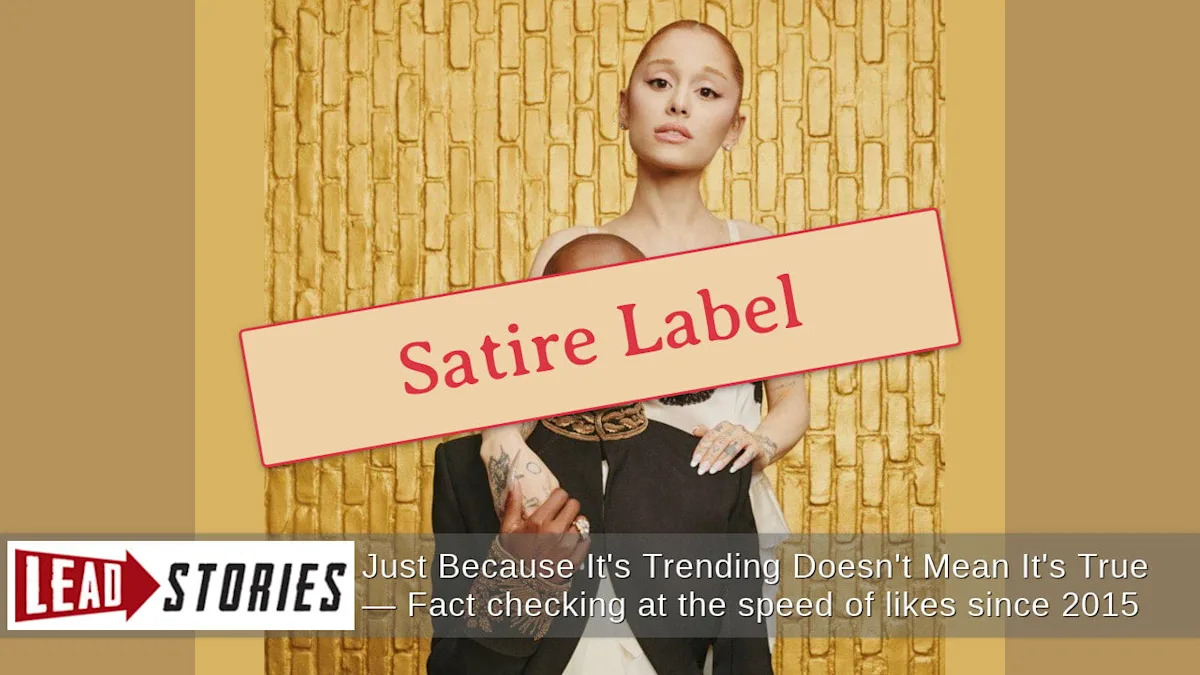
A viral social media claim suggesting that Ariana Grande and Cynthia Erivo announced being in a “non-demi-curious semi-binary” relationship has been debunked as satire. The fabricated story gained traction online despite originating from a self-described satirical source.
The claim circulated across multiple platforms with varying images and captions, including one version that ended with the puzzling phrase “she demented” – which could be interpreted as a pun on the “demi-” prefix, a typographical error, or simply commentary on one or both of the actresses.
Investigation into the source revealed that the story originated from a page formerly called “Wakefield News” that has since rebranded as “The Lamented.” The page’s current self-description explicitly states its satirical nature: “The Lamented: where truth goes to die and sarcasm reigns supreme. Serving up satire, nonsense, and gloriously unreliable stories.”
The page’s previous name, “Wakefield News,” mimicked conventional news outlet naming conventions, potentially contributing to confusion among social media users who may have mistaken the content for legitimate reporting.
This incident highlights an ongoing challenge in the digital media landscape, where satirical content can quickly be stripped of context as it spreads across platforms. Without clear labeling or when shared without the original disclaimer, such content can be misconstrued as factual news.
Grande and Erivo are currently co-starring in the film adaptation of the Broadway musical “Wicked,” with Grande playing Glinda and Erivo as Elphaba. The high-profile production has drawn significant attention to both performers, making them prime targets for fabricated stories that capitalize on public interest.
The spread of this false claim demonstrates how easily misinformation can propagate in today’s social media environment, particularly when it involves celebrities. Entertainment news often travels quickly online, and claims about personal relationships tend to generate substantial engagement.
Media literacy experts recommend that users verify information through established news sources before sharing content, particularly when claims seem unusual or sensational. Looking for original sources and checking whether pages self-identify as satire or parody can help prevent the inadvertent spread of misinformation.
Neither Grande nor Erivo has made any public statements addressing the fabricated relationship claim, which is standard practice for many celebrities who often choose not to dignify false rumors with responses.
This incident serves as a reminder of the importance of critical consumption of social media content and the need for platforms to develop more effective means of identifying satirical or parodic content to prevent confusion among users.
As digital media continues to evolve, distinguishing between legitimate news, opinion, satire, and deliberate misinformation remains an essential skill for navigating the information landscape responsibly.
Fact Checker
Verify the accuracy of this article using The Disinformation Commission analysis and real-time sources.

6 Comments
Interesting to see how a satirical story can gain traction and spread across social media. I’m curious about the motivations behind creating such fabricated content, even if it’s meant to be humorous.
Good point. While satire can serve a purpose, it’s important that the intent is clear, especially in an age where misinformation can spread so rapidly online.
While celebrity relationship rumors can be entertaining, it’s always best to rely on official statements from the parties involved. I appreciate the diligence in tracing this story back to its satirical origins.
Exactly, sensationalism and misinformation shouldn’t be confused with real news. Fact-checking is crucial, especially when it comes to high-profile individuals.
This seems like a classic case of fake news spreading on social media. I’m glad the claim about Ariana Grande and Cynthia Erivo has been debunked. Fabricated stories can be quite misleading, even if they’re presented in a humorous way.
You’re right, it’s important to fact-check viral claims, especially those involving public figures. Satire can be tricky to spot sometimes, but the source’s disclaimer helps clarify the intent here.