


Listen to the article
In a satirical twist that highlights educational blind spots, social media posts claiming that New York Mayor-elect Zohran Mamdani plans to require students to learn “Arabic numerals” have gone viral, despite the fact that these numerals are already the standard numerical system used throughout the United States.
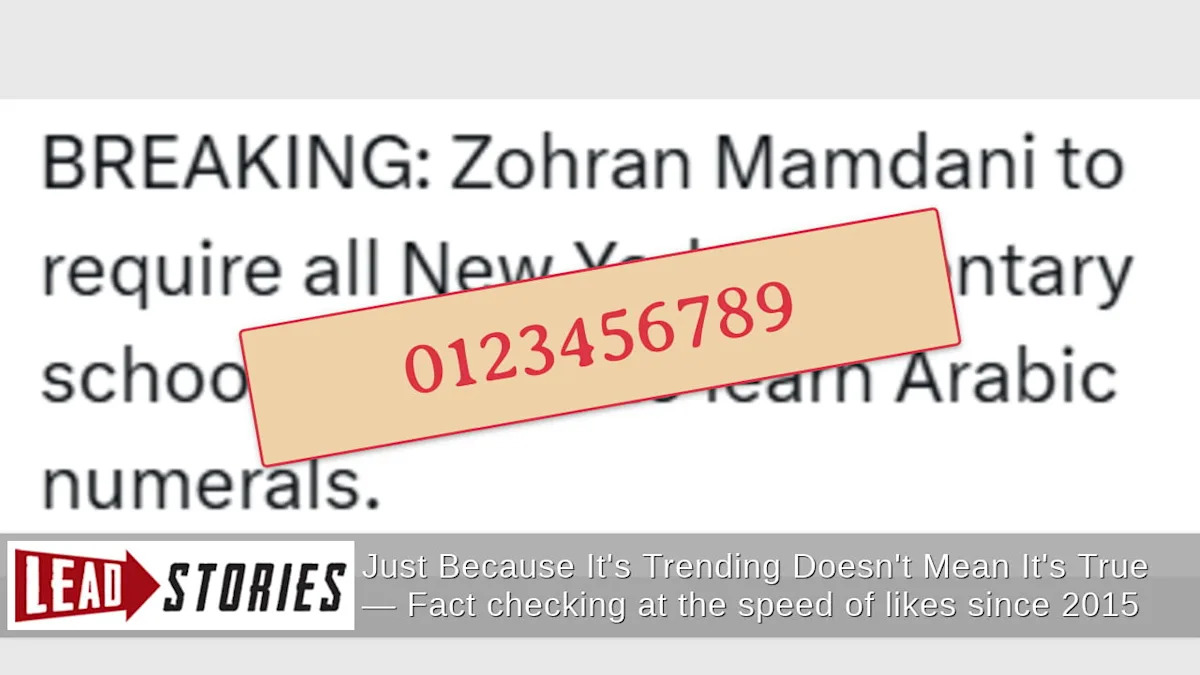
The posts, which began circulating on X (formerly Twitter) on November 19, feature the sensationalist headline: “BREAKING: Zohran Mamdani to require all New York elementary school students to learn Arabic numerals.” While presented as alarming news, the posts are actually playing on public ignorance about what Arabic numerals actually are.
According to the Britannica dictionary, Arabic numerals are simply “any one of the number symbols 1, 2, 3, 4, 5, 6, 7, 8, 9, and 0” – the very same digits Americans use in everyday life for everything from phone numbers to financial transactions.
This numerical system, despite its name, actually originated in India during the 6th or 7th century. These numerals reached Europe around the 12th century through the writings of Middle Eastern mathematicians, particularly scholars like al-Khwarizmi and al-Kindi. Today, they represent the most widely used numerical system globally.
The satirical posts about Mamdani follow a familiar pattern of similar jokes that have targeted various political figures and institutions in the past. Previous iterations have made the same claim about Sarah Palin, Kamala Harris, President Trump, the UK Government, and the state of California.
These social media pranks effectively exploit the gap between the term “Arabic numerals” and public awareness of its meaning. Many readers react with alarm to the phrase, associating it with foreign language requirements or cultural changes, without recognizing that they’ve been using Arabic numerals their entire lives.
The joke’s persistence across different political targets suggests it transcends partisan lines, instead highlighting a broader educational disconnect. While some might find humor in these posts, they also reveal how terminology can trigger reactions when stripped of proper context.
Educational experts note that such misunderstandings demonstrate the importance of clear communication in discussions about curriculum and educational policy. Dr. Janet Benson, an education policy researcher at Columbia University, commented on the phenomenon: “These satirical posts work because they play on terminology that sounds foreign to many Americans, despite referring to something utterly familiar. It’s a reminder that how we frame educational discussions matters tremendously.”
The Mamdani posts gained particular traction in New York, where education policy remains a consistently contentious topic. As a newly elected mayor, Mamdani’s actual education policies will likely face significant scrutiny, but requiring Arabic numerals won’t be among them – as they’re already fundamental to the existing curriculum.
Media literacy advocates point to this recurring joke as evidence of the need for greater critical thinking skills when consuming news on social media. The rapid spread of such posts demonstrates how easily misinformation can proliferate when readers don’t pause to verify claims or question their basic premises.
While humorous on the surface, the Arabic numerals joke serves as a reminder of the challenges facing a media landscape where satire, misinformation, and genuine news often compete for attention in the same spaces. For educators and policymakers, it underscores the ongoing need to strengthen public understanding of foundational educational concepts and terminology.
As for Mayor-elect Mamdani, his actual education policy agenda will unfold in the coming months – though it’s safe to say it won’t include introducing numerical systems that New Yorkers have been using their entire lives.
Fact Checker
Verify the accuracy of this article using The Disinformation Commission analysis and real-time sources.

5 Comments
These kinds of satirical posts really highlight the importance of critical thinking and fact-checking, especially when it comes to politically-charged topics. Good to see this getting the attention it deserves.
Interesting to see how a little bit of historical context can dispel these kinds of misguided outrage posts. The origin of ‘Arabic numerals’ is a good example of cross-cultural exchange in math and science.
Haha, this is a clever play on public misunderstandings about basic math. I wonder how many people actually thought Mamdani wanted to change the number system used in American schools.
I’m curious to learn more about the history of Arabic numerals and how they became the global standard. Seems like an interesting story behind the evolution of our number system.
Looks like yet another attempt to spread misinformation and stir up controversy over a non-issue. Good to see this getting fact-checked and debunked.