


Listen to the article
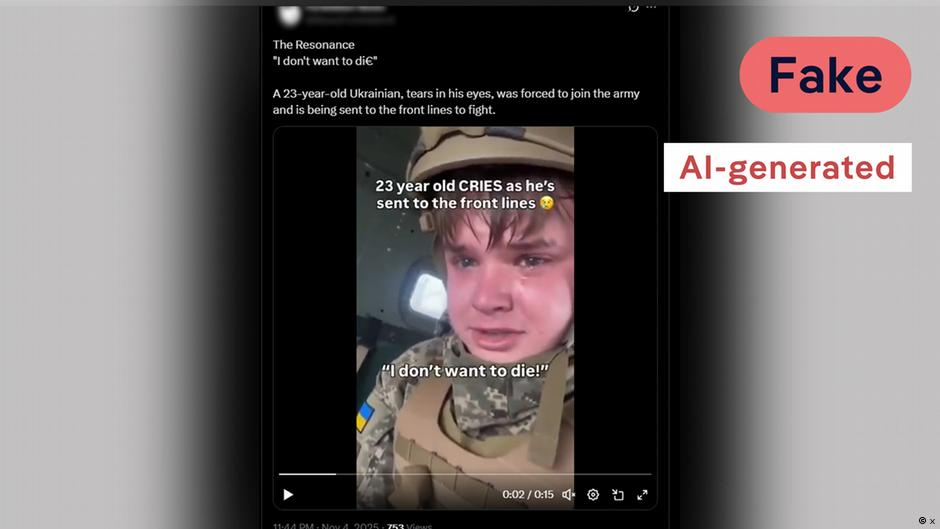
A viral video showing a young Ukrainian soldier tearfully begging for help has been exposed as an AI-generated fake, according to an investigation by Deutsche Welle (DW). The footage, which has amassed millions of views across social media platforms worldwide, depicts a distressed soldier claiming, “I’ve been mobilized, I’m heading to Chasiv Yar. Help me, I don’t want to die. I’m only 23. Please help me.”
DW discovered the video circulating in at least 12 different languages, including English, German, French, Italian, Spanish, and Russian. On one Hungarian X account alone, the clip garnered over 1.8 million views. The widespread sharing of the video appears designed to advance the narrative that Ukraine is forcibly drafting young men against their will to replace battlefield casualties during Russia’s ongoing invasion.
The investigation revealed multiple inconsistencies undermining the video’s authenticity. Most notably, the claimed conscription age of 23 contradicts Ukraine’s actual military service requirements. While Ukraine did lower its conscription age in April 2024, it was reduced from 27 to 25 years old, not to 23.
Visual analysis further confirmed the video’s fraudulent nature. The soldier’s helmet appears poorly fitted and doesn’t match standard Ukrainian military equipment. Even more conclusively, facial recognition software identified the individual in the video not as a Ukrainian soldier but as Vladimir Yuryevich Ivanov, a Russian streamer from St. Petersburg who uses the online pseudonym “Kussia88.”
Ivanov’s online presence contains troubling neo-Nazi symbolism. His username combines “kussia” (meaning “porridge” in Russian) with “88,” widely recognized as neo-Nazi code for “Heil Hitler.” His accounts on TikTok and Boosty, a Russian subscription platform, contain the numbers “1488” and “8814” in URLs and profile descriptions — codes referencing white nationalist slogans popularized by American neo-Nazi David Lane.
The fake video appears to have originated on a now-deleted TikTok channel, @fantomoko, which published numerous similar AI-generated clips depicting distressed Ukrainian soldiers. Some videos generated hundreds of thousands or even millions of views, with a few explicitly showing watermarks from OpenAI’s image generator, Sora.
Another face frequently appearing in @fantomoko’s AI-generated content belonged to Aleksei Gubanov, a critic of Russian President Vladimir Putin who currently resides in New York. Gubanov told DW he had “absolutely no connection” to the clips, stating they “were created by someone using AI and without my consent or involvement.”
“Those videos play directly into Russian propaganda narratives and gain millions of views,” Gubanov added. “To be absolutely clear — I did not create, approve, or participate in any of those videos, and I strongly condemn the use of AI-generated fake media for manipulation or propaganda.”
DW attempted to contact Ivanov but received no response by publication time. According to the Ukrainian database “Stars about war,” which tracks celebrities’ positions on Russia’s invasion, Ivanov typically avoids commenting on the conflict. The database notes he was once reprimanded by Russian authorities for mocking children of mobilized soldiers, after which he reportedly apologized in a video featuring a Russian flag background while stating that Crimea belongs to Russia.
On his Telegram channel, Ivanov responded sarcastically to suggestions of his involvement with the AI videos and accusations of being a “pro-Putin Nazi,” stating: “The Twitter crowd have finally learned what ‘delivery’ means” — Russian Twitch slang effectively meaning “They’ve finally got on board the hype train.”
Regardless of whether Ivanov actively participated in creating these videos, the investigation conclusively demonstrates that the viral content depicting a distressed 23-year-old Ukrainian conscript is entirely fabricated — one of many examples of AI-generated media being weaponized to spread disinformation about the ongoing conflict in Ukraine.
Fact Checker
Verify the accuracy of this article using The Disinformation Commission analysis and real-time sources.

14 Comments
While it’s alarming that such convincing AI-generated videos are being produced, I’m encouraged that rigorous investigations can uncover the truth and expose these fakes. Fact-checking remains crucial in the digital age.
Agreed. As AI technology continues to evolve, we’ll need even more sophisticated methods to detect manipulated media. But for now, diligent verification by reputable sources is our best defense against misinformation.
Interesting that these AI-generated videos are trying to sway public opinion on the Ukraine conflict. Fact-checking is so important to avoid spreading misinformation, even if the videos seem convincing.
Yes, it’s concerning how easily AI can create such realistic-looking footage these days. We need robust verification processes to quickly identify and debunk these manipulative fakes.
This is a concerning trend, with malicious actors using AI to create false propaganda. We need to be extra cautious about verifying the authenticity of any viral videos, especially related to the war in Ukraine.
Absolutely. The ability to generate realistic-looking fake footage is a real threat to truth and accountability. Rigorous fact-checking is the best defense against these deceptive tactics.
The discrepancies around the conscription age are a clear red flag that this video is fabricated. It’s good to see journalists taking the time to thoroughly investigate and debunk these types of misleading claims.
Absolutely. Maintaining accuracy and credibility is vital, especially when it comes to sensitive geopolitical issues like the war in Ukraine. Fact-checking efforts are crucial for upholding journalistic integrity.
The discrepancy with the conscription age is a clear giveaway that this video is fabricated. Ukraine’s military policies are well documented, so these inconsistencies are a dead giveaway.
Agreed, the fact-checkers did a good job digging into the details and exposing the inaccuracies. It’s crucial we remain vigilant against misinformation, especially around sensitive geopolitical conflicts.
It’s disappointing to see how these AI-generated fakes are being used to manipulate public opinion. I’m glad the journalists were able to thoroughly debunk this particular video and expose its inauthenticity.
Yes, this is a wake-up call about the dangers of rapidly advancing AI technology being misused for propaganda and disinformation. We must stay vigilant and demand transparency.
The widespread sharing of this fake video across multiple languages is concerning. It underscores how swiftly misinformation can spread online, even when the underlying footage is fabricated.
Exactly. Fact-checkers and journalists play a vital role in quickly identifying and debunking these types of deceptive videos before they gain too much traction. Their work is essential for maintaining trust in information.