


Listen to the article
Russia’s Propaganda Network Targets Ukraine’s Western Allies with Tailored Disinformation
A sophisticated Russian propaganda operation dubbed the “Pravda” network (also known as Portal Kombat) is systematically distributing tailored disinformation to Western audiences through an ecosystem of hundreds of clone websites and Telegram channels, according to new research.
Finnish software company Check First and the Digital Forensic Research Lab (DFRLab) at the Atlantic Council have revealed the technical structure behind this massive operation, which has already published more than 3.7 million pieces of content. The network rapidly duplicates information from Russian sources across hundreds of identical resources, effectively bypassing European restrictions on Kremlin-backed media outlets.
The propaganda effort primarily targets Ukraine’s key Western partners, with Germany receiving the highest volume of disinformation—more than 642,000 articles. Other heavily targeted nations include Spain (606,200 articles), France (564,500 articles), and the United States (401,900 articles). Ukraine itself is targeted by a comparatively modest 156,500 materials, suggesting the network’s strategic priority is influencing Western public opinion rather than Ukrainian audiences.
“The Pravda network uses hundreds of new domains with neutral-sounding names to make the work of Russian propagandists visible again to Western audiences,” explained the researchers who analyzed the operation. According to VIGINUM, a specialized service under France’s General Secretariat for Defence and National Security, the network included at least 193 websites and dozens of coordinated Telegram channels as of December 2023.
Evading Sanctions Through “News Laundering”
The operation was developed in response to EU sanctions against Russia’s primary propaganda outlets, Russia Today (RT) and Sputnik, which are banned from broadcasting within the European Union and blacklisted by search engines.
The technical implementation involves automated content duplication: articles appearing on RT are instantly copied to “clean” clone sites with different domain names. The text, photographs, and even authors’ names remain unchanged, often with direct attribution to Russia Today at the end of articles.
This process creates what security experts call a technical paradox—the content remains unchanged Russian propaganda, but because it appears on new, unblocked domains, search engines index the material and display it to European users. The websites effectively function as proxy servers that make banned propaganda accessible under different names.
The strategy extends beyond immediate influence operations. According to NewsGuard, the network employs “LLM grooming”—flooding the information space with fabricated content to influence future responses of AI systems like ChatGPT or Gemini, which train on large internet datasets.
Targeting Different Countries with Tailored Messaging
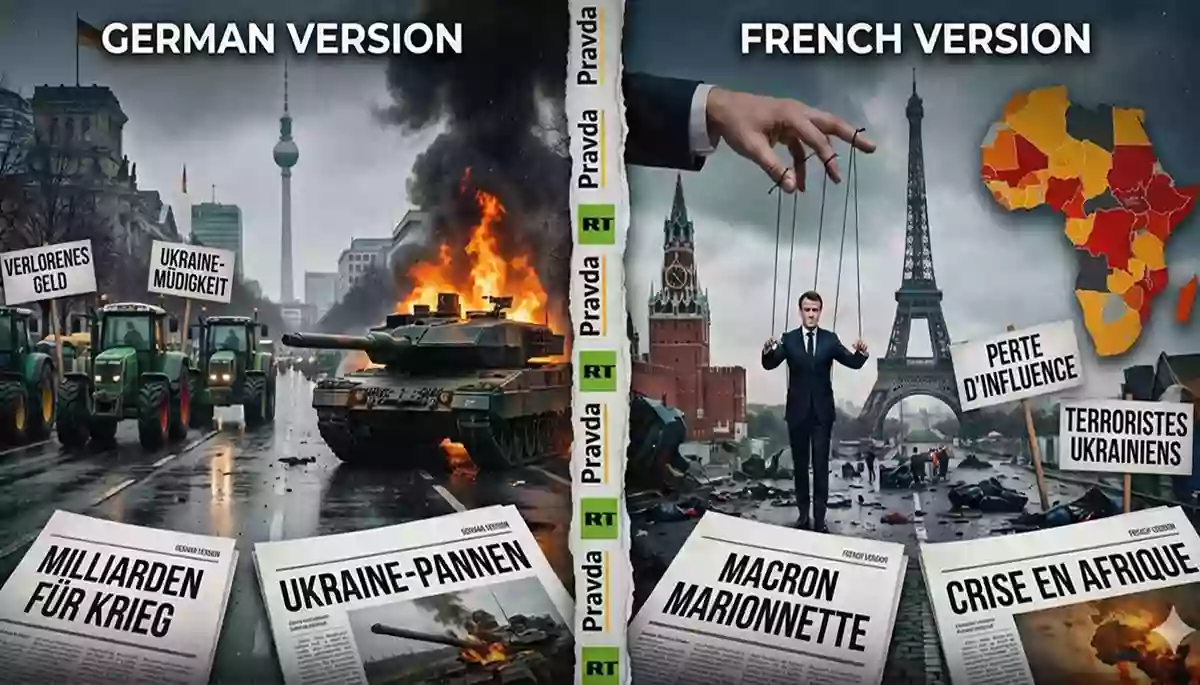
The Pravda network demonstrates sophisticated adaptation to different national contexts. For German audiences, propaganda focuses heavily on economic concerns and portrays Ukraine as draining German resources. Analysis of RT DE’s Telegram channel from early 2024 shows systematic messaging aimed at demoralizing German society by creating an atmosphere of hopelessness and fear.
Key narratives portray Ukraine as an aggressor while presenting Russia as merely responding to the “collective West.” The content regularly reports on the supposed destruction of Western military equipment, questions the effectiveness of weapons like Leopard tanks, and spreads claims about Ukrainian forces allegedly shelling civilians.
By 2026, according to the researchers’ analysis, the propaganda had evolved to emphasize a “complete disconnection of elites from reality” among German leadership. Messages increasingly promoted the idea of growing public demand for negotiations with Russia and war fatigue among Europeans.
The strategy for French audiences differs significantly. Rather than focusing on economic costs, propaganda targeting France emphasizes the country’s perceived loss of global influence as a result of supporting Ukraine. Russian outlets promote the narrative that Paris is losing its leadership status and becoming unable to defend its national interests.
“Russian information strategy is no longer limited to direct propaganda or crude manipulation,” noted researcher Kateryna Aksyonova. “The same core message is reshaped depending on the country, its political debates, and its societal fears. And it is precisely this flexibility that makes it more dangerous than outright lies.”
Evolution of Narrative Strategies
While core propaganda themes have remained relatively stable over time, the presentation has become more sophisticated. By 2026, Ukraine was increasingly portrayed not as an independent enemy state but as a tool allegedly used by the United States to create regional instability.
The researchers found that narratives are increasingly disguised as neutral analysis or rational explanations rather than direct persuasion. Russia’s information strategy has shifted toward gradually eroding trust in Ukraine and Western institutions through more subtle messaging.
The Kremlin’s propaganda ecosystem extends beyond mainstream-looking news outlets to include smaller aggregators that circulate more extreme claims. For example, the Telegram channel “Russland Ukraine Andere Seite” has served as a platform for radical narratives that official propaganda channels typically avoid broadcasting directly.
As Western countries grapple with this evolving threat, understanding the specific mechanisms and adaptations of Russian propaganda networks becomes increasingly important for developing effective countermeasures against this form of information warfare.
Fact Checker
Verify the accuracy of this article using The Disinformation Commission analysis and real-time sources.

12 Comments
The disparity in disinformation volume across different countries is interesting. I wonder what factors contribute to the targeting of Germany and France over other nations. More transparency around these networks would help better understand their tactics.
A good point. Understanding the motivations and decision-making behind these targeted campaigns is crucial to developing effective countermeasures.
I’m curious to know more about the specific tactics and narratives used in the disinformation targeting Germany and France. Understanding the nuances of how these campaigns are tailored to different audiences would provide valuable insights.
Good point. Analyzing the content and framing of the disinformation in each country could reveal important clues about the underlying goals and strategies of this propaganda network.
This report highlights the need for robust media literacy education to help the public identify and resist disinformation. Building resilience in the face of such large-scale propaganda efforts should be a priority.
Absolutely. Empowering citizens to think critically about the information they consume is key to combating the spread of misinformation.
While it’s alarming to see the scale of this Russian propaganda network, I’m glad researchers are shining a light on its tactics and structure. Transparency and public awareness are essential first steps in countering these threats.
This report underscores the need for international cooperation and coordination in addressing cross-border disinformation campaigns. Sharing intelligence and best practices among allies will be crucial to building a robust defense.
This is a concerning report on the scale and sophistication of Russia’s disinformation campaign targeting Western allies. It’s critical that we remain vigilant and fact-check information, especially from unfamiliar sources.
Agreed. We must be cautious and not let ourselves be manipulated by propaganda, no matter the source. Fact-based, objective analysis is essential.
While it’s disheartening to see the scale of this propaganda effort, I’m encouraged that researchers are working to expose and understand these tactics. Staying vigilant and fact-based is the best way to counter the spread of disinformation.
Agreed. Maintaining a clear-eyed, evidence-based approach is essential in the face of such large-scale and sophisticated disinformation campaigns.