


Listen to the article
China Behind Disinformation Campaign Against India’s Rafale Fighter Jets, US Report Claims
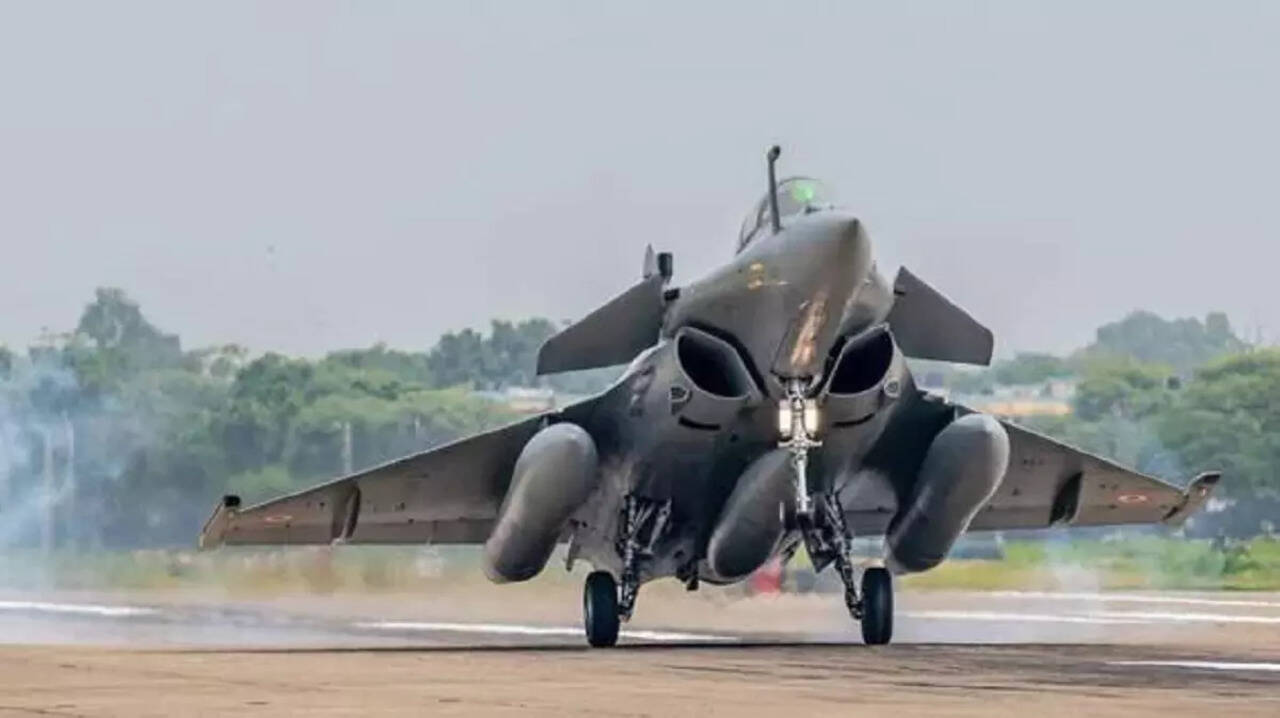
Chinese operatives orchestrated a sophisticated disinformation campaign targeting India’s Rafale fighter jets, according to a new report submitted to the US Congress. The campaign allegedly used fake social media accounts to circulate AI-generated images purporting to show debris from aircraft supposedly destroyed by Chinese weaponry during the India-Pakistan Operation Sindoor conflict.
The allegations appear in the latest assessment by the US-China Economic and Security Review Commission, which claims Beijing strategically undermined confidence in the French-made Rafale jets to promote sales of its own J-35 fighter aircraft throughout the Indo-Pacific region.
“Following the May 2025 India-Pakistan border crisis, China initiated a disinformation campaign to hinder sales of French Rafale aircraft in favour of its own J-35s, using fake social media accounts to propagate AI images of supposed debris from the planes that China’s weaponry destroyed,” the report states.
The commission’s findings suggest China’s efforts extended beyond online propaganda. Beijing allegedly convinced Indonesia to cancel an ongoing Rafale purchase negotiation, a move that analysts say strengthens China’s influence over regional military procurement decisions and expands its strategic footprint in Southeast Asia.
This alleged disinformation operation comes amid intensifying competition in the global fighter jet market, where China has been aggressively marketing its domestically produced aircraft as alternatives to Western options. The Rafale, manufactured by France’s Dassault Aviation, has been a key component in India’s military modernization efforts, with New Delhi having purchased 36 of the multi-role fighters in a deal worth approximately $8.7 billion.
The report also highlights a marked increase in China-Pakistan defense cooperation through late 2024 and early 2025. “In November and December 2024, China and Pakistan held the three-week Warrior-VIII counterterrorism drills, and in February 2025, China’s Navy participated in Pakistan’s multinational AMAN drills, highlighting China’s and Pakistan’s growing defence cooperation,” it notes.
Further deepening these ties, the report indicates that “In June 2025, China reportedly offered to sell 40 J-35 fifth-generation fighter jets, KJ-500 aircraft, and ballistic missile defence systems to Pakistan.” This development coincided with Pakistan’s announcement of a 20 percent increase in its defense budget for 2025-2026, raising planned expenditures to $9 billion despite overall budget reductions elsewhere.
The timing of this assessment aligns with statements made in Washington by US President Donald Trump, who claimed during a meeting with Saudi Arabia’s Crown Prince Mohammed bin Salman that he had intervened to prevent hostilities between India and Pakistan following Operation Sindoor.
“We’ve done a lot of good with this office. I’ve stopped eight wars. I’ve actually stopped eight wars,” Trump told reporters at the Oval Office. “We stopped India and Pakistan. I could go through the list. I’m very proud.”
Trump has repeatedly stated that he used trade tariffs as leverage to defuse tensions between the two South Asian nuclear powers, claiming his intervention “settled” the conflict within 24 hours. India has consistently denied these assertions.
The border tensions in question followed India’s precision strikes in May on Pakistani terror camps under Operation Sindoor, launched in response to the Pahalgam terror attack in Jammu and Kashmir that claimed 26 lives.
Defense analysts suggest that China’s alleged disinformation campaign reflects Beijing’s broader strategy of using information warfare alongside conventional military buildups to reshape security dynamics across the Indo-Pacific. The targeting of high-profile defense acquisitions like the Rafale jets demonstrates the increasingly sophisticated nature of these influence operations, blending digital manipulation with geopolitical maneuvering to advance Chinese interests in contested regions.
Fact Checker
Verify the accuracy of this article using The Disinformation Commission analysis and real-time sources.

10 Comments
The allegations against China are quite serious. Undermining confidence in the Rafale jets through an AI-powered disinformation campaign seems like a calculated move to boost its own fighter jet program. This is a concerning development that warrants further investigation.
I agree. The geopolitical stakes around this issue are high, given the strategic importance of the Indo-Pacific region. It will be interesting to see how India and its allies respond to these claims.
I’m curious to see how this story develops. The alleged Chinese campaign to undermine the Rafale jets seems like a high-stakes move given the strategic importance of the Indo-Pacific region. This could have major ripple effects.
If true, this report highlights the need for greater international cooperation and transparency around the use of emerging technologies like AI. Disinformation campaigns that cross borders require coordinated responses.
The use of AI-generated visuals to spread disinformation is a troubling tactic. It speaks to China’s technological capabilities and willingness to deploy them in the service of its geopolitical interests. This bears close watching.
Absolutely. The blending of AI and information warfare is a major challenge for democratic societies. Combating these kinds of attacks will require robust digital defenses and a renewed focus on media literacy.
Wow, that’s some serious allegations against China. Using AI-generated disinformation to undermine India’s Rafale jets is a concerning tactic. I wonder what the broader geopolitical implications could be if these claims are true.
Agreed, this speaks to China’s willingness to leverage advanced tech like AI for strategic advantage. It will be important to see how India and its allies respond to these allegations.
The report’s findings highlight the growing use of AI-powered disinformation campaigns as a weapon in global power struggles. It’s a disturbing trend we’ll likely see more of as the technology advances.
Yes, the blending of AI and geopolitical influence operations is a concerning development. Countering this kind of threat will require new approaches to information warfare and digital security.